

Farha Yusof
There is something peculiarly familiar about the haze.
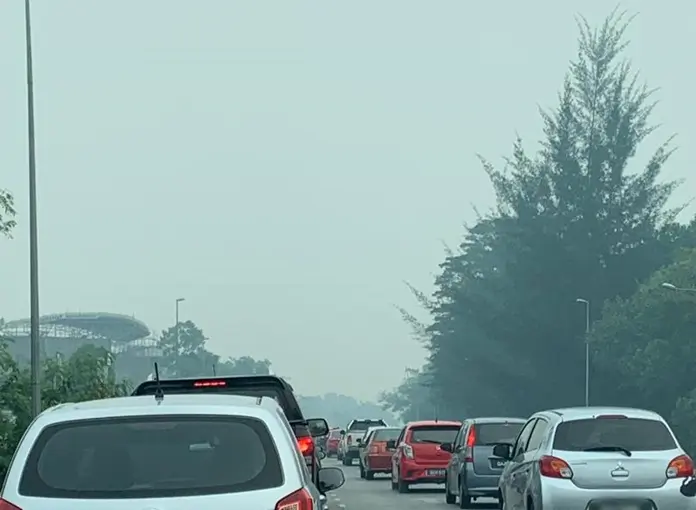
The sky loses its colour. Buildings disappear behind a grey curtain. The Air Pollutant Index returns to our conversations. Parents wonder whether their children should be outdoors. Those with respiratory conditions become more cautious. Masks reappear.
Then come the familiar questions. Where is the smoke coming from? How long will it last? What is the government doing? What is Asean doing?
Eventually, the rain comes. The air clears. The questions disappear with the smoke – until the next time.
On 19 September, unhealthy air quality was recorded across numerous parts of Malaysia. In Sarawak, Lubok Antu reached an Air Pollutant Index (API) reading of 178. Air pollution enters homes, schools, workplaces and lungs.
But the recurrence of the haze raises a larger question. After decades of transboundary haze, why does Southeast Asia still confront the problem as though it were unexpected?
- Sign up for Aliran's free daily email updates or weekly newsletters or both
- Make a one-off donation to Persatuan Aliran Kesedaran Negara (ALIRAN), Maybank a/c 507246118995 or CIMB a/c 8004240948
- Make a regular pledge or periodic auto-donation to Aliran
- Become an Aliran member
We already have an agreement
The Asean Agreement on Transboundary Haze Pollution provides a regional framework for monitoring, prevention, preparedness and cooperation.
That matters. Environmental problems do not respect national borders. Smoke produced in one territory can affect millions of people elsewhere.
But the existence of an agreement and the effectiveness of an agreement are different questions.
Prime Minister Anwar Ibrahim has said Asean’s existing mechanisms for dealing with transboundary haze should be reviewed.
A regional mechanism has existed for decades, and governments are still asking whether it needs improvement. That raises the question of whether what Asean has built is sufficient.
The haze exposes one of Asean’s central tensions. The regional grouping has historically emphasised sovereignty, consensus, consultation and non-interference.
There are reasons for this. Southeast Asia consists of countries with different political systems, histories and national interests. Consultation has helped Asean maintain relationships across those differences.
But smoke does not observe the principle of non-interference. A forest or peatland fire does not stop at a national boundary because another country is sovereign. The atmosphere is shared even when political jurisdiction is not.
The Asean haze agreement creates mechanisms for cooperation. But disputes over its interpretation or implementation are settled through consultation or negotiation. There is no straightforward compulsory regional tribunal waiting to determine responsibility whenever transboundary smoke crosses a border.
That makes diplomacy essential. It also reveals the limitations of a system dependent upon cooperation when the problem may demand difficult questions of accountability.
Should Malaysia sue?
As the haze worsens, an old question returns: should Malaysia pursue legal action?
The attraction is understandable. People in Malaysia bear health consequences and economic costs from pollution believed to originate beyond our borders. Asking who should be legally responsible seems a reasonable response.
But international environmental litigation is more complicated than identifying smoke on a satellite image and assigning blame. The source must be established, causation demonstrated, losses proven and a legal forum identified.
That does not make international law irrelevant. It means the legal question deserves more care than the slogan “Malaysia should sue Indonesia” suggests.
If credible evidence implicates Malaysian companies or interests, accountability cannot stop at nationality. Environmental responsibility means little unless we apply the same standard to ourselves.
Malaysia has emphasised diplomacy, prevention and technical cooperation rather than compensation. That should not automatically be treated as weakness.
Fires must be prevented. Peatlands must be managed. Hotspots must be detected. Information must move quickly. Assistance must arrive before smoke becomes a regional crisis.
The more useful question is not whether Malaysia should choose diplomacy or accountability. It is whether Asean can develop a system capable of providing both.
It is easy to imagine that air pollution is entirely someone else’s problem.
Malaysia has responsibilities too. Domestic open burning and other sources of pollution require enforcement. Nor should every unhealthy API reading automatically be attributed to a foreign source without evidence. Local fires, domestic pollution and weather conditions can also affect air quality.
A credible Malaysian position on transboundary pollution therefore requires credibility at home.
Clean air should not depend on the wind
Perhaps the most troubling feature of the haze is how normal it has become.
We know what an API reading means. We know what the skyline looks like when the air deteriorates. There is value in preparedness, but there is danger in familiarity.
The haze is not a monsoon. Where it results from fires, land management practices or other preventable human activity, there are decisions behind it. That means there can also be better decisions.
Asean deserves credit for recognising transboundary haze as a regional problem and establishing a framework to address it collectively. But frameworks must evolve when experience exposes their weaknesses.
That may mean better monitoring and data sharing, stronger domestic enforcement and clearer expectations of governments and companies. It may also mean difficult conversations about responsibility, evidence and remedies.
After decades of haze, Southeast Asia should be able to ask for more than another cycle of emergency response followed by collective amnesia.
The real measure of a regional environmental agreement is not how many meetings it produces when the sky turns grey. It is whether, eventually, fewer skies turn grey at all.
For everyone who shares the air of this region, clean air should not remain something we receive only when the wind happens to blow in our favour.
Farha Yusof (a pseudonym) writes on society, history and public institutions in Malaysia, and on constitutional life with a particular interest in the relationship between law, power, identity and everyday life in Malaysia.
The views expressed in Aliran's media statements and the NGO statements we have endorsed reflect Aliran's official stand. Views and opinions expressed in other pieces published here do not necessarily reflect Aliran's official position.
- Tegakkan maruah serta kualiti kehidupan rakyat
- Galakkan pembangunan saksama, lestari serta tangani krisis alam sekitar
- Raikan kerencaman dan keterangkuman
- Selamatkan demokrasi dan angkatkan keluhuran undang-undang
- Lawan rasuah dan kronisme
