

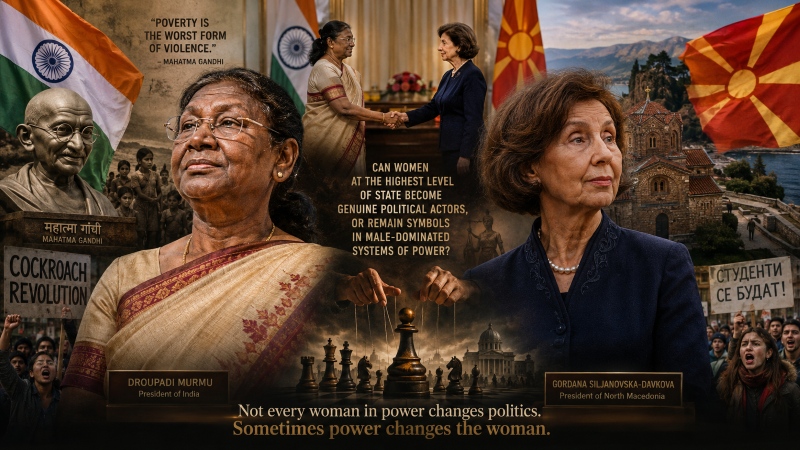
This may seem like a slightly belated reaction to India’s president’s visit to Macedonia on 20-23 July. Yet the event deserves a brief reflection through a gender lens.
The real inspiration comes from my engagement in a two-year project aimed at encouraging greater participation of women in politics – Gender Equality Mobilization (Gem), implemented together with academic and civil society institutions from Slovenia, Serbia, Bosnia and Herzegovina, and Macedonia.
Our aim is to encourage young women and girls to consider politics as a way to improve their position in society and make their voices heard and effective. As part of this effort, we organised mentoring sessions with female MPs and councillors, offering young women an opportunity to see political work beyond the public image.
That was until some of the ‘mentors’ began publicly calling their female colleagues ‘hens’. At that moment, the masks fell off, revealing something deeply rooted in Macedonian political culture.
The visit of India’s President Droupadi Murmu, hosted by Macedonia’s President Gordana Siljanovska-Davkova, was undoubtedly a significant event for a small state like Macedonia.
An official visit by the head of state of a country of 1.4 billion people naturally attracted attention. Some interpreted it, mistakenly, as a possible sign of a shift away from Macedonia’s almost fatalistic attachment to the so-called Collective West. Yet the visit was not primarily about geopolitics, even though there were some gestures in promoting economic cooperation (a topic that deserves a comprehensive analysis).
Here we raise a much broader question: can women who reach the highest positions of state become genuine political actors, or do they remain symbolic figures within male-dominated parties and systems of power?
- Sign up for Aliran's free daily email updates or weekly newsletters or both
- Make a one-off donation to Persatuan Aliran Kesedaran Negara (ALIRAN), Maybank a/c 507246118995 or CIMB a/c 8004240948
- Make a regular pledge or periodic auto-donation to Aliran
- Become an Aliran member
The protocol elements of the visit (the bust of Mahatma Gandhi, the visit to Mother Teresa’s birthplace, a rather non-transparent business forum and the trip to Ohrid) unfolded according to the expected script for two ‘British-style queens’, ie constitutional figures with limited political power.
In both India and Macedonia, the presidency is largely ceremonial. Both women performed the roles assigned to them. Perhaps this is precisely why the visit will soon fade from public memory.
At first glance, however, the image of two women representing their respective states appeared inspiring.
Yet a closer look reveals a different reality. In India, the dominance of Prime Minister Narendra Modi is so strong that many barely remember that the country also has a president. In Macedonia, Prime Minister Hristijan Mickoski remains the central political actor, while the president largely performs diplomatic, cultural and representational duties.
The question, therefore, is not only constitutional power. It is also moral and public authority: what do these women do with the symbolic power entrusted to them in societies facing deep social and political challenges?
The life trajectories of the two presidents could hardly be more different.
Droupadi Murmu comes from one of India’s most marginalised communities. She belongs to the Santal people, an indigenous Adivasi community with constitutional protections and affirmative measures in education, employment, and political representation.
She became India’s first president from an indigenous community, the second woman to hold the office, and the first person from a tribal background to occupy the country’s highest constitutional position.
Her biography is marked by hardship, including profound personal tragedies. As governor of Jharkhand, she demonstrated independence by refusing to approve two controversial bills that would have facilitated the transfer of tribal land, one of the most significant moments of her political career.
However, her path to the presidential palace was ultimately shaped not by direct popular support but by the strength of Narendra Modi’s party within India’s electoral college. For the ruling establishment, Murmu represented an ideal candidate: a woman from a marginalised community, carrying enormous symbolic value, but without an independent political base that could challenge the power structure that elevated her.
Since becoming president in 2022, she has largely remained within the conventional boundaries of India’s ceremonial presidency, approving government decisions and appearing mainly at official, cultural and symbolic events.
Siljanovska-Davkova’s trajectory is almost the opposite. Unlike her counterpart, she does not come from the social margins. Born into a partisan family and later connected through marriage to another even more prominent partisan family, she possessed significant social capital in socialist Yugoslavia, a position within what could be described as the country’s ‘red bourgeoisie’.
This does not diminish her academic achievements or personal effort, but her path was fundamentally different from that of Murmu. She built a respected academic career and entered politics during the early years of transition, initially associated with liberal politics before moving towards the conservative camp.
After her unsuccessful presidential campaign in 2019 as the candidate of VMRO-DPMNE, she became an MP and later, with the support of the same party structure, became president in 2024.
The promises that she would be a ‘subversive‘ president, outspoken and willing to address Parliament when necessary, have largely remained unfulfilled.
The paradox is that both presidents publicly support greater participation of women in politics. Yet their political conduct, characterised by ceremonial performance, restraint in moments of controversy, and alignment with government policies, raises questions about the meaning of women’s representation when the structures of power remain unchanged.
The Gandhi bust presented during Murmu’s visit was intended to symbolise shared values of nonviolence and peace. Yet both countries remain far removed from Gandhi’s understanding that poverty is the greatest form of violence and from his support for Palestinian rights.
Today, India and Macedonia share, among other things, close relations with Israel and elements of alignment with US President Donald Trump’s political agenda, although the nature and scale of these relationships differ.
Meanwhile, inequality continues to deepen: through class divisions in Macedonia and caste inequalities in India.
The irony is that during this carefully choreographed diplomatic visit, India was experiencing what became known as the Cockroach Revolution, a movement named in response to a Supreme Court judge’s insult against young protesters, whom he called “cockroaches” and “parasites”.
For the sake of balance, it should also be remembered that when Macedonian students protested in 2011 and 2014-15, Siljanovska-Davkova, then a professor, stood on their side, opposing policies supported by the very party that later helped bring her to the presidency.
I follow developments in India closely and listen with admiration to Arundhati Roy, whose voice has become one of the strongest critiques of Modi’s authoritarian tendencies. Her voice is powerful and uncompromising – unlike the institutional silence of India’s president.
This contrast leads to a subversive thought: imagine the political scandal if a president decided to act not merely as a constitutional ornament, but as the conscience of the state.
This is the paradox of contemporary politics: presidents are not expected to demonstrate courage, but discipline; female presidents even more so.
But is not the greater scandal that, rather than using the moral authority of their office to speak on behalf of the oppressed, they choose to legitimise the very policies of the parties that placed them at the summit of the state?
The conclusion imposes itself. Not every woman in power changes politics. Sometimes power changes the woman. – Globetrotter
Biljana Vankovska is a professor of political science and international relations at Ss Cyril and Methodius University in Skopje, the president of Synergia Orbi: Institute for Global Analysis in Skopje, and the most influential public intellectual in Macedonia. She is a member of the No Cold War collective.
The views expressed in Aliran's media statements and the NGO statements we have endorsed reflect Aliran's official stand. Views and opinions expressed in other pieces published here do not necessarily reflect Aliran's official position.
- Tegakkan maruah serta kualiti kehidupan rakyat
- Galakkan pembangunan saksama, lestari serta tangani krisis alam sekitar
- Raikan kerencaman dan keterangkuman
- Selamatkan demokrasi dan angkatkan keluhuran undang-undang
- Lawan rasuah dan kronisme
