
Selvakumar Krishnan
There are birthdays – and then there are quiet gatherings that carry echoes of another time. They hold faint images of the past, memories in their breath and gratitude in their wake.
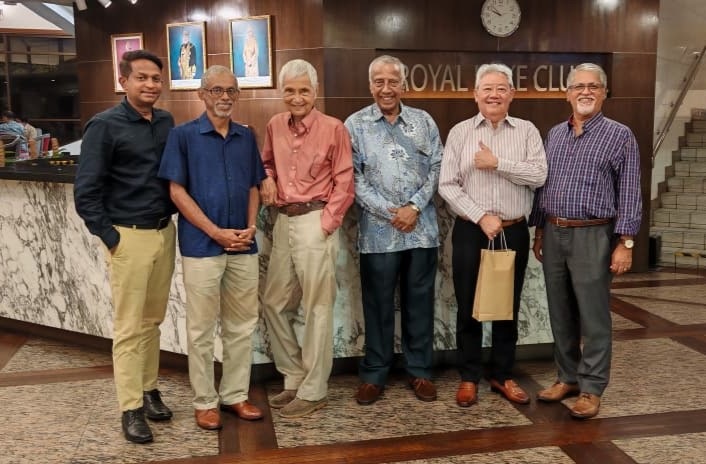
Recently, I found myself at one such gathering. Invited by Ben Morais – who, with the strategic subtlety of a seasoned teacher, had organised what he described merely as “a small get-together” – I soon discovered I had walked into something far more meaningful: a celebration of Denis Armstrong’s 88th birthday. For good company, three old boys also joined in.
But as the evening unfolded, it became clear this was about far more than a birthday. It was, in its own gentle and unexpected way, a return – a return to classrooms that now live only in memory; to school fields baked beneath the afternoon sun; to voices that once filled our days; to a version of ourselves left behind somewhere in the 1970s.
The gathering itself was simple: no grand speeches or ceremony worthy of headlines; just soft laughter, unhurried conversations and the easy warmth that only old familiarity can produce. It was an evening where time seemed, if only briefly, to loosen its grip and allow the past to sit among us once more.
- Sign up for Aliran's free daily email updates or weekly newsletters or both
- Make a one-off donation to Persatuan Aliran Kesedaran Negara (ALIRAN), Maybank a/c 507246118995 or CIMB a/c 8004240948
- Make a pledge or schedule an auto donation to Aliran every month or every quarter
- Become an Aliran member
Morais, ever the educator, reminded me that attendance came with terms and conditions. Payment, he informed me with a knowing smile, would not be rendered in cash, but in words – a blog post, to be precise.
One might say I was gently coerced into literary labour – though, truthfully, it is a debt I repay with immense pleasure. After all, how often does life allow one to attend an 88th birthday? And rarer still, how often are we granted the privilege of sitting once more with the very teachers who shaped us, while we wide-eyed and unsuspecting in their classrooms all those decades ago?
The coach who built champions
Time, as it always does, has softened many details. But not the imprint of great teachers. That remains.
Armstrong is not a man one easily forgets: discipline master, coach, taskmaster to some. Beneath that stern exterior was a man who believed excellence was never accidental. It was earned through repetition, precision and the refusal to accept mediocrity simply because one was tired.
Many of us still remember those long afternoons on the field. Baton exchanges were practised again and again beneath the unforgiving heat: feet repositioned, timing corrected, movements repeated until muscle memory replaced thought itself.
At the time, it felt relentless. To boys of that age, perhaps even excessive.
But memory has a curious habit of maturing alongside us. What once felt like strictness now feels, in retrospect, like devotion. What once seemed demanding now reveals itself as care.
Coach Denis was never merely teaching athletics. He was teaching discipline, perseverance, pride in doing something properly even when no applause followed.
And like so many gifts given by good teachers, we were simply too young then to recognise their value.
His vision for building an elite athletics programme at La Salle Brickfields was, in many ways, ahead of its time – methodical, uncompromising and almost surgical in its precision. Not everyone understood it then. But success, eventually, explains itself.
And as though coaching and discipline were not already formidable enough, he carried another quiet credential: a taekwondo black belt. Somehow, it suited him perfectly – an outward expression of the principles he already embodied so naturally: strength without aggression, discipline without noise, and control without spectacle.
He guided, never pushed
Then there was Ben Morais, our class teacher, and in many ways, the perfect counterbalance. Where Armstrong was steel, Morais was silk.
Gentle, empathetic and endlessly patient, he created a classroom that felt less like a place of instruction and more like a space for becoming. He rarely raised his voice. He did not need to. His words arrived softly but landed deeply.
Where others corrected loudly, he guided quietly. Where others imposed, he invited. Growth, in his world, was never forced but nurtured.
Long before phrases like “holistic education” became fashionable, he seemed already to understand that teaching was not simply about producing good students, but about shaping decent human beings.
His philosophy would later find its way into his book, Raise the Bar – a title that captures not ambition in the loud modern sense, but the quieter and far more difficult belief that one should strive each day to become slightly better than before.
A mischievous thought
And yet, looking at both men together that evening, one could not resist a mischievous thought: what if their roles had been reversed?
Imagine Morais on the field during athletics practice: “Take your time, boys… feel the rhythm… no need to rush…” We might still be standing there today, contemplating the deeper philosophical meaning of relay races.
And then picture Armstrong in the classroom – arms folded, gaze unwavering – declaring that essays must be rewritten 10 times until every sentence achieved peak performance. Under his supervision, literature itself might well have become an Olympic event.
The school, one suspects, may not have survived the experiment – though we, perhaps, would have emerged both intellectually enlightened and emotionally battle-hardened.
Humour aside, what made both men remarkable was not merely their differences, but the way those differences completed something essential. Together, they stood at opposite ends of the educational spectrum: discipline and empathy, rigour and gentleness, structure and understanding.
Yet beneath those contrasting styles lay the same unwavering truth: they cared deeply about their students. And that is what endures.
Today, the world feels very different from the one we knew as schoolboys. Life moves quickly now, rarely pausing long enough for memory to catch its breath.
But somewhere in the corridors of memory, teachers like them remain untouched by time: steady, certain and enduring.
They did not teach for recognition or acclaim. Instead, they taught from conviction – from the belief that education was never merely the transfer of knowledge, but the shaping of character itself.
Perhaps such teachers have become rarer now. If so, what a profound legacy they leave behind.
And so, Armstrong’s 88th birthday became more than the marking of years. It became a moment of recognition. It was a quiet tribute to two men who gave so much of themselves to generations of students who continue, in ways both visible and unseen, to carry their lessons forward into the world.
Time moves on, as it always does. Voices soften. Steps slow. Entire decades disappear silently behind us.
Yet what they gave remains – quietly within us, steady as ever – like a baton passed cleanly from one hand to another – still moving, still enduring, still finding its way forward long after the runners themselves have faded from sight.
The boy who once sat in those classrooms has long since grown up – carried forward into adulthood, responsibility and the restless movement of life. Yet somewhere within the man, the boy lingers quietly.
And it was that boy who sat among them again that evening – not to learn this time, but to honour; to sit once more before the teacher and say, in the silent language that gratitude understands best: “You shaped my life. And I have not forgotten.”
As Shakespeare once wrote: “When to the sessions of sweet silent thought, I summon up remembrance of things past…”
So too did this gathering awaken voices, faces and memories long tucked away beneath the dust of time.
The evening passed swiftly. But its warmth lingers.
Until we meet again, Sirs, may the days ahead be gentle to all of us, and may there yet be many more of them. – benmorais.wordpress.com
Selvakumar Krishnan is from the class of 1975, La Salle Brickfields.
AGENDA RAKYAT - Lima perkara utama
- Tegakkan maruah serta kualiti kehidupan rakyat
- Galakkan pembangunan saksama, lestari serta tangani krisis alam sekitar
- Raikan kerencaman dan keterangkuman
- Selamatkan demokrasi dan angkatkan keluhuran undang-undang
- Lawan rasuah dan kronisme
