

Charles Chia Yong Tai
For decades, Umno and Pas were political arch-rivals.
Their rivalry was built around a common battlefield: the ethnic Malay-majority constituencies where both competed for the support of the same voters.
Their competition was not merely electoral. It was ideological. Umno represented Malay nationalism within a ‘ketuanan Melayu’ (Malay supremacy) framework. Pas promoted a more explicitly Islamic political vision.
For much of Malaysia’s post-independence history, cooperation between the two parties appeared difficult, if not impossible.
A new political phase
Malaysian politics has entered a new phase.
The old rivalry may be giving way to a new calculation. Umno and Pas may have discovered that they no longer need to defeat each other in order to achieve their larger political goal.
- Sign up for Aliran's free daily email updates or weekly newsletters or both
- Make a one-off donation to Persatuan Aliran Kesedaran Negara (ALIRAN), Maybank a/c 507246118995 or CIMB a/c 8004240948
- Make a regular pledge or periodic auto-donation to Aliran
- Become an Aliran member
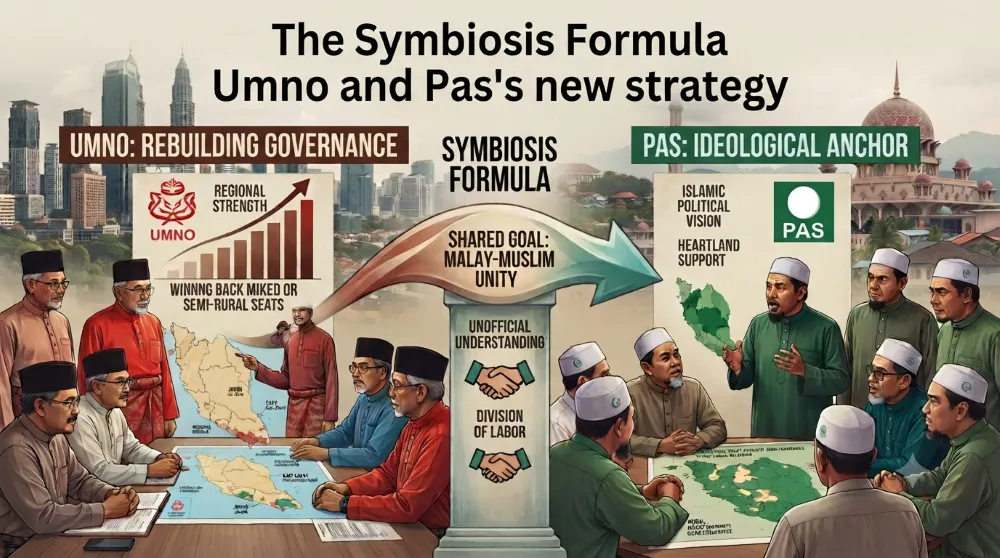
I call this the ‘symbiosis formula’. It is not a formal coalition, nor is it an electoral pact with publicly negotiated seat arrangements. Instead, it is an informal understanding: the two parties maintain their separate identities and compete selectively, but their actions strengthen the same political direction.
The logic is simple. Pas has built a strong base in many Malay-majority seats. It holds over 40 parliamentary seats, many of which would be difficult for Umno to win back. A direct contest between Umno and Pas would only divide Malay votes and benefit their opponents.
Under the symbiosis formula, Pas retains and strengthens its existing strongholds. Umno, meanwhile, focuses on winning back seats held by Bersatu, PKR and Amanah, where its traditional machinery and networks remain competitive.
The result is a division of political labour.
Pas strengthens its position as the dominant force in the Malay heartlands. Umno tries to rebuild itself as the broader governing vehicle capable of drawing support beyond its traditional base.
This arrangement also avoids the difficulties of a formal Umno-Pas alliance. Both parties have competed against each other for decades. A formal partnership would need hard compromises and could put off some of their own supporters.
The symbiosis formula gets around this problem. They do not need to openly unite if their strategic interests already converge.
The larger question is why such cooperation is possible today.
A shared project
The answer lies in their shared political project. Efforts such as Muafakat Nasional (national consensus) and broader ideas around Malay political unity, including concepts like Rumah Bangsa (house of the nation), point to a push to strengthen Malay-Muslim political dominance in Malaysia.
The goal is not merely winning individual elections. It is to reshape the direction of national politics.
Under this strategy, Pas may not need to demand the prime minister’s post immediately. Its priority may be to steadily expand its parliamentary influence and strengthen its position as the most powerful force within Malay politics.
Umno, with its longer governing experience and broader acceptance among some voters, could provide the prime minister.
Pas, meanwhile, could continue to shape the ideological direction of the government.
From a strategic perspective, this may be the most rational move for both parties.
The Johor election provided an early indication of how such a formula might work. Bersatu has weakened. Enthusiasm within parts of the PH support base has declined too. This creates an opportunity for Umno and Pas to build on their own strengths.
The challenge for the reform movement is that its political opponents do not need to become formal allies to cooperate effectively. They only need a shared goal and a strategy that allows each side to gain from the other’s success.
This is the essence of the symbiosis formula.
The question facing Malaysia is whether supporters of a more plural and democratic political order can recognise this changing landscape before it is too late.
Elections are not won only by individual parties alone. They are won by strategies.
The symbiosis formula may become one of the most important strategies shaping the coming general election. Would the reformist parties set aside their differences and build their own symbiosis alliance? Would Anwar make that call?
Charles Chia Yong Tai is a member of Monsoons Malaysia.
An earlier version of this commentary was published in SinChew Daily.
The views expressed in Aliran's media statements and the NGO statements we have endorsed reflect Aliran's official stand. Views and opinions expressed in other pieces published here do not necessarily reflect Aliran's official position.
- Tegakkan maruah serta kualiti kehidupan rakyat
- Galakkan pembangunan saksama, lestari serta tangani krisis alam sekitar
- Raikan kerencaman dan keterangkuman
- Selamatkan demokrasi dan angkatkan keluhuran undang-undang
- Lawan rasuah dan kronisme
