

Evelyn Teh
About 14 years ago, we held our wedding dinner at a charming old hotel in Batu Ferringhi.
Facing the colonial-style hotel was a gently sloping shore, where the sea lapped softly at the edge of a sandy beach.
What made the coast even more picturesque was a row of tall, majestic casuarina trees swaying in the wind – the quintessential charm that has defined Batu Ferringhi since the 1960s. The sunset that evening was unforgettable.
We returned recently, this time with our young son, hoping to share that memory with him. He had just started walking and loved nothing more than exploring sand beneath his feet.
- Sign up for Aliran's free daily email updates or weekly newsletters or both
- Make a one-off donation to Persatuan Aliran Kesedaran Negara (ALIRAN), Maybank a/c 507246118995 or CIMB a/c 8004240948
- Make a pledge or schedule an auto donation to Aliran every month or every quarter
- Become an Aliran member
So we thought he would love the beach where his parents got married. It would be a full-circle moment – or so I thought.
But the beach I vividly remembered was barely recognisable. Where there was once a gentle slope into the sea, the shoreline had been harshly carved away.
All six casuarina trees that once stood tall had fallen in a row towards the sea, their crowns partially submerged, their branches tangled with plastic bags where green foliage used to sway.
My son wandered close beside me, curiously examining the trunk of one of those fallen trees.
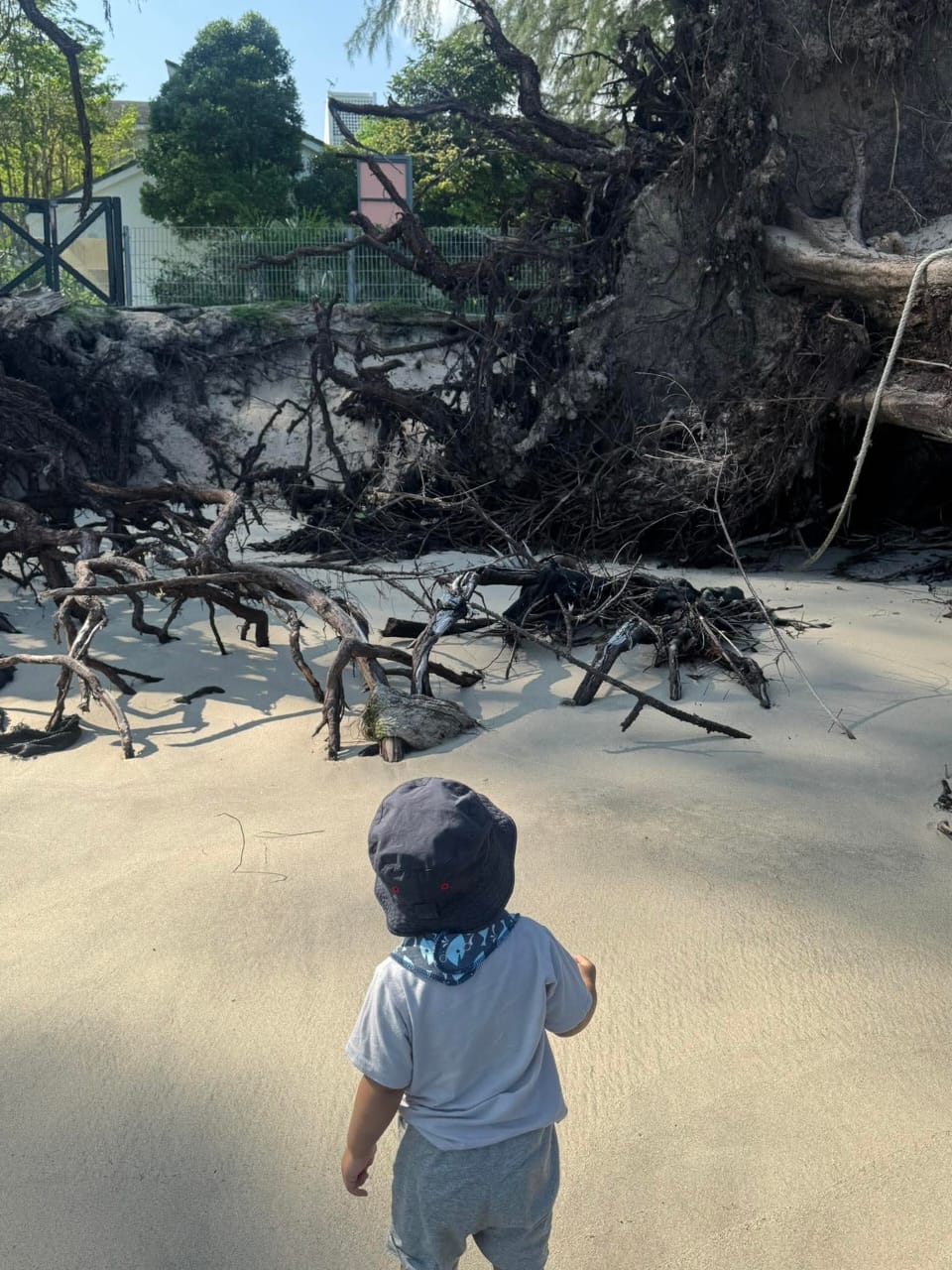
I wanted to tell him: it wasn’t meant to be like this. This wasn’t the beach where his parents got married. I hadn’t expected coastal erosion to become something I would feel at such a personal, intergenerational level.
The small gate from the hotel to the beach still stands, but it now opens to a steep, one-metre drop-off where the sand used to be.
Not an isolated incident
This didn’t happen overnight. As far back as 2021, news reports flagged the erosion at Batu Ferringhi, at which point the Penang government’s council member for infrastructure and transport, Zairil Khir, described it as an isolated incident confined to the Rasa Sayang area.
Today, the same devastation has reached the hotel I was at, barely 600 metres away. The erosion is anything but isolated.
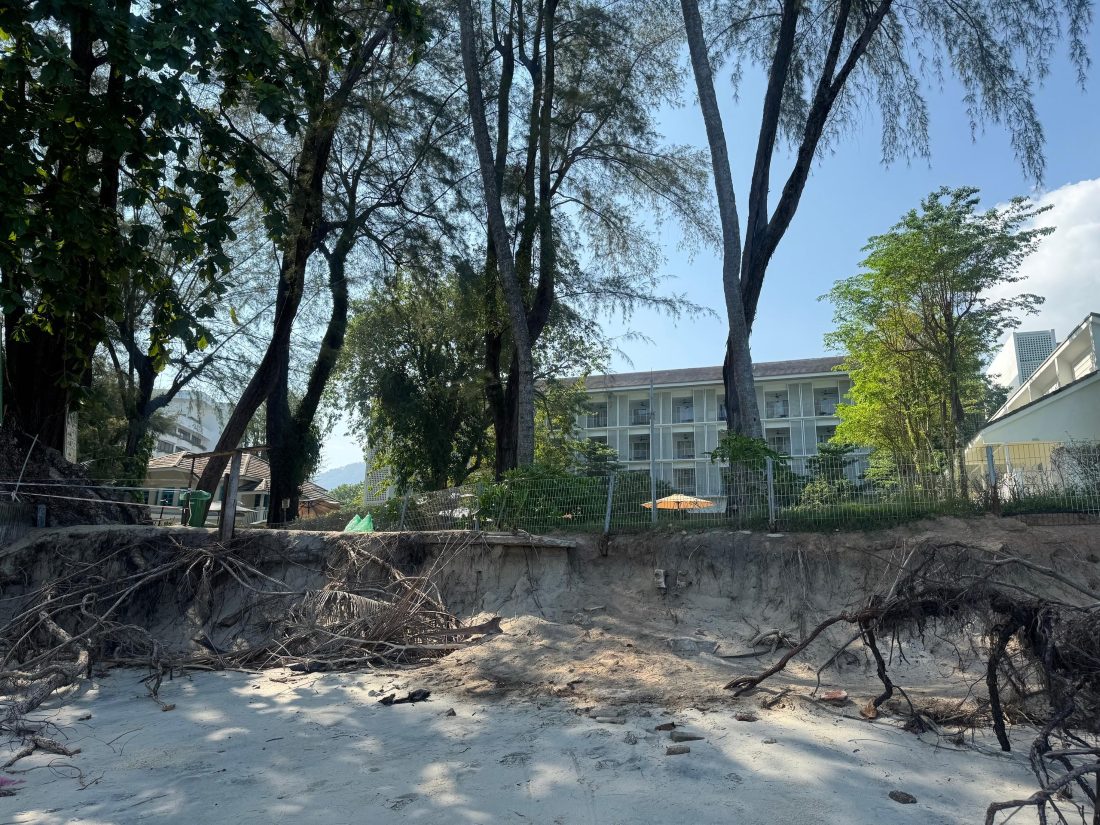
I cannot help but wonder: had this been taken more seriously then, with proper assessment and urgent intervention, could measures have been taken to curb further erosion?
We picked our way carefully over the large sandbag barriers that now cover most of the beach, many of them already torn and misshapen from the force of the waves. These are the RM250,000 temporary measures the state government put in place in April last year.
In that same period, the Department of Irrigation and Drainage (DID) announced it was finalising the design for a long-term RM61m mitigation project, approved under the 12th Malaysia Plan, signalling that this is now a matter of serious national concern.
Yet the public remains in the dark about what is actually causing this. What is the root cause of the chronic erosion stretching from Batu Ferringhi to Tanjung Bungah? Is it natural? Is it climate change? Is it human-induced?
And critically, is there anything we should be paying attention to, to prevent this from happening elsewhere?
The DID is currently conducting a study into the causes of erosion in both Batu Ferringhi and Tanjung Bungah, alongside a review of the integrated shoreline management plan.
But in most people’s minds, the question keeps coming back to the large land reclamation projects nearby. Before those projects, erosion of this rate and scale was simply unheard of.
The reclamation question
In response to growing public concern, the Chief Minister Chow Kon Yeow stated that the erosion is unrelated to reclamation, attributing it to natural factors and seasonal weather changes.
He argued that any reclamation-linked erosion would be confined to the Seri Tanjung Pinang area, and that the identified erosion sites, at least 10km away, are too distant to be connected to work carried out years ago.
This conclusion warrants closer scrutiny. The relationship between reclamation and coastal erosion is rarely straightforward, and distance alone is not sufficient to rule out a connection.
Reclamation is known to alter shoreline geometry, disrupt longshore sediment transport and modify hydraulic patterns in ways that can manifest well beyond the immediate site, depending on a coastal area’s morphology. The reach of human-induced shoreline changes is not neatly bounded by geography.
No independent, peer-reviewed evidence has been presented to substantiate the claim that reclamation is definitively not a contributing factor.
To categorically dismiss this possibility – without a thorough, transparent coastal impact study – risks closing off questions the public deserves to have answered, especially when RM61m of public funds is being committed to address the consequences.
More than an engineering problem
We cannot keep treating engineering fixes as the default response while conveniently dropping the question of cause.
Scientific literature tells us that coastal erosion is commonly driven by offshore sand mining, coastal development, loss of mangroves, altered wave patterns from nearby construction and climate-driven sea level rise.
Attributing the unprecedented scale of what we are witnessing simply to “natural factors and seasonal weather changes” is not a sufficient answer.
We cannot afford a cycle of fix, spend, move on – and blame the weather – until the beach is eventually gone. This is not simply a tourism problem to be fixed. It is a governance and accountability failure that must be interrogated.
I keep returning to the photos and videos I took that day. The fallen trees. The carved-away shore.
My son, just 13 months old, toddling unsteadily toward the trunk of one of those fallen casuarinas and pressing his small palm flat against the bark, the way babies do with everything new, without knowing why. He had no idea what that tree once was, no idea what that beach once looked like. But I do.
And in a way, that unknowing is the most heartbreaking part of all. He will grow up with this as his normal. And if nothing changes, even the next generation may not know this beach at all.
That alone, more than any figure or policy failure, is what makes this matter so urgent.
We owe it to him and to every child who will inherit this coastline to demand more than a multi-million-ringgit fix and a “blame the weather” response where real answers are owed.
Evelyn Teh is a Penang-based public policy researcher and environmental scientist specialising in ecological management, climate change and urban studies, with a background in marine biology.
AGENDA RAKYAT - Lima perkara utama
- Tegakkan maruah serta kualiti kehidupan rakyat
- Galakkan pembangunan saksama, lestari serta tangani krisis alam sekitar
- Raikan kerencaman dan keterangkuman
- Selamatkan demokrasi dan angkatkan keluhuran undang-undang
- Lawan rasuah dan kronisme

As one who lived and grew up in Batu Ferringhi in the seventies, it is sad to witness what is happening now! For anyone to discount that the soil erosion occurring now is purely due to weather and water current is very shortsighted and misleading. I am pretty sure the land reclamation all over Penang’s coastline is partly responsible for the soil erosion. Engaging a detailed Hydraulic study of the effects of land reclamation is surely the proper way to address the situation in Batu Ferringhi if the Authorities is serious. See the changes in the water currents and movements of tides due to land reclamation works all over the coastline!
Let’s see whether the Penang State Government is serious in addressing this issue!
Salahkan Cuaca Dan Keadaan Air pasang besar,alasan mudah bagi kerajaan Negeri.Bagi saya yang telah membesar Dan bermain d kawasan persisiran pantai ini…perkara ini berkaitan dgn pembuatan Pulau(Reclaim Land).PASIR YANG DIGUNA ..BUKAN DIBAWA DARI BULAN ATAU PLANET LAIN.