

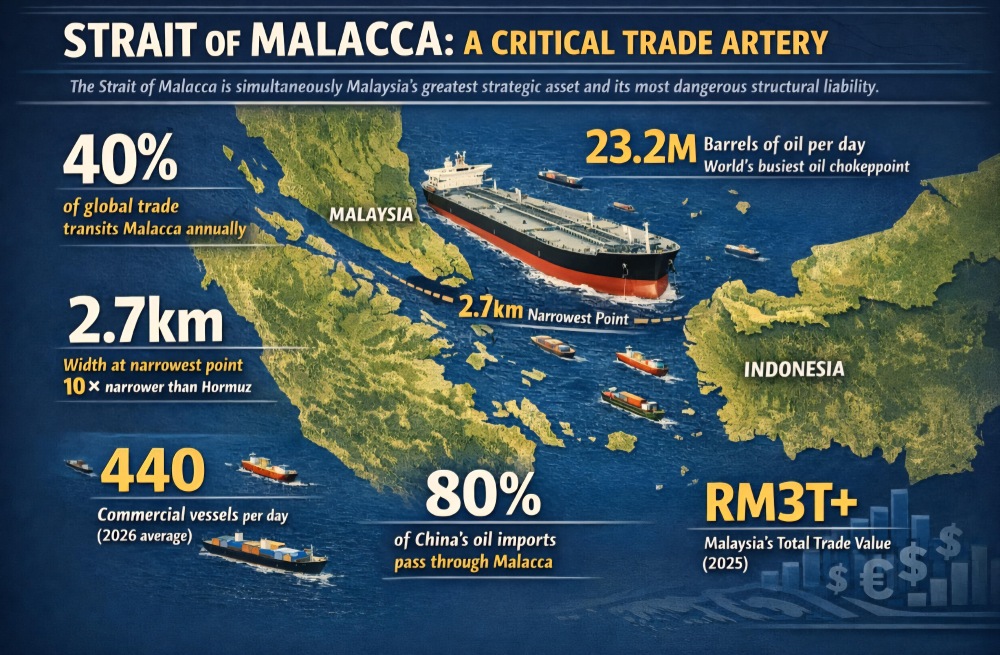
TThe Strait of Malacca is a precious asset to Malaysia, and yet it is also a structural liability.
As one of three littoral states, alongside Indonesia and Singapore, Malaysia co-manages a waterway that carries roughly 29% of global maritime oil flows and handles an estimated $3.5tn in global trade annually.
Yet geographic centrality is not matched by military capability, diplomatic agility or the economic resilience needed to absorb a worst-case disruption.
The Hormuz crisis has laid bare the Strait of Malacca’s geoeconomic vulnerability. The question is: under what conditions, by whom, and with what consequences for Malaysia if such a crisis were to reach our shores?
Three scenarios
One plausible kinetic scenario involves conflict over Taiwan triggering US naval interdiction of Chinese shipping lanes through Malacca – or China mounting retaliatory naval measures, possibly including mining or blockade operations in adjacent South China Sea approaches.
The geopolitical reality is that Chinese “lawfare” and other physical obstruction tactics deployed at Scarborough Shoal could migrate to the Malacca approaches, creating de facto access restrictions without a formal blockade declaration.
It is often stated that China depends on the strait for roughly 40% of its trade. Less frequently stated is that about 60% of India’s sea-based trade and nearly all of its liquefied natural gas imports also rely on the Malacca route.
- Sign up for Aliran's free daily email updates or weekly newsletters or both
- Make a one-off donation to Persatuan Aliran Kesedaran Negara (ALIRAN), Maybank a/c 507246118995 or CIMB a/c 8004240948
- Make a regular pledge or periodic auto-donation to Aliran
- Become an Aliran member
China does, however, have alternative trading routes: the China-Pakistan Economic Corridor linking Gwadar port to Xinjiang, the Myanmar-China pipelines, the Arctic “Polar Silk Road” with Russia, and the trans-Pacific route to Canada and South America.
A second scenario involves US geopolitical pressure on the littoral states.
Singapore has a quasi-alliance with Washington through a 1990 Memorandum of Understanding (MoU), upgraded through a 2005 strategic framework agreement.
Malaysia signed a critical minerals MoU with the US in October 2025.
And Indonesia established a “major defence cooperation partnership” with Washington in April 2026.
The US could demand that these states formally choose sides, with non-compliance met by a withdrawal of US Sea Lines of Communication protection, effectively removing the deterrent against a blockade.
Then there is the possibility of state-sponsored or opportunistic non-state actors exploiting the strait’s 900km length and patrol complexity to conduct sustained disruption through piracy, drone swarms or underwater sabotage of undersea pipelines and cables.
Beneath these waters, submarine cable-laying has become a theatre of geopolitical competition between rival infrastructure platforms.
A fracture in consensus
Malaysia’s strategic neutrality doctrine – refined during Dr Mahathir Mohamad’s era, rebranded through Asean and refurbished under “Madani” – was designed for a world where major powers agreed on the inviolability of international shipping lanes.
In its earliest form, it was something more ambitious. The Zone of Peace, Freedom and Neutrality (Zopfan) declaration, signed by Asean’s five founding states in Kuala Lumpur in 1971, was Malaysia’s own initiative. It was a bid to keep Southeast Asia free from the interference of outside powers. But that foundational commitment to regional autonomy remains an unrealised ideal.
The Hormuz crisis is the latest reminder of the potential threats lurking. The crisis suggests that the consensus underpinning the global maritime order has fractured.
The situation has produced something of a strain between Malaysia and Singapore over whether UN Convention on the Law of the Sea (UNCLOS) transit passage rights are unconditional or subject to diplomatic negotiation.
Singapore’s position – that conceding even one iota to Iran over passage “tolls” sets a precedent that destroys the legal basis of the strait’s openness – may be analytically correct, even if it is politically uncomfortable.
Malaysia’s bilateral approach to Tehran, while tactically successful in securing passage for its vessels, risks eroding the very norm on which its most vital strategic asset depends.
That tension surfaced closer to home when Indonesia’s finance minister floated the idea of imposing tolls on ships passing through the strait. The suggestion was swiftly rejected by Malaysia’s Foreign Minister Mohamad Hasan, who stated that no country could unilaterally impose such tolls. Indonesia later clarified it would not pursue the idea.
The episode was a reminder that the tripartite framework binding Malaysia, Indonesia and Singapore – in place since 1971 and grounded in UNCLOS – prohibits tolls and guarantees free transit passage. It is not a mechanism to be tested for political effect.
Malaysia’s defence minister reinforced the point: the four littoral states, including Thailand, are fully capable of managing the strait themselves. “Whatever is to be done in the Strait of Malacca must involve the cooperation of all four countries. That is our understanding – it cannot be done unilaterally.”
Indeed, Malaysia’s 2019 defence white paper, tabled in Parliament and adopted with bipartisan support, formally declared the country a “maritime nation with continental roots”. That self-description carries obligations: a maritime nation cannot outsource the security of its most critical waterway to the goodwill of great powers or manage its most vital strategic asset crisis by crisis.
Yet Malaysia faces what might be called a chokepoint trilemma. It cannot simultaneously:
- maintain economic integration with China as its primary trading partner
- rely on US naval power to guarantee Malacca’s openness and
- preserve an Asean-mediated neutrality that exempts it from the obligations of either alignment
The Hormuz crisis and the prospect of an emerging Malacca crisis force a choice that Malaysia’s political economy may be structurally ill-equipped to make.
What needs to change
Three structural reforms could improve Malaysia’s resilience. The first two are only now receiving serious government attention, while the full calendar for the third remains unclear.
Strategic petroleum reserve adequacy: Malaysia has no publicly confirmed strategic reserve equivalent to the International Energy Agency’s member standards.
In a prolonged disruption, the absence of a 90-day reserve is not just a logistical problem, but a political one as well. The government would lose the capacity to absorb public fuel price shocks during a crisis.
The government is studying a proposal to create strategic petroleum reserves as part of the country’s long-term energy security planning, following global supply concerns that led to the Strait of Hormuz closure.
Maritime security capacity-building: The Malaysian Maritime Enforcement Agency’s coastguard patrol deficit, relative to the strait’s length and traffic density, is a structural vulnerability that diplomatic goodwill alone cannot address.
Malaysia needs substantially deeper investment in maritime domain awareness, undersea infrastructure protection and coordinated operational capacity with Indonesia and Singapore, its two fellow littoral states.
The government has now committed to a billion-ringgit modernisation plan that includes motherships, helicopters, a radar system for northern Sabah, and additional fast boats.
Diplomatic doctrine recalibration: The bilateral passage negotiation approach applied to Iran in Hormuz is tactically expedient but strategically self-defeating when applied to Malacca.
Malaysia needs a coherent doctrine – developed in genuine partnership with Singapore and Indonesia, the three nations that together border and are legally responsible for the strait – that asserts UNCLOS transit passage rights as absolute and is backed by credible multilateral enforcement mechanisms, rather than managing each crisis transactionally.
This is where Asean has a role to play. Rather than leaving each littoral state to navigate the pressure alone, Asean should act collectively. It needs to assert what it calls “Asean centrality” – the principle that the grouping, not external powers, should be the primary architect of regional security.
The risk of not doing so is real. Indonesia, the largest of the littoral states, has already shown an appetite for independent signalling on the strait. A fragmented littoral response, however, would hand outside powers the leverage they need.
The Hormuz crisis has shown that the international rules-based maritime order is not self-enforcing.
Malaysia’s position as a Malacca littoral state gives it geographical centrality but not realistic naval power.
The Madani government’s hedging strategy – economically integrated with China, diplomatically engaged with the West and institutionally committed to Asean – is coherent in a stable world. In a contested one, it is fragile.
The question Malaysia has to answer is not merely “what do we do if Malacca is blocked?” but “what kind of state are we building to survive in a world where chokepoints are weapons?”
That question demands a quality of strategic thinking that the current political architecture – coalition-constrained, electorally anxious, institutionally short-termist and embedded within a semi-peripheral economy – is not yet equipped to provide.
With additional input from Dr Johan Saravanamuttu
The views expressed in Aliran's media statements and the NGO statements we have endorsed reflect Aliran's official stand. Views and opinions expressed in other pieces published here do not necessarily reflect Aliran's official position.
- Tegakkan maruah serta kualiti kehidupan rakyat
- Galakkan pembangunan saksama, lestari serta tangani krisis alam sekitar
- Raikan kerencaman dan keterangkuman
- Selamatkan demokrasi dan angkatkan keluhuran undang-undang
- Lawan rasuah dan kronisme
