

Kee Thuan Chye
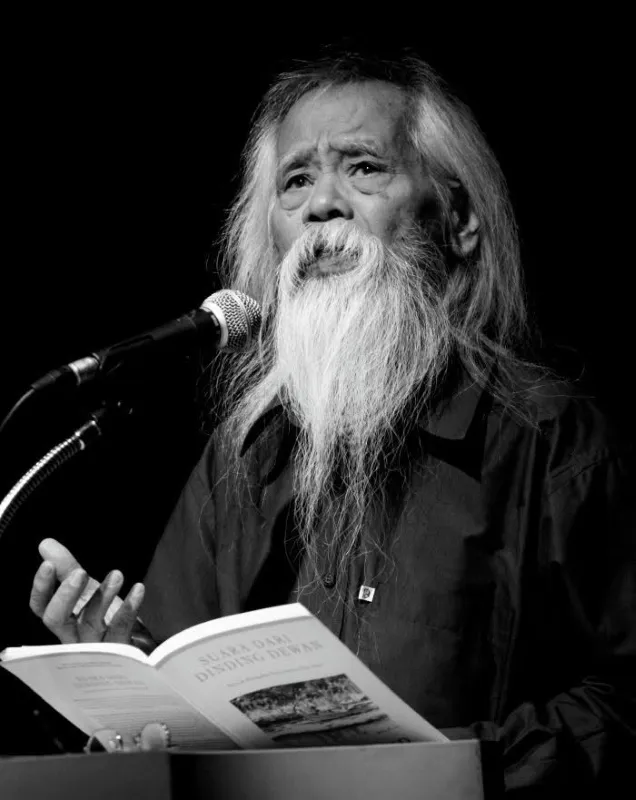
A Samad Said once told me that when RTM was planning to do a documentary on him, they wanted him to cut his hair, which they found to be too long for their broadcasting policy.
He asked them one question, “You want my hair or you want my mind?”
RTM let him keep his hair.
That was Samad, a man who just wanted to be himself.
Even in the standard way he dressed – in loose-fitting shirts or tunics (somewhat like kurtas), loose-fitting trousers and sandals – he was being himself. He moved around Kuala Lumpur and practically everywhere else attired like that.
With his long hair and long beard, he cut quite an iconic figure, but looking more like a maharishi of the streets than a literary legend – not at all matching the image conventional people would conventionally have of a Sasterawan Negara (National Laureate).
Despite having been bestowed that literary honour, the nation’s highest, Samad eschewed status and prestige. He lived modestly, carried himself with humility. To me, he was a consummate model of back-to-basics simplicity and down-to-earth grounding that our society needs.
Regarding his writing, he maintained his individual independence as staunchly. Criticised by another literary legend, Shahnon Ahmad, for not projecting an Islamic world-view and conveying what it means to be a good Muslim in his novels, Samad retorted, “I have the right to write novels as I please.” Indeed he did.
In any case, Samad was not one who wore religion – or race – on his sleeve. He was more concerned with telling stories centred on the human condition, culled from his own experiences. He intimated to me that they were documents of his “sufferings”.
He suffered trauma as a child during the Japanese war. He developed a stammer. His family home was demolished by bombs. He witnessed his relatives being blown to bits. He had to steal food from storehouses at the risk of being killed by Japanese soldiers. These things became rich material for some of his novels.
Outside of writing, he mixed easily with other races, advocated an inclusive Malaysia, rejected racial division, and publicly denounced politicians who exploited racial and religious issues.
He was proudly Malay and Muslim for sure, and he defended the Malay language as the nation’s primary and unifying language, but he was, above all, a humanist.
He was co-chairperson of Bersih 2.0, together with Ambiga Sreenevasan, calling not only for fair and free elections but also condemning corruption. At the end of that successful 2011 rally, he proudly declared, “I have never seen all the races in Malaysia so united behind one cause before.”
In 2015, he raised dissenters’ hackles when he joined the DAP.
Two weeks ago, in the wake of Najib Razak’s conditional pardon and house arrest, he was among seven Sasterawan Negara who issued a joint statement condemning double standards in the justice system and calling for the equal enforcement of the rule of law.
These seven prominent people lighted the way for others to speak up against the granting of amnesty to a criminal from a privileged background.
Significantly, it also showed that Samad at the end of his life remained true to his beliefs and righteously stood up to defend one of them.
Last Tuesday, when Samad breathed his last at the age of 91, we lost not only a thinker, role model, legend and social activist, we also lost a voice of conscience for the nation.
I shall cherish the numerous times I met with the man, especially in the 1980s when I got to know him better and followed his mogok seni (art strike) – his protest against delayed royalty payments and institutional neglect of creative writers.
He had left his full-time job at Berita Harian in 1986 with the resolve to prove that a modern Malay writer could survive on his writing alone.
But after a few years, he met with an obstacle when his publisher, Dewan Bahasa dan Pustaka, dragged their feet when it came to paying him his royalties.
He decided to go on strike, vowing not to engage in writing or making public literary appearances for five years.
I admired his commitment to taking on the Establishment all by himself, and wrote an article or two in the media to support it.
Then when Dewan Bahasa dan Pustaka began to show sympathy for his predicament, he stopped his strike after a year.
I asked him what he did all that time.
- Sign up for Aliran's free daily email updates or weekly newsletters or both
- Make a one-off donation to Persatuan Aliran Kesedaran Negara (ALIRAN), Maybank a/c 507246118995 or CIMB a/c 8004240948
- Make a regular pledge or periodic auto-donation to Aliran
- Become an Aliran member
He said, “Nothing, just being lazy. It’s enjoyable.”
He had an abundant sense of humour. In later years, when we met up again after a long hiatus, it was this that easily reconnected us. His light-heartedness was reassuring; it reflected an understanding of how large the world is and how small we are as particles in it.
I cherished that and his world-view. He was always the same old Samad. Unassuming, understated, soft-spoken, unimposing. A man who lived on his own terms.
I shall remember him that way.
Kee Thuan Chye is a prominent Malaysian playwright, poet, journalist and political commentator known for his outspoken views on social justice and democracy.
The views expressed in Aliran's media statements and the NGO statements we have endorsed reflect Aliran's official stand. Views and opinions expressed in other pieces published here do not necessarily reflect Aliran's official position.
- Tegakkan maruah serta kualiti kehidupan rakyat
- Galakkan pembangunan saksama, lestari serta tangani krisis alam sekitar
- Raikan kerencaman dan keterangkuman
- Selamatkan demokrasi dan angkatkan keluhuran undang-undang
- Lawan rasuah dan kronisme
