

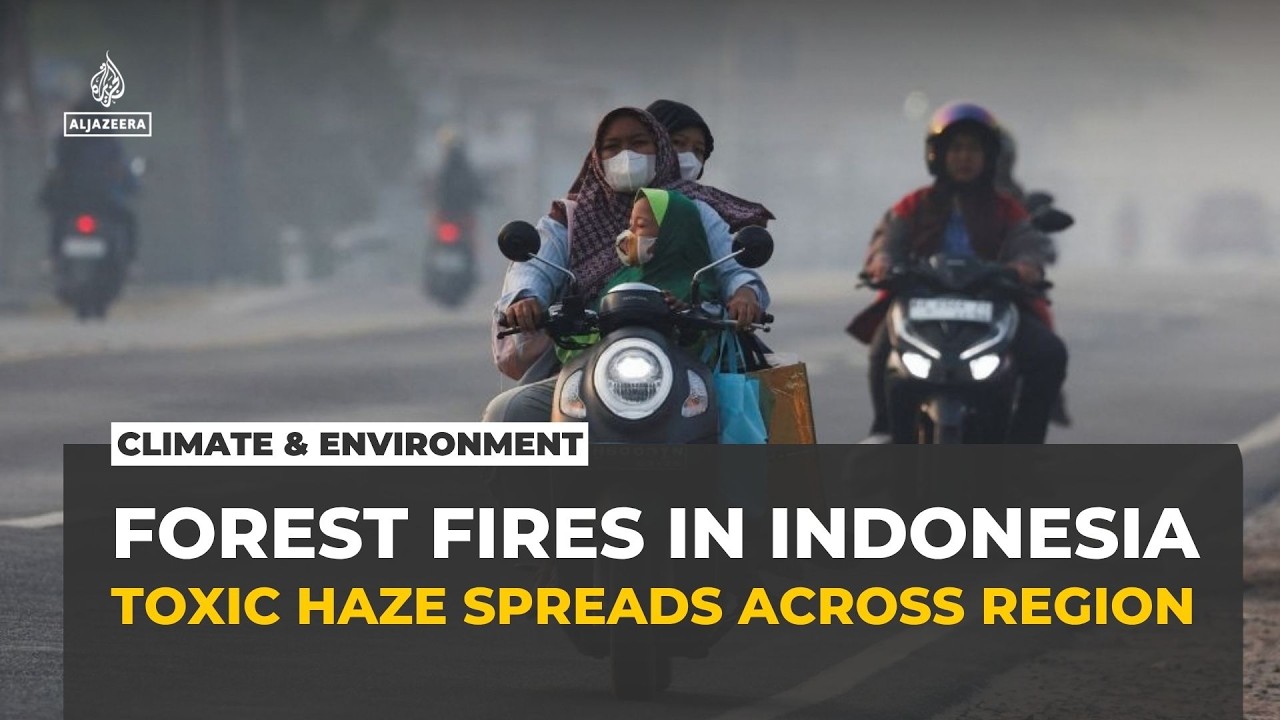
The hazy blankets over Southeast Asia are not mere ecological accidents. They are better understood, critics argue, as the atmospheric exhaust of a transborder capital formation, a system of money that moves across borders.
History shows that the peat and forest fire smoke haze is linked to Malaysian capital accumulation, Indonesian land dispossession and Singaporean financial intermediation.
The emission cycle starts in three stages.
Stage one: Malaysian capitalisation
Let us go back to the introduction of the New Economic Policy (NEP) in the 1970s. It was built around the accumulation of capital by a bumiputra community that was largely excluded from the colonial-era capitalist structure and its formation.
The policy was helped by government-linked investment companies and, later, government-linked firms. There was Umno-linked patronage, often justified by the need for community upliftment and wealth creation. There were contracts, licences, equities, directorships and scholarships for the bumiputra community.
The policy was protected by the state’s regulatory apparatus and a narrow economic nationalism that was spreading in post-colonial Southeast Asia (Frank H Golay et al, 1969).
The government also used public funds from government-linked investment companies to build bumiputra corporate wealth.
- Sign up for Aliran's free daily email updates or weekly newsletters or both
- Make a one-off donation to Persatuan Aliran Kesedaran Negara (ALIRAN), Maybank a/c 507246118995 or CIMB a/c 8004240948
- Make a regular pledge or periodic auto-donation to Aliran
- Become an Aliran member
Some of this money went into the oil palm plantation economy. Several companies grew into plantation giants.
The ‘Dawn Raid’ on the London Stock Exchange on 7 September 1981 was a moment of national pride. Through PNB, Malaysia took control of the British-owned Guthrie Corporation Limited.
Stage two: Crossing the strait
However, by the late 1990s, Malaysian plantation companies, including Chinese Malaysian-owned ones, sought new land for expansion as suitable land in the peninsula became scarcer. Expansion into Sabah and Sarawak faced strong resistance from Indigenous communities.
The Federal Land Development Authority (Felda) was set up in 1956 to settle landless rural ethnic Malay households on smallholder rubber and oil palm schemes.
Critics argue that Felda’s land banks were later treated as financial assets. In 2012, its commercial arm, Felda Global Ventures (FGV), was listed on the stock exchange (Varkkey, 2016).
Some Malaysian conglomerates then crossed into Indonesia to set up plantation operations in Riau, Jambi and Central Kalimantan.
Critics call this a neo-colonial extension of David Harvey’s ‘accumulation by dispossession’. They argue that this is when a neighbouring state’s land and customary rights are taken by outside capital without equivalent compensation (Pye and Bhattacharya, eds, 2013; Pichler, 2015).
Stage three: Singapore
Singapore is seen as the financial hub that channels this flow of capital. Its limited enforcement of the 2014 Transboundary Haze Pollution Act (THPA) may be perceived as trasformismo (transformism). This is where dominant elites absorb or neutralise dissent to keep the existing capital structure intact.
Each haze episode – 2015, 2019, 2023 and now 2026 – stirred public anger. The anger appears to have been tempered and absorbed.
Haze as capital’s exhaust
In 2026, Indonesia experienced one of its most intense wildfire seasons in recent years.
In September, Malaysia declared a state of emergency in Sarawak’s Serian district after the Air Pollutant Index exceeded 500.
Singapore’s National Environment Agency later reportedly issued notices to 10 companies it suspects of links to the fires. These notices requested them to stop burning on their land and to submit plans for how they plan to prevent the fires from recurring. This is the second time the THPA has been used.
It was previously invoked after the 2015 haze, when the agency issued legal notices to six Indonesian companies. Two of the cases have been closed based on information they provided, while the remaining four are still open.
These episodes are not an ecological oddity.
The 2015 fires burned an estimated 2.6 million hectares and released an estimated 1.2-1.8 billion tonnes of carbon dioxide equivalent, depending on the study. They cost Indonesia an estimated $16.1bn, about 1.9% of its gross domestic product (GDP).
The haze, seen as the exhaust of a transborder capital formation, may be easier to understand through a neo-colonial lens.
Two thinkers help here: the Italian thinker Antonio Gramsci, in his Prison Notebooks (Gramsci, 1971), and the geographer David Harvey, in his writings on accumulation by dispossession (Harvey, 2003, 2005).
Together, they help identify hegemony. This is the moment when a dominant class wins ‘spontaneous’ consent through material concessions and elite ideological leadership, to protect its accumulation of capital.
The financial engine
Singapore is home to the headquarters of some of the world’s largest palm oil traders. It is also the stock exchange hub where these companies raise money.
Singapore’s official narrative often frames the city-state as an innocent victim of Indonesian fires.
Some argue that this hides the fact that Singapore-based capital has financed and profited from practices linked to the smoke (Varkkey, 2015b). In this argument, Singapore-based capital acts as the middleman. Land rights are taken in Riau and Kalimantan and converted into liquid, hedge-able, pension fund-grade financial returns.
Singapore passed its THPA in 2014. A decade later, the act had yet to produce a known successful case against a company.
Critics say the law exists mainly to calm public anger, less so to punish polluters or the accumulators of capital.
Singapore’s government says it will hold errant companies to account under the act.
The illusion of solutions
When the public gets angry about the haze, political and business elites are perceived to use the Gramscian tactic of absorbing the anger by offering ‘solutions’ that protect corporate interests:
- The Asean agreement: But instead of imposing strict penalties on polluters, Asean states rely on ‘voluntary cooperation’, which critics say lets companies escape scrutiny.
- The Roundtable on Sustainable Palm Oil (RSPO): This certification scheme was meant to ensure sustainable palm oil. But some critics allege it has been used to greenwash the industry.
- Seldom-used laws and unevenly enforced pledges: Singapore’s THPA and Indonesia’s zero-burning policies are said to absorb public outrage. Whether they are fully enforced is another question.
Critics say all these programmes give the illusion of action while leaving a profitable, destructive business model untouched.
Not a mystery
The Southeast Asian haze is not a mystery. The maze of capital behind it can bewilder, but we should not be dazzled by political entrepreneurs. Nor is the failure to stop the haze an accident.
This commentary argues that the current regional agreements and corporate sustainability pledges are not broken. They work as designed – to manage public anger while protecting profits.
For civil society and the public, the lesson is clear. True change requires challenging the underlying economic system that treats forests as cheap sources of profit.
We should not let our land, lungs and labour become an acceptable cost of doing hazy business.
The views expressed in Aliran's media statements and the NGO statements we have endorsed reflect Aliran's official stand. Views and opinions expressed in other pieces published here do not necessarily reflect Aliran's official position.
- Tegakkan maruah serta kualiti kehidupan rakyat
- Galakkan pembangunan saksama, lestari serta tangani krisis alam sekitar
- Raikan kerencaman dan keterangkuman
- Selamatkan demokrasi dan angkatkan keluhuran undang-undang
- Lawan rasuah dan kronisme
