

Vijay Prashad
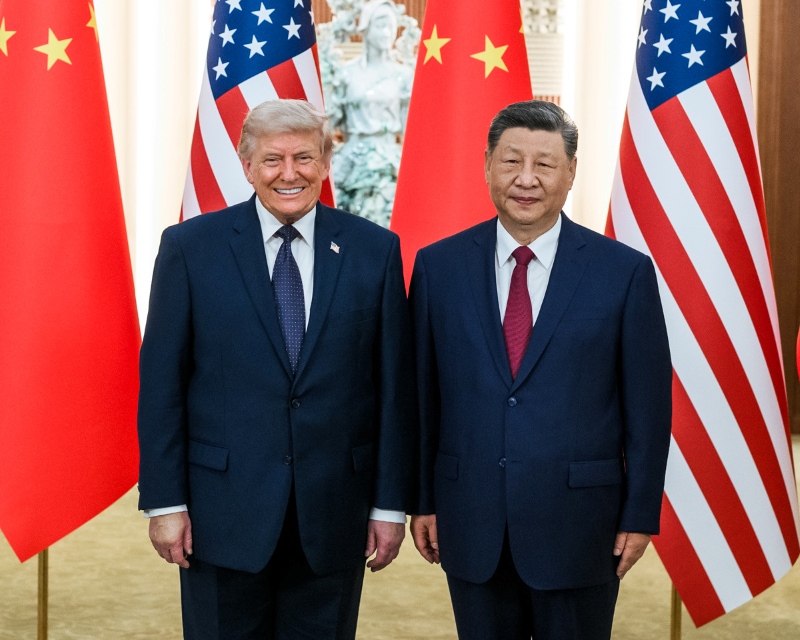
President Xi Jinping’s forthcoming visit to the US must be understood as more than an encounter between two heads of state; it must be seen as an encounter between two possible futures.
In one future, the US imposes a spiral of confrontation with China. Trade disputes harden into economic warfare, then economic warfare intensifies into technological blockades, technological blockades produce military encirclement, and finally military encirclement creates incidents, and incidents the danger of becoming an unimaginable war.
In the other future, the two countries accept that neither can destroy the other without destroying much of humanity. They recognise that coexistence is not an act of charity, and collaboration is not a concession. Both are necessities.
That is the significance of Xi’s decision to travel to the US. China’s foreign ministry has described head-of-state diplomacy as having an ‘irreplaceable’ role in guiding relations between the two countries.
The visit follows President Donald Trump’s trip to China in May and continuing negotiations over tariffs, trade and investment.
There are indications that President Xi will travel with a substantial delegation of Chinese business leaders. These facts suggest that Beijing wants to move the relationship away from permanent crisis and towards practical engagement.
- Sign up for Aliran's free daily email updates or weekly newsletters or both
- Make a one-off donation to Persatuan Aliran Kesedaran Negara (ALIRAN), Maybank a/c 507246118995 or CIMB a/c 8004240948
- Make a regular pledge or periodic auto-donation to Aliran
- Become an Aliran member
But diplomacy between China and the US cannot merely be a photo opportunity – nor should it be understood as a negotiation in which one side must surrender to the other. It must be based on a sober recognition of reality – or, to be precise, four realities.
The first reality is that China cannot be contained. China is not a minor country whose development can be suffocated by sanctions. It has a population of more than 1.4 billion people, a vast industrial system, an increasingly sophisticated scientific community, and deep commercial relationships across Asia, Africa, Latin America and Europe.
Whatever one thinks of China, it is absurd to imagine that it can simply be excluded from the world economy. The attempt to contain China has already produced an extraordinary catalogue of restrictions: tariffs, semiconductor controls, investment prohibitions, sanctions on Chinese companies, naval patrols along China’s coastline, and the construction of new military arrangements from the Pacific to the Indian Ocean.
Each of these measures is presented as defensive. Taken together, however, they form an architecture of confrontation.
There is a dangerous illusion in Washington that pressure will force China to abandon its development.
No Chinese government could accept such a demand. After the century of humiliation (from the Opium Wars to the Japanese invasion) the restoration of national sovereignty and the improvement of living standards are not negotiable matters for the Chinese people.
The US may slow certain aspects of China’s development, but it cannot persuade China to return to poverty.
The second reality is that economic separation is neither simple nor painless. The US and China remain deeply connected through trade, investment, supply chains, scientific knowledge and consumer markets.
US farmers depend upon Chinese buyers. US companies depend upon Chinese manufacturing and upon Chinese consumers.
China, meanwhile, benefits from access to US technology, agricultural products and capital.
Negotiators are now discussing reciprocal tariff reductions and new mechanisms for trade and investment. These are modest measures, but they acknowledge an important truth: economic warfare injures both countries. Tariffs are announced with nationalist speeches, but their costs appear in grocery bills, factory closures, disrupted supply chains and lost employment.
Working people in the US do not benefit when China is weakened. Their difficulties are rooted principally in decisions made by their own ruling class: decades of deindustrialisation, the power of finance, attacks on trade unions, the privatisation of public services, and the refusal to undertake serious social investment.
China did not close the factories of the US Midwest. US corporations closed them in search of higher profits. The answer to inequality in either country is not economic nationalism by the US.
The third reality is that humanity faces problems that cannot be solved by either country acting alone. The climate catastrophe does not carry a passport. Carbon emitted in one country heats the atmosphere everywhere.
The US possesses immense scientific and financial resources, while China has developed enormous productive capacity in solar panels, batteries, electric vehicles, public transport and renewable energy infrastructure.
Collaboration between them could accelerate a worldwide energy transition. Confrontation will delay it precisely when delay has become intolerable.
The same is true of public health. The Covid pandemic showed us the human cost of secrecy, competition and vaccine nationalism.
AI creates another urgent area for cooperation. These technologies cannot be governed adequately by rival military doctrines or private companies seeking maximum profit.
The two countries must develop common safeguards against autonomous weapons, destabilising cyber-attacks, mass surveillance and the use of AI to intensify social inequality.
Finally, the fourth reality is the question of war. China and the US are nuclear-armed powers. Any direct military conflict between them would have consequences beyond calculation.
This is why Taiwan must not be transformed into the trigger for a catastrophic confrontation. The one-China framework and the existing diplomatic understandings must not be hollowed out by provocations, arms sales or gestures designed for domestic political theatre.
Peace requires restraint from both sides, but restraint cannot mean that the US surrounds China with military bases and warships and then demands that China alone remain calm. Security cannot be achieved through the permanent insecurity of another country.
There will, of course, be disagreements. Collaboration does not require agreement on every political question. Nor does coexistence require silence about differences.
But disagreement must be conducted through diplomacy, international law and UN institutions – not through sanctions, threats and military exercises.
The countries of the Global South have a particular interest in the success of this visit.
They do not want to be instructed to choose between China and the US. They do not want their ports, minerals, telecoms systems and political institutions turned into battlefields in a new cold war.
They want access to finance, technology, medicine and markets without political subordination. They want development, not recruitment into rival military camps.
Xi’s visit therefore carries a responsibility that extends far beyond Washington and Beijing. The world does not need an agreement merely to divide markets between Chinese and US companies. It needs a commitment to reduce the danger of war, dismantle unilateral coercive measures, restore normal economic relations, cooperate on climate and public health, and strengthen the principles of the UN Charter.
The importance of the visit lies not in ceremony but in possibility. It offers both countries an opportunity to step back from the cliff.
The US must abandon the fantasy that it can preserve its primacy by preventing China’s development. China, for its part, has repeatedly said that it does not seek to replace the US as a hegemonic power.
That principle must become the basis of a durable relationship: no containment, no domination, no war.
There is an old habit among powerful states of treating compromise as weakness. In the nuclear age, the opposite is true.
It takes no courage to order another warship into contested waters. It takes political courage to recognise that one’s adversary also has legitimate interests, that coexistence requires reciprocity, and that the survival of humanity is more important than the vanity of supremacy.
This visit should therefore carry a simple message from Washington to the world: collaboration is not surrender, diplomacy is not weakness, and peace is not an abstraction.
Confrontation offers neither country a future. Collaboration offers the world a chance. – Globetrotter
Vijay Prashad is an Indian historian and journalist. He is the author of 40 books, including Washington Bullets, Red Star Over the Third World, The Darker Nations: A People’s History of the Third World, The Poorer Nations: A Possible History of the Global South, and How the International Monetary Fund Suffocates Africa, written with Grieve Chelwa. He is the executive director of Tricontinental: Institute for Social Research, the chief correspondent for Globetrotter, and the chief editor of LeftWord Books (New Delhi). He also appeared in the films Shadow World (2016) and Two Meetings (2017).
The views expressed in Aliran's media statements and the NGO statements we have endorsed reflect Aliran's official stand. Views and opinions expressed in other pieces published here do not necessarily reflect Aliran's official position.
- Tegakkan maruah serta kualiti kehidupan rakyat
- Galakkan pembangunan saksama, lestari serta tangani krisis alam sekitar
- Raikan kerencaman dan keterangkuman
- Selamatkan demokrasi dan angkatkan keluhuran undang-undang
- Lawan rasuah dan kronisme
