

Vijay Prashad
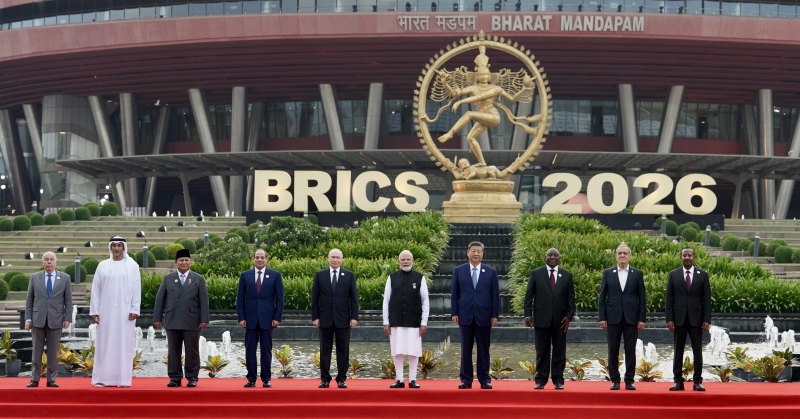
The 18th Brics summit, held in New Delhi on 12-13 September, occurred amid an exceptional intensification of international contradictions.
Wars in West Asia, unilateral sanctions, tariff barriers and the weaponisation of finance and technology have exposed the fundamentally unequal character of the imperialist-dominated international order.
Against this background, the continued expansion of Brics reflects the desire of developing countries for greater strategic autonomy and a more democratic system of global governance.
At the same time, the summit demonstrated that Brics+ remains a heterogeneous grouping whose members differ substantially in their political alignments and economic interests.
The New Delhi Declaration, the outcome of the summit, reiterated the demand for reform of the UN, international financial institutions and the multilateral trading system.
It opposed unilateral sanctions not authorised by the UN Security Council and advocated greater trade in national currencies.
- Sign up for Aliran's free daily email updates or weekly newsletters or both
- Make a one-off donation to Persatuan Aliran Kesedaran Negara (ALIRAN), Maybank a/c 507246118995 or CIMB a/c 8004240948
- Make a regular pledge or periodic auto-donation to Aliran
- Become an Aliran member
The declaration also supported increased representation for developing countries in institutions whose rules continue to be determined primarily by the US States and its allies.
These positions have objective significance at a time when Washington increasingly employs sanctions, tariffs, export controls and control over payment systems to discipline countries unwilling to accept its dictates.
Ambiguity
Yet the declaration’s carefully negotiated language also revealed the limitations of the expanded formation.
Brics+ now includes countries subjected to sustained Western pressure, such as Russia and Iran, as well as the United Arab Emirates and other states retaining extensive economic and security ties with the West.
Consensus can consequently be maintained only through formulations that acknowledge conflicts without always identifying their political causes. This ambiguity was especially apparent in the summit’s treatment of the widening war in West Asia and the position adopted by Iran.
Iranian President Masoud Pezeshkian used the summit to denounce unilateral sanctions and the war of aggression against Iran carried out by the US and Israel. He correctly stressed that economic resilience cannot be separated from peace, sovereignty and security.
Iran also advocated trade in national currencies, greater use of the New Development Bank, and the construction of independent transport and energy corridors (as it has already created through Pakistan, which has provided six roadways for Chinese and Russian goods to enter Iran).
For a country subjected to decades of sanctions, exclusion from Western financial networks, and repeated threats of regime change, membership of Brics+ provides an important diplomatic and economic opening.
Iran’s position, however, contains a marked ambiguity. Tehran presents Brics+ as an instrument for resisting unilateralism and defending sovereignty. Simultaneously, it must seek accommodation with neighbouring Gulf states, several of which are deeply integrated with Western capital and security arrangements.
Iran signed a declaration calling for restraint and de-escalation even while accusing the US and Israel of aggression and defending its own retaliatory actions. Its militancy against hyper-imperialist pressure is therefore combined with a pragmatic effort to avoid regional isolation, secure sanctions relief, and preserve channels of negotiation.
This should not be understood simply as inconsistency. Iran confronts a vastly superior military and financial coalition and must manoeuvre within severe constraints.
But it also illustrates the broader problem facing Brics+. Opposition to Western domination does not automatically produce a coherent anti-imperialist programme.
The participating states are capitalist states pursuing their respective national interests. Their ruling classes may resist particular aspects of US hegemony while remaining prepared to reach accommodations with global finance or with regional reactionary powers.
Brics+ is consequently an arena of struggle within the changing world order, not an already constituted alternative to hyper-imperialism.
Partners
The summit’s most consequential political development for Asia was the meeting between Prime Minister Narendra Modi and Chinese President Xi Jinping. Xi’s first visit to India in seven years confirmed the gradual improvement in relations since the military disengagement arrangements initiated in 2024.
The two leaders agreed that India and China should regard each other as partners rather than rivals and approach bilateral relations from a long-term strategic perspective. They also discussed the boundary question, trade, market access and supply-chain problems.
Any durable improvement in India-China relations must be welcomed. The prolonged confrontation following the Galwan Valley clash of 2020 damaged both countries, increased military expenditure and strengthened the efforts of the US to incorporate India into its Indo-Pacific strategy.
Washington has consistently sought to turn India into a strategic counterweight to China through the Quad and expanding military and technological cooperation.
A continuing India-China confrontation therefore serves US strategy far more than it serves the interests of the Indian or Chinese peoples.
Peace and tranquillity along the Line of Actual Control remain indispensable. Agreements on disengagement must be followed by sustained diplomatic and military-level engagement, clarification of disputed areas and strict observance of existing arrangements.
Neither nationalist rhetoric nor competitive infrastructure construction should be allowed to trigger another confrontation. Differences over the boundary cannot be wished away, but they can and must be managed without subordinating the entire relationship to militarised rivalry.
Economic relations present an equally difficult contradiction. China is one of India’s largest trading partners and an important source of machinery, electronic components, chemicals, renewable energy equipment and other industrial inputs.
India’s enormous trade deficit with China, however, reflects both the weakness of Indian manufacturing and the obstacles faced by Indian exports in the Chinese market.
Addressing this imbalance requires improved market access, Chinese investment under transparent conditions and, above all, an Indian industrial policy capable of developing domestic productive capacity. Over the past six months, two-way bilateral trade has soared.
The Modi government’s approach has alternated between dependence on Chinese imports and politically motivated restrictions on Chinese investment and technology.
Its ‘China-plus-one’ rhetoric cannot conceal the failure of its own policies to generate broad-based industrialisation – nor can closer strategic alignment with the US supply India with an independent manufacturing base.
The US seeks privileged access to the Indian market while using tariffs, technology restrictions and political pressure whenever Indian policies diverge from its interests.
The incoherence of the Modi government is best demonstrated in its inability to actually produce a national development agenda that takes advantage of the buoyancy of the Chinese economy and disengages from a US more geared towards economic nationalism.
China, for its part, must recognise that stable relations require sensitivity to India’s legitimate concerns. These include the unresolved boundary, unequal market access and the trade imbalance.
The considerable asymmetry between the two economies makes reciprocity particularly important. Beijing’s call for partnership will acquire substance only when accompanied by practical measures enabling Indian goods and services to enter the Chinese market and preventing border tensions from repeatedly overwhelming political dialogue.
Cooperation between India and China would give Brics+ far greater weight in the struggle for democratisation of the international order. Together, the two countries represent more than a third of humanity.
Their cooperation could advance reform of international institutions, climate finance, technology sharing, public-health initiatives, and a fairer trading system.
Conversely, renewed confrontation would paralyse Brics+ and permit outside powers to exploit divisions throughout Asia.
India must therefore pursue an independent foreign policy based on peaceful coexistence, not participate in a US project to contain China.
The New Delhi summit produced proposals for institutional continuity, stronger financial cooperation, and greater resilience among developing economies. But declarations will have limited value unless translated into material arrangements.
The New Development Bank must expand lending in national currencies and prioritise socially necessary infrastructure rather than reproduce the conditionalities and corporate orientation of the World Bank. Cross-border payment mechanisms must be developed transparently, without creating new forms of domination by the strongest Brics economies.
The strong statements on behalf of the Cuban Revolution and the Palestinian people’s aspirations for self-determination will need practical application. Will Brics+ find a way to break the cruel and illegal US embargo on Cuba, and will Brics+ provide support for the revival of Palestinian political life?
Brics+ embodies both the movement towards a new world equilibrium and all the contradictions of that movement. The cautious India-China rapprochement is one example of the contradiction, combining recognition of mutual dependence with unresolved strategic distrust.
The future of Brics+ will depend upon whether such contradictions are peacefully managed and whether cooperation delivers tangible gains to working people rather than merely expanding the room for manoeuvre of national ruling classes.
For India, the necessary course is clear: restore normal and peaceful relations with China, resist incorporation into the US’ military strategy, oppose aggression and unilateral sanctions against Iran, and work for a genuinely democratic multilateral order.
A new world equilibrium will only be when it restricts hyper-imperialist domination and enlarges the sovereignty and developmental possibilities of peoples.
The New Delhi summit marked another step in that contested transition, but the direction and social content of the emerging order remain matters of political struggle. – Globetrotter
Vijay Prashad is an Indian historian and journalist. He is the author of 40 books, including Washington Bullets, Red Star Over the Third World, The Darker Nations: A People’s History of the Third World, The Poorer Nations: A Possible History of the Global South, and How the International Monetary Fund Suffocates Africa, written with Grieve Chelwa. He is the executive director of Tricontinental: Institute for Social Research, the chief correspondent for Globetrotter, and the chief editor of LeftWord Books (New Delhi). He also appeared in the films Shadow World (2016) and Two Meetings (2017).
The views expressed in Aliran's media statements and the NGO statements we have endorsed reflect Aliran's official stand. Views and opinions expressed in other pieces published here do not necessarily reflect Aliran's official position.
- Tegakkan maruah serta kualiti kehidupan rakyat
- Galakkan pembangunan saksama, lestari serta tangani krisis alam sekitar
- Raikan kerencaman dan keterangkuman
- Selamatkan demokrasi dan angkatkan keluhuran undang-undang
- Lawan rasuah dan kronisme
