

Carmen Navas Reyes
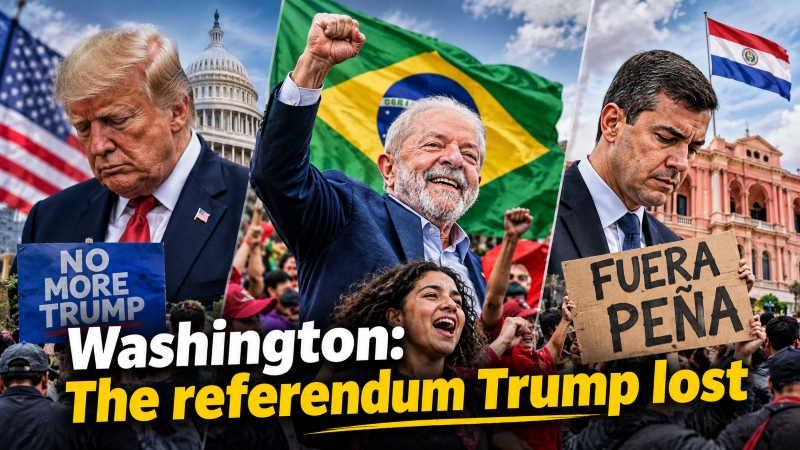
Washington: The referendum Trump lost
On 3 November, the Democratic Party regained control of both chambers of the US Congress.
Donald Trump had turned the election into a referendum on himself and asked his supporters to vote as if his name was on the ballot. The result was a clear rejection: the Democrats even made gains in strongholds like Texas.
For Latin America, what matters most is not the change in party control, but the weakening of the centre of gravity of the reactionary international. Trump served as a role model, symbolic financier and political guarantor for Flavio Bolsonaro, Javier Milei and Santiago Peña, among others. When the imperial centre loses internal strength, its satellites lose support.
Here it is worth recalling Atilio Borón: imperialism is not a government policy, but a structure. A Congress under the Democrats does not dismantle the Monroe Doctrine or the sanctions against Venezuela, but it does open cracks in Washington’s ability to impose its agenda without checks and balances, and those cracks are grounds for contention.
Brazil: Comeback from the streets
On 25 October, Luiz Inácio Lula da Silva won 51.8% of the valid votes compared to 48.2% for Flávio Bolsonaro, according to the Superior Electoral Court.
Three weeks earlier, in the first round, Flávio had won with 47.0% against 45.2%. Since the end of the dictatorship, no candidate who lost the first round had ever won the second.
- Sign up for Aliran's free daily email updates or weekly newsletters or both
- Make a one-off donation to Persatuan Aliran Kesedaran Negara (ALIRAN), Maybank a/c 507246118995 or CIMB a/c 8004240948
- Make a regular pledge or periodic auto-donation to Aliran
- Become an Aliran member
That comeback cannot be explained solely by campaign strategy. Activists took to the streets in massive marches in major cities, with a surge of leftist fervour not seen in decades. Lula, moreover, called out his opponent for what he was: a project tied to Milei’s austerity measures and the international right.
Paraguay: When capital devours its own
On 5 November, Santiago Peña resigned following the overnight closure of Ueno Bank due to a solvency crisis, which left its customers unable to access their money.
The final blow did not come from the opposition, but from Horacio Cartes, leader of the Colorado Party, who announced his faction’s support for impeachment.
The Paraguayan case differs from the other two: here, there was no popular victory at the polls. There is something even more revealing.
The model that promised order, financial stability and alignment with Washington ended up expropriating the savings of ordinary people. Peña, an economist trained at the Central Bank and the International Monetary Fund, embodied that neoliberal technocracy.
Legacy of bank failures
Asunción (capital of Paraguay) 2026 is not an isolated case. It repeats a scenario that Latin America has already experienced in Caracas in 1994 and in Buenos Aires in 2001: when the financial model collapses, the losses are socialised, and the political system that sustained it loses legitimacy.
Venezuela (1994)
- Nature of the event: Insolvency and massive bank failures. The banks ended up in technical bankruptcy due to fraud and a total lack of liquidity.
- Trigger: The collapse of Banco Latino, caused by the exposure of schemes involving self-loans, corruption and the granting of fraudulent loans.
- Measures taken: Government intervention, along with massive financial aid and the nationalisation of the failed banks.
- Cost to the government: The financial bailout represented a cost equivalent to between 18-31% of gross development product (GDP).
- Political consequence: It led to the total discrediting of traditional political parties, paving the way for Hugo Chávez’s subsequent rise to power.
Argentina (2001)
- Nature of the event: Freezing of funds by decree (‘Corralito’). The banks had the money, but the government prohibited citizens from withdrawing it.
- Trigger: A severe public debt crisis, a prolonged economic recession, and the imminent end of the convertibility regime (1 peso = $1).
- Measure implemented: Establishment of a strict weekly limit on cash withdrawals (initially set at 250 pesos/dollars).
- Cost to the government: Massive loss of international reserves and a sovereign default exceeding $100bn.
- Political consequence: The resignation of President Fernando de la Rúa and the succession of five presidents over a 13-day period.
Paraguay (2026)
- Nature of the event: Overnight closure of Ueno Bank due to a severe solvency crisis, leaving customers without access to their money.
- Trigger: Ueno Bank’s declaration of insolvency and the subsequent arrest of eight of its executives.
- Measures taken: Winding up of the bank by the Central Bank of Paraguay and the start of discussions on the use of the deposit insurance fund for savers.
- Cost to the government: Still to be determined.
- Political consequence: President Peña’s resignation in the face of the imminent threat of impeachment backed by his own party.
The three cases share a common logic: private profits during the boom, public losses during the crisis. It is always the small saver, the retiree and the working woman who saved what little she had in the bank who pays the price.
But history also teaches us that crisis alone does not produce alternatives.
In Venezuela, the 1994 collapse compounded the open wound of the 1989 Caracazo, and it was that accumulation of organised anger that found expression at the polls in 1998.
In Argentina, the ‘Que se vayan todos’ (let them all go) movement took shape in neighbourhood assemblies, among the piqueteros, and in the recovered factories.
The question for Paraguay is whether there exists today a grassroots movement capable of turning the outrage over Ueno Bank into a project of its own, or whether the Colorado Party will manage, once again, to manage its own crisis.
What the divide is not
An objective assessment of the current moment requires three necessary caveats.
The Democratic Party is not the left: Its victory puts the brakes on Trump, but it does not guarantee a change in policy towards Venezuela, Cuba or the rest of the continent. The history of Democratic governments in the region serves as a reminder.
Bolsonarism is still alive. It garnered nearly half the electorate, and in the first round, it gained ground in Congress and in state governorships.
In Paraguay, the Colorado Party is in charge. The ruling party itself is seeking to have Vice-President Pedro Alliana assume the presidency. This is an internal realignment of the right, not a rupture.
A task for popular power
What unites Washington, Brasília and Asunción is not a progressive wave, but the erosion of the same project: political authoritarianism, financial plunder and subordination to an imperial centre.
That project promised order and delivered a crisis. It promised security and delivered bankrupt banks, failed coups, and hatred as its agenda.
But the rifts close on their own if no one fills them. The Venezuelan experience teaches us that politics is not limited to the ballot box: it is built through popular power.
That is the lesson from Brazil: the comeback was possible because the people took to the streets.
For the peoples of the Global South, the question is not whether the right wing is retreating, but who decides what grows in the space it leaves behind.
If organised popular power does not occupy that space, it will be filled by new versions of the same project, with different faces. – Globetrotter
Carmen Navas Reyes is a Venezuelan political scientist with a master’s degree in Ecology for Human Development (UNESR). She is currently pursuing a PhD in Studies of Our America at the Rómulo Gallegos Foundation for Latin American Studies (Celarg) in Venezuela. She is a researcher at the Tricontinental Institute for Social Research.
The views expressed in Aliran's media statements and the NGO statements we have endorsed reflect Aliran's official stand. Views and opinions expressed in other pieces published here do not necessarily reflect Aliran's official position.
- Tegakkan maruah serta kualiti kehidupan rakyat
- Galakkan pembangunan saksama, lestari serta tangani krisis alam sekitar
- Raikan kerencaman dan keterangkuman
- Selamatkan demokrasi dan angkatkan keluhuran undang-undang
- Lawan rasuah dan kronisme
