

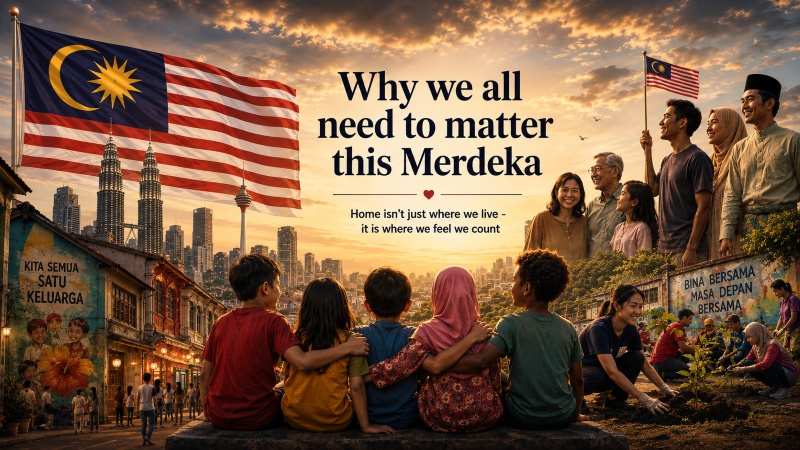
In this month of Merdeka (independence) and National Day, we think about our nation.
We think about home, and what it means to belong to a place called home.
To feel that we belong and matter somewhere, we need to feel valued. At the same time, we need to feel we can add value to the world around us.
What mattering means
The social psychologist Morris Rosenberg came up with the idea of mattering in the 1980s, while studying teenagers’ self-esteem.
Journalist Jennifer Breheny Wallace explores this further in her book Never Enough – When Achievement Culture Becomes Toxic – and What We Can Do About It. She says mattering begins in families, where children need to matter to their parents. It then extends outwards to the community and the wider world.
Mattering is both psychological and political.
It is psychological because it shapes our behaviour, thoughts and emotions. It addresses some of our most fundamental questions: “Am I valued? Does my presence make a difference in this world?”
- Sign up for Aliran's free daily email updates or weekly newsletters or both
- Make a one-off donation to Persatuan Aliran Kesedaran Negara (ALIRAN), Maybank a/c 507246118995 or CIMB a/c 8004240948
- Make a regular pledge or periodic auto-donation to Aliran
- Become an Aliran member
Mattering is therefore also political because it involves power dynamics that limit how much we feel we matter – at home, at work or in the community.
When it comes to mattering in the wider community, we need to strike a balance between adding value to ourselves and to others. Otherwise, entitlement may prevail. Without limits or laws, people or organisations can behave selfishly and destructively.
Mattering straddles rights and responsibilities, or the self and others.
Narcissism complicates mattering, because it satisfies only half of the equation – the half that prioritises the self.
Mattering and politics
Not wanting to sit with someone from a different political party might sound like a playground squabble.
But look closer, and a pattern of exclusion emerges – visible in the racial rhetoric around the recent Johor and Negeri Sembilan state elections.
One narrative framed the elections as contests for the political leadership of a specific majority. Another warned against a federal government said to be dominated by an ethnic minority.
Such narratives have been worrying. The insinuation that the nation belongs to only one ethnic group may have left some of us uneasy.
Often, we brush those remarks aside because we have grown used to them. Madness is part of life, and we make light of it. ‘Malaysia, truly Asia’ (a national tourism slogan), ‘Malaysia boleh’ (Malaysia can), we joke. Absurd statements from political elites make the headlines, and we laugh.
Home feels like home because of its familiarity, even when that familiarity is painful or downright maddening.
In Malaysia, as someone who is ethnically Chinese but raised with English as a first language, my poor grasp of Hokkien and Mandarin has raised eyebrows. It has even triggered gossip and ridicule among relatives and colleagues.
I am also risk-averse, and now a mother to a toddler. So I drive cautiously on Penang roads – a habit that puts me in the minority. My fellow motorists, avid honkers, never fail to remind me that there is, apparently, a minimum speed limit.
It has been said that home is a verb. For some, the quest to find familiarity, continuity and belonging is harder than for others.
Narcissism and inequality have something in common – some people’s lives matter more than others.
Poverty, inadequate education, poor living conditions and insufficient access to healthcare are not easy to deal with. People with low economic status suffer not just material deprivation, but also worth deprivation.
A deep sense of unfairness can be distressing for victims of inequality. It can lead to a lack of control and damaged self-esteem – and to a lack of mattering.
Building a fairer home
Research finds that social democratic policies that foster equality produce people who feel they matter.
Countries that promote socioeconomic justice and equality have societies with better physical and mental health, education, safety, social mobility, and life expectancy.
People living in countries with fair policies on health, education, labour market inclusion, and welfare report better life satisfaction.
Scandinavian policies, for instance, focus on high-quality public education, parental leave, high-quality day care, unemployment insurance and universal health insurance. This leads to less stress, fewer crimes and mattering experiences that are open to all.
We are currently facing not just a trust deficit, but a mattering one. We must push for mattering at home, in our workplaces, in communities and in policymaking.
Let’s build a society where equality and fairness win out over narcissism and entitlement.
Home is a process – unfixed and dynamic. We can all take part in this journey. Through small acts of kindness, or by joining movements for reform, we can help build a home where we all matter.
The views expressed in Aliran's media statements and the NGO statements we have endorsed reflect Aliran's official stand. Views and opinions expressed in other pieces published here do not necessarily reflect Aliran's official position.
- Tegakkan maruah serta kualiti kehidupan rakyat
- Galakkan pembangunan saksama, lestari serta tangani krisis alam sekitar
- Raikan kerencaman dan keterangkuman
- Selamatkan demokrasi dan angkatkan keluhuran undang-undang
- Lawan rasuah dan kronisme
