

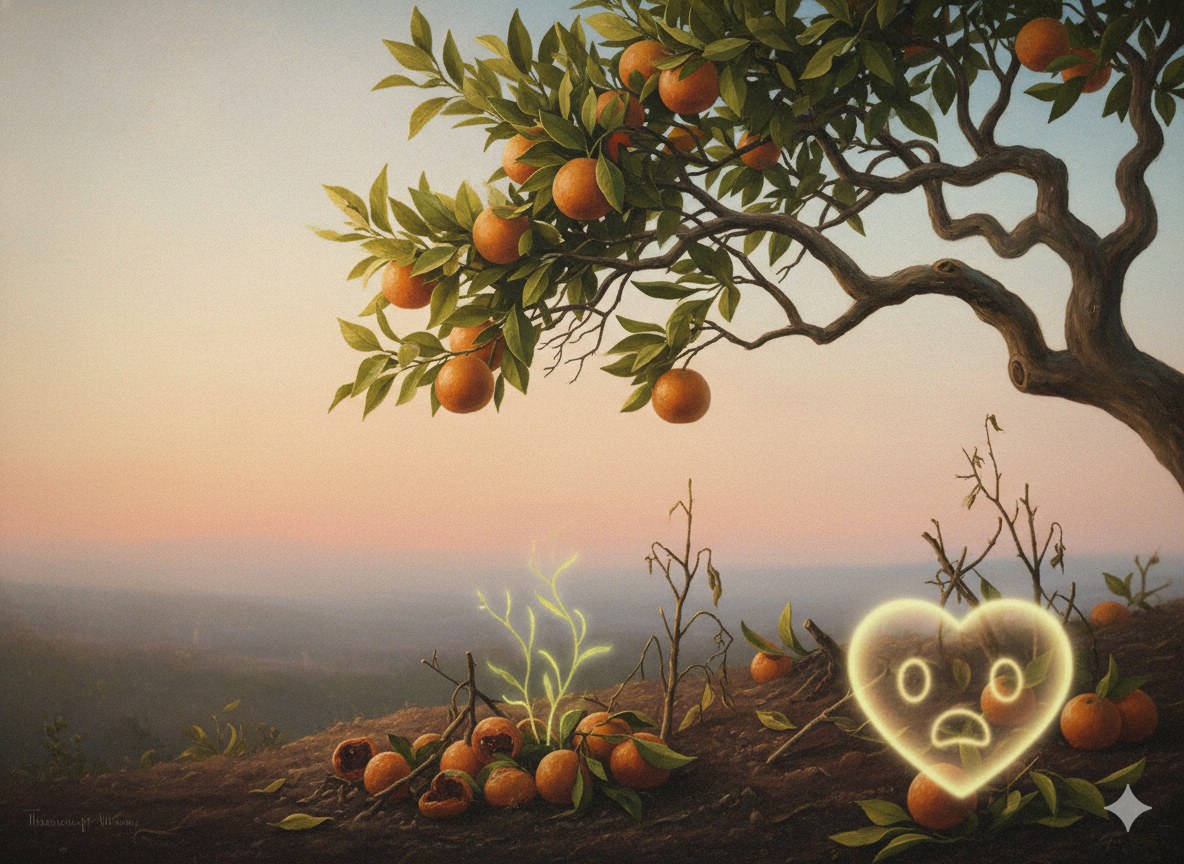
How calmly does the orange branch
Observe the sky begin to blanch
Without a cry, without a prayer
With no betrayal of despair
Sometime while night obscures the tree
The zenith of its life will be
Gone past forever
And from thence
A second history will commence
A chronicle no longer gold
A bargaining with mist and mold
And finally the broken stem
The plummeting to earth, and then
And intercourse not well designed
For beings of a golden kind
Whose native green must arch above
The earth’s obscene corrupting love
And still the ripe fruit and the branch
Observe the sky begin to blanch
Without a cry, without a prayer
With no betrayal of despair
O Courage, could you not as well
Select a second place to dwell
Not only in that golden tree
But in the frightened heart of me
I first encountered Tennessee Williams’ How Calmly Does the Orange Branch over six decades ago, when I was in Form Six.
- Sign up for Aliran's free daily email updates or weekly newsletters or both
- Make a one-off donation to Persatuan Aliran Kesedaran Negara (ALIRAN), Maybank a/c 507246118995 or CIMB a/c 8004240948
- Make a regular pledge or periodic auto-donation to Aliran
- Become an Aliran member
Williams was not one of our prescribed authors, but my literature teacher gave me a typewritten copy of the poem as a reward for a presentation I gave on some long-forgotten subject.
Though I read it many times and was moved by its rhythm and imagery, I did not truly understand what it meant. It stayed with me nonetheless, tucked away at the back of my mind like a message waiting for the right code to unlock it.
That code arrived years later at ITM, when I stepped in to cover a literature class for a teacher on maternity leave. Standing before the class and working through the verses, I began to catch a glimmer of meaning.
The poem, I realised, was about the profound courage we need to live in a world where the only certainty is our own decay.
What a thing to discover in a classroom.
Courage without a cry
In the opening lines, we are given an unusual image of calm acceptance: the orange branch observes the sky “begin to blanch” – to whiten, to fade – “without a cry, without a prayer” and crucially, “with no betrayal of despair”.
This is not simply a description of a branch on a tree. It is a portrait of the human spirit.
Williams looks upon this silent, dignified acceptance of the inevitable and recognises it as the ultimate form of courage – a calmness that holds even as “the plummeting to earth” draws near.
As I taught those lines, “the golden kind” Williams describes took on new weight. Despair, I came to see, is not the answer to our decay. Our task instead is to earn our golden hue, to “infuse purpose” into our lives – through raising families, helping those around us, committing to something larger than our own ambitions.
The second history
This aligns closely with existentialist thought, particularly the idea of “self-transcendence” described by Viktor Frankl.
This quality is not merely an internal state; it finds its most potent expression in our lives as inhabitants of this land.
When we commit to a movement like Aliran, we are essentially tending to a “native green” that extends far beyond our individual branches. By advocating for justice, transparency and the rights of the marginalised, we generate a “golden hue” through collective action.
This commitment transforms the fear of our own “blanching” into a purposeful contribution to the democratic health of our country. We begin to see that while our personal “chronicle” may eventually fade, the values we fight for – equality, freedom and integrity – form the “second history” that sustains the generations that follow.
By committing to a purpose larger than our individual survival, we effectively silence the noise of mortality. The “gold” we generate through our actions becomes a contribution to the “native green” that “arches above” the fallen fruit.
In this sense, the “golden kind” is not a status we reach for ourselves, but a light we generate for the wholeness of humanity. When we live with this level of commitment, death loses its terror. It becomes a homecoming to the process that sustained us – and a second history begins and a third and so on.
A larger cause
When I recite these lines today – 60 years after receiving that typewritten sheet – they feel less like literature and more like a message sent ahead of its time.
The poet watches the courage of the branch as it drops its fruit and begins its “second history”. He is asking for that same steadiness to inhabit his own “frightened heart”.
And mine.
In a world often fractured by “mist and mould”, choosing to act as a conscious individial is the ultimate refusal of despair. Whether within the borders of our nation or as members of a global community, our task is to witness the “plummeting” of old, corrupt systems and have the courage to plant the seeds of something better.
By aligning our “frightened hearts” with a cause larger than ourselves, we find that the “zenith” of our life is not a fixed point in the past, but a continuous light we provide for the wholeness of humanity.
In this shared struggle, we find the dignity to live beyond our own decay, so that our “golden kind” remains a part of the world’s enduring arc.
Our individual decay is a narrow view, unable to take in the larger process of which we are a part. In reality, we are part of a wholeness we cannot fully comprehend.
The views expressed in Aliran's media statements and the NGO statements we have endorsed reflect Aliran's official stand. Views and opinions expressed in other pieces published here do not necessarily reflect Aliran's official position.
- Tegakkan maruah serta kualiti kehidupan rakyat
- Galakkan pembangunan saksama, lestari serta tangani krisis alam sekitar
- Raikan kerencaman dan keterangkuman
- Selamatkan demokrasi dan angkatkan keluhuran undang-undang
- Lawan rasuah dan kronisme
