
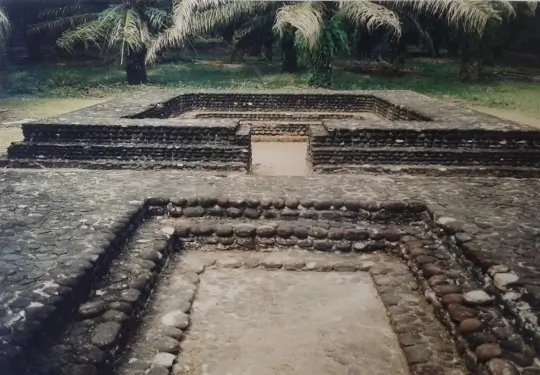
In Malaysia today, it is more than ever time to push for a people’s archaeology – one that regards heritage preservation as an act of resistance against capital-driven urbanisation and cultural erasure.
That, in turn, means examining the roles of colonial and post-colonial economic forces in shaping how we see history today.
Lost ancient temples
Under the National Heritage Act, an archaeological site is generally only protected once it has been officially gazetted by the minister.
Bujang Valley is vast – spanning over 1,000 sq km – and much of it remains unexcavated.
If a developer bulldozes an unexcavated candi (ancient temple) that has not been gazetted, they have technically broken no heritage law. On paper, the site simply does not legally exist yet.
- Sign up for Aliran's free daily email updates or weekly newsletters or both
- Make a one-off donation to Persatuan Aliran Kesedaran Negara (ALIRAN), Maybank a/c 507246118995 or CIMB a/c 8004240948
- Make a pledge or schedule an auto donation to Aliran every month or every quarter
- Become an Aliran member
The burden of proof falls on archaeologists and NGOs. They must prove a site’s historical significance before the bulldozers arrive. That is an almost impossible task, given how little state funding goes towards thorough, advance archaeological surveys.
The demolition of Bujang Valley’s candi reflects what the geographer David Harvey calls “accumulation by dispossession”.
The Malaysian state, in effect, allows parts of the cultural commons to be fenced off and sold – turning 1,500-year-old sites from shared historical heritage into privatised, commodified land.
Rewriting Malaysia’s history
Bujang Valley’s Indo-Buddhist culture was not just a matter of religious diffusion. It reflected the economic structures of the time.
The ruling class – probably merchant elites and local rulers – controlled trade and resources.
The labouring classes – craftsmen, traders and possibly bonded labour – produced goods and built infrastructure such as temple complexes and jetty-ports.
Brahmanical and Buddhist artefacts point to what the philosopher Louis Althusser called ideological state apparatuses. These were religious systems that framed the ruling class’s power as sacred or divinely sanctioned, reinforcing their control by making it look natural rather than imposed.
Reinterpreting Bujang Valley’s Indo-Buddhist influence from a progressive perspective means recognising how archaeology, history and politics are deeply intertwined.
Malaysia’s national history is shaped by dominant power structures: the state, capital, property-owning elites and global economic forces.
Official Malaysian historiography tends to downplay pre-Islamic and Indo-Buddhist influences. Instead, it favours a Malay-Islamic historical continuity that reflects the ethno-nationalist priorities of the post-colonial state.
Since the New Economic Policy, the post-colonial Malaysian state – dominated by Malay ethnocapitalist elites – has selectively promoted an Islamic-Malay historical framework. It has also minimised pre-Islamic community and cultural diversity.
This post-NEP restructuring of history prioritises Malay ethno-capital accumulation over a more pluralistic account of society – one in which politics and religion are shaped mainly by elite capital capture under shifting economic conditions.
Profit over the past
The apparent suppression of Indo-Buddhist heritage can be read as an ideological erasure, necessary for consolidating a unified Malay-Muslim community aligned with state capitalism.
In world-systems terms, Bujang Valley functioned as a semi-periphery, dependent on both the Chinese and Indian economic cores.
Unlike later sultanates, which consolidated power through feudal land ownership and tribute systems, Bujang Valley’s power rested on merchant capital and long-distance trade.
This suggests Malaysia’s early economy was not purely agrarian. It was linked to proto-capitalist formations, where control over trade routes determined power.
The eventual decline of Indo-Buddhism coincided with shifting capitalist world orders – particularly the rise of Islamic trade networks from West Asia, which reorganised regional economic and ideological structures.
Malaysia remains a semi-peripheral state today. It occupies a contradictory position: neither a core economy that sets the terms of global capital, nor a peripheral zone that merely supplies raw materials.
Instead, it’s compelled to compete – to attract foreign direct investment, to show off ‘development’ through visible infrastructure, and to mimic the urbanisation patterns of the Global North.
The state becomes, in effect, a competitive, authoritarian developer, using control over land as a tool to signal investment-friendly policies.
Heritage preservation gets framed as an obstacle to competitiveness. It is presented as a luxury semi-peripheral states supposedly cannot afford if they want to “catch up” and “beat the rising tide” (stay ahead of rising global competition) – to borrow the kind of language found in World Bank slogans.
The refusal to build meaningful archaeological protection into national development policy shows how heritage is subordinated to real estate speculation and elite interests under financial capitalism.
Malaysia’s neoliberal economy, with its focus on land privatisation and rapid development, mirrors colonial-era extractive capitalism – where historical preservation is treated as an obstacle to profit.
Under financialisation, land stops being valued for its use as a site of memory, spiritual significance or archaeological knowledge. It is reduced purely to its exchange value. It becomes a speculative asset: a vehicle for capital accumulation, and a form of collateral for credit expansion.
The “vulture capital” metaphor fits well here. Financial capital circles spot undervalued assets – in this case, state land sitting above heritage – and extracts maximum short-term profit through rapid turnover: housing developments, industrial parks, commercial zones.
The candi isn’t merely destroyed but liquidated. Its cultural value becomes invisible in developers’ balance sheets and state revenue projections.
The short time horizon of finance capital – annual returns, election cycles – is fundamentally incompatible with the deep time of archaeology.
This creates a dependency trap. The Kedah state government is structurally dependent on land-based revenue and foreign investment – regardless of its political colouring, whether Pas, Barisan Nasional or Pakatan Harapan. It needs these to fund its operations, create jobs and maintain its position within the national and global capital hierarchy.
The demolition of candi is not really an ideological choice against Hindu-Buddhist heritage. It is a structural imperative of semi-peripheral capitalism.
The state becomes what some scholars call a ‘local fix’ for global capital’s need for new frontiers of accumulation. It absorbs the violence of dispossession, while the profits flow to transnational developers, dressed up as the symbolic capital of “modernisation”.
A counter-hegemonic narrative on Bujang Valley reveals Malaysia’s pre-colonial class dynamics, its dependency within global trade networks, and the modern state’s manipulation of history.
By reclaiming a truer understanding of the past, it becomes possible to resist the destruction of heritage for profit – and to challenge a nationalist historiography that serves the ruling ethnocapital elites and their partners in global finance.
AGENDA RAKYAT - Lima perkara utama
- Tegakkan maruah serta kualiti kehidupan rakyat
- Galakkan pembangunan saksama, lestari serta tangani krisis alam sekitar
- Raikan kerencaman dan keterangkuman
- Selamatkan demokrasi dan angkatkan keluhuran undang-undang
- Lawan rasuah dan kronisme








There’s a lack of one true strong argument there to justify towards nation building identity albeit a mild persuasion to tickle the conscience.
Author, what is the value/relevance of such past to current or future identity of this nation? Tourists to marvel at restored sites? Academics updating their own knowledge?
Aliran racial perspective
A bias repoting
Perhaps re-pist in normal English without so many intellectual used buzz words if you want support from ordinary people.
It’s just an extension of what we’ve seen for decades with Malaysia’s natural heritage – the lack of protection for forest reserves, and often (apparent) complicity in their destruction.
Any country blind to its true histoer and living on narratives created to satisfy political or fantastical beliefs can never have a future that it can be proud of since they ddnied their cery origins
Sounds like Singapura isn’t it