

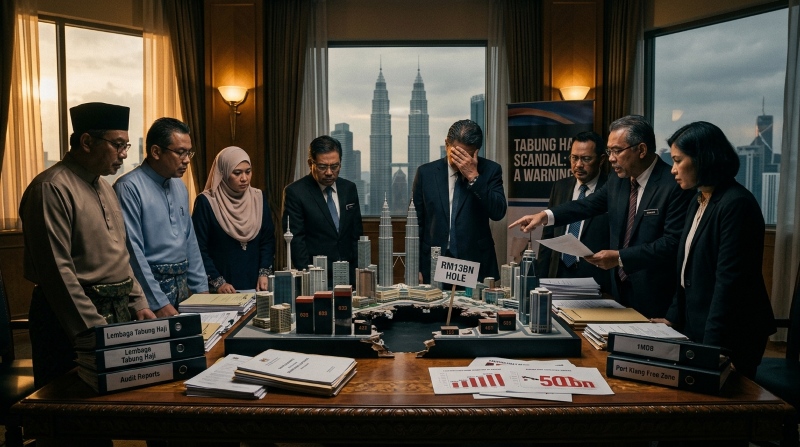
The Royal Commission of Inquiry into Tabung Haji’s governance has asked a simple question: who pays for it, and who answers for it? Are they the same people?
They are not. That gap matters because it will outlast every structural reform now on the table.
The balance sheet gap
In 2018, the government moved 106 listed shareholdings, a plantation company and 29 properties out of Tabung Haji. They went into Urusharta Jamaah Sdn Bhd, a special-purpose vehicle set up to absorb the fund’s bad assets.
The government paid RM19.9bn for assets independently valued at roughly RM9.7bn.
This RM10.2bn gap between what those assets were worth and what taxpayers paid for them is not a rounding error. It is the price of restoring Tabung Haji’s balance sheet to solvency, and of naming who made it insolvent in the first place.
Former Bank Negara Malaysia deputy governor Sukhdave Singh put the imbalance plainly. In a LinkedIn post responding to the government’s initial decision to withhold the royal commission’s report, he said taxpayers meet their obligations because the law leaves them no choice. It has proven far easier for governments to squeeze compliant people, he argued, than to demand a reckoning from the people who depleted the fund in the first place.
That is a precise description of how the cost of institutional failure and the consequence for causing it have been kept in separate ledgers.
- Sign up for Aliran's free daily email updates or weekly newsletters or both
- Make a one-off donation to Persatuan Aliran Kesedaran Negara (ALIRAN), Maybank a/c 507246118995 or CIMB a/c 8004240948
- Make a regular pledge or periodic auto-donation to Aliran
- Become an Aliran member
The debate is sometimes wrongly framed as a matter only for Muslims. Every taxpayer has standing to ask where RM10.2bn of public money went, regardless of their own relationship to the Hajj.
A pilgrim fund financed partly by general taxation is a public accountability question before it is a religious one.
Rules without teeth
The royal commission’s headline legislative fix – amending the Tabung Haji Act 1995 to bar active politicians from the board and require “fit and proper” appointments – is necessary.
But Malaysia has recent experience of a statute that existed in full and changed nothing.
The Pathology Laboratory Act 2007 was gazetted but neglected for years and never enforced. That was because the implementing regulations needed to give it force – its “punca kuasa” (source of authority), in the Ministry of Health’s own words – were never completed.
Tabung Haji’s reforms need a fit-and-proper requirement. But without an ongoing conduct review mechanism behind it, the rule risks becoming another law that exists on paper while staying absent in practice.
Singapore’s regulatory tradition offers a genuinely different model – not because it is more punitive, but because of where it aims.
Malaysian practice tends to go the other way. When a public institution’s failure threatens confidence in the whole system, the government usually absorbs the loss and issues a guarantee.
The Urusharta Jamaah transfer is exactly this pattern. Tabung Haji’s own uncapped section 24 deposit guarantee is its standing version.
Singaporean statute, by contrast, gives courts and regulators the power to issue a remedial order. This is a legal instrument that requires the party responsible for a breach to fix it directly, in addition to or instead of a fine (Consumer Protection (Fair Trading) Act 2003, section 70, Singapore).
The Monetary Authority of Singapore’s enforcement toolkit similarly includes prohibition orders. These bar individuals from continuing to hold positions of trust in the financial sector – not just monetary penalties (Kroll, n.d.).
The distinction matters because it changes who the corrective action is aimed at.
A government guarantee repairs the institution’s balance sheet and leaves the decision-makers untouched.
A remedial or prohibition order repairs the institution by acting on the people who broke it. It can also bar them from the positions that let them do it again.
Tabung Haji’s own history shows why this distinction is not academic. The royal commission’s forensic audit list names 14 separate investments for further scrutiny, beyond Al-Rawda alone, the investment scandal that triggered the inquiry. These include TH Indo Plantations, Emrail, Wellspring Worldwide, Trurich Resources and Abraj.
This is not the record of one bad deal. It is a pattern that survived multiple governments because the people responsible were never the ones who paid for being wrong.
The Tabung Haji episode exposes how far this went. Then-chairman Abdul Azeez Abdul Rahim held eight concurrent chairman or director posts across Tabung Haji subsidiaries, while sitting as an MP and an Umno supreme council member. A former chief executive sat on 18 subsidiary boards, and a former chief financial officer on nearly 24.
The test ahead
None of the royal commission’s structural recommendations address who pays when the next Al-Rawda happens – not the bar on politicians, not the Securities Commission-regulated Dana Haji department, not audited-accounts-only distributions. Instead, they address who gets appointed and how investments get approved.
Whether Tabung Haji’s reforms close the gap between the balance sheet and the boardroom depends on two things.
First, will the forensic audits that the royal commission ordered produce findings against named individuals?
Second, will those findings lead anywhere beyond another taxpayer-funded repair?
The stakes for the current government are high. Tabung Haji reported a RM3.4bn profit for the 2017 financial year. Under properly audited standards, it should have shown a RM1.4bn loss.
This did not arise from a supervisory vacuum in the usual sense. Section 22 of the Tabung Haji Act already prohibited declaring a distribution when liabilities exceeded assets.
‘GLC capture’ – a term used elsewhere in Aliran commentary, and in Gomez’s (2017) account of Malaysia’s government-linked investment companies – shows how control concentrates.
It rarely happens through one single instrument. Instead, it comes through interlocking directorships, appointment powers and the collapse of distance between ownership and oversight.
Tabung Haji’s variant is distinctive in one way. Its capture pathway ran through dual ministerial custody – religious affairs and finance both claiming partial responsibility – rather than through the Minister of Finance Incorporated structure. The latter is the structure Gomez traces for the seven major government-linked investment companies, of which Tabung Haji is one.
The royal commission’s own diagnosis of “too many layers and deliberations” producing bad decisions describes something else too. It resembles a Gramscian trasformismo (transformism – the absorbing of dissent to preserve the existing order) in miniature.
Put simply, institutional process appears to absorb and neutralise scrutiny, without ever requiring anyone to formally own up or follow through with compliance.
The views expressed in Aliran's media statements and the NGO statements we have endorsed reflect Aliran's official stand. Views and opinions expressed in other pieces published here do not necessarily reflect Aliran's official position.
- Tegakkan maruah serta kualiti kehidupan rakyat
- Galakkan pembangunan saksama, lestari serta tangani krisis alam sekitar
- Raikan kerencaman dan keterangkuman
- Selamatkan demokrasi dan angkatkan keluhuran undang-undang
- Lawan rasuah dan kronisme
