

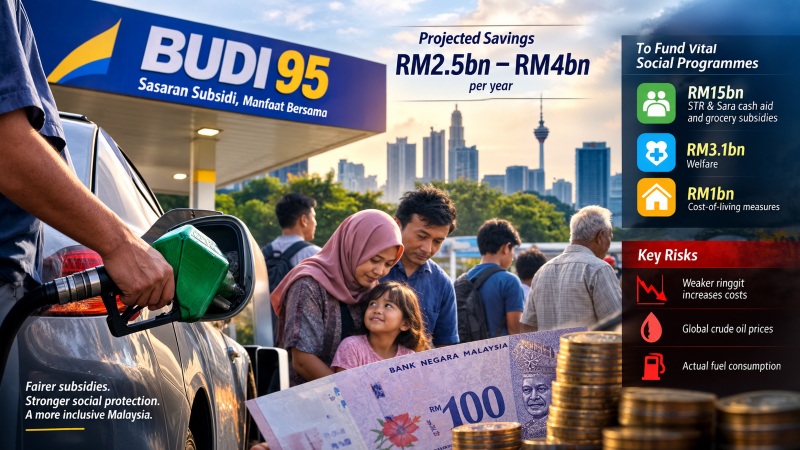
The Malaysian government’s shift to targeted Ron 95 fuel subsidies, known as Budi 95, is a major milestone for public money.
It is projected to save between RM2.5bn and RM4bn a year.
These savings are not just abstract numbers. They can help fund vital social welfare.
However, a closer look reveals weaknesses. These projected savings are highly vulnerable to a weaker ringgit. That poses a serious risk to goals that social justice advocates support.
The exchange rate trap
The Ministry of Finance has explicitly said the Budi 95 savings depend on three things: global crude oil prices, exchange rate movements and actual fuel consumption.
This is a crucial admission.
With another rise in the Ron 95 price recently, the government will absorb RM2.58 per litre in subsidies.
- Sign up for Aliran's free daily email updates or weekly newsletters or both
- Make a one-off donation to Persatuan Aliran Kesedaran Negara (ALIRAN), Maybank a/c 507246118995 or CIMB a/c 8004240948
- Make a regular pledge or periodic auto-donation to Aliran
- Become an Aliran member
Because crude oil is priced in US dollars, a weaker ringgit automatically makes fuel more expensive for the government to buy. Even if people use the same amount of fuel, a falling ringgit will shrink the projected savings.
These forces are beyond Malaysia’s immediate control.
At first glance, RM2.5bn to RM4bn seems modest against Malaysia’s RM470bn Budget 2026. If a weaker ringgit wiped out these savings entirely, the deficit-to-gross domestic product (GDP) ratio would barely change.
But this is where the social justice implication becomes clear. These savings are not a one-off bonus. They are a crucial part of the 13th Malaysia Plan to reduce the national deficit to below 3% by 2030.
More importantly, the government has earmarked these savings to fund progressive social programmes. They include RM15bn for the STR and Sara cash aid and grocery subsidies, RM3.1bn for welfare and RM1bn for cost-of-living measures.
Who bears the risk
Here lies the major dilemma. If a weaker ringgit shrinks the savings, the government will face a serious fiscal problem.
Those savings help pay for cash transfers to the bottom 40% and middle 40% of households.
Politically and morally, it is very difficult to cut promised cash aid to vulnerable households while the country is still carrying out its development plans. Doing so would betray public trust and worsen inequality.
The risk is that the top 15% of earners will not absorb the shortfall. Instead, it could lead to cuts in essential public services, healthcare or education, or force the government to borrow more.
Adding to this risk is the reality on the ground. As of mid-2026, the framework to exclude the top 15% through the Padu database is still in “operational refinement”.
It is uncertain whether this targeting system can absorb shocks from currency swings. The system may accidentally pass these costs to middle and lower-income groups, who often suffer most from imperfect systems.
The deeper problem
Nearly two-thirds of wage earners in Malaysia were in semi-skilled and low-skilled jobs in 2025. Their median monthly wages were RM2,223 for semi-skilled workers and RM1,758 for low-skilled workers, according to the Department of Statistics.
The country is stuck in a middle-income trap, marked by stagnant private investment. We depend on low-wage foreign labour in some sectors. We also do not generate enough high-productivity jobs in either traded or non-traded sectors, according to Iseas.
The IMF says Malaysia’s challenge is to raise productivity among the large numbers of workers in non-traded services and in the micro and small firms that dominate employment.
Micro, small and medium-sized enterprises make up over 97% of all businesses. They contributed 39.7% (RM689.8bn) of GDP.
Our total factor productivity is low. Spending on research and development is a miserable 1% of GDP, well behind Singapore (2.2%), China (2.6%), Japan (3.4%), Taiwan (3.5%) and South Korea (4.9%).
Labour productivity is sluggish because high-skill job creation lags far behind the expansion of tertiary education. Such jobs are often concentrated in lower value-added services, such as wholesale and retail, food and accommodation, and transport.
Meanwhile, underemployment is widespread. Many graduates and holders of technical and vocational qualifications work below their skill levels.
This creates wage penalties and dilutes the returns on people’s education and skills (human capital), according to the World Bank.
Yet structural constraints tied to ethnic-based economic policy make coordinated action hard. These embedded structures weaken merit in vocational systems and limit the spread of management practices and technology.
They also pull policy attention towards ethnic-based equity targets and away from the economy’s overall productive capacity, according to the IMF.
Economy Minister Akmal Nasrullah Mohd Nasir acknowledged recently that Malaysia should look beyond the headline value of investments. He said the focus should be on whether they create better-paying skilled jobs, raise productivity and strengthen local companies.
He said investments should be judged not only by the number of jobs created but also by how many skilled and semi-skilled jobs they generate, whether local vendors benefit, and whether productivity and workers’ skills improve (The Edge Malaysia, 21 September 2026).
Under the Gear-up programme, government-linked investment companies have committed RM120bn over five years. About RM10bn more has gone into venture and growth funds such as Dana Perintis, Dana Permaju and Dana Impak.
These ventures favour government-linked companies rather than the medium-sized manufacturing sector, where most jobs are.
Where current governance falls short is that, after winning on a reform mandate, the government still relies on a patronage-style relationship between state and business. The underlying ownership structure was never confronted or restructured.
It was not a failure of will. It was a failure of institutional design.
Using Peter Evans’ concept of “embedded autonomy”, we could move beyond the technocratic developmental state towards genuine stakeholder governance. But we never do.
In a September 2026 Finance & Development essay ‘Rethinking development’, Gordon Hanson, Dani Rodrik and Rohan Sandhu (from the IMF and Harvard) argue that the classic model of structural transformation has lost its potency. That model paired export-oriented industrialisation with broad tertiary education.
Manufacturing has become more capital-intensive, more skill-intensive and less labour-absorbing. Geopolitical fragmentation, automation and climate constraints limit its potential to create jobs even further.
Without institutional reforms, expanding technical and vocation education or service-sector industrial policy risks remaining superficial. Such reforms would cut the handing out of unearned advantages, improve transparency and competition, and reward capability and productivity, while still addressing legitimate equity concerns.
Success needs more than technical fixes to skills and firm capabilities. It also needs a deliberate move away from the patronage-based model towards institutions that reward productivity, experimentation and inclusive growth.
Otherwise, an economy that depends on oil and gas stays at the mercy of forces beyond its control. Since crude oil is priced in US dollars, a weaker ringgit costs the government more to buy, and the people lose real economic benefits.
Indeed, the government will find it hard to meet its budget targets, according to ANZ forecasts. ANZ expects the fiscal deficit to reach 3.7% of GDP in 2026, above the 3.5% target.
For advocates of social justice, the picture is clear. Fiscal policy is not just accounting. It is about people’s livelihoods.
The government must be open about how fragile these subsidy savings are. If a weaker ringgit threatens funding for social safety nets, the answer cannot be to cut aid to the poor.
Instead, the top 15% should pay their fair share. Where are their wealth taxes? Government-linked investment companies also have a national duty to help build shared prosperity.
The national budget must stay resilient enough to protect the most vulnerable, whatever happens to global currencies. True fiscal responsibility means putting the people first.
The views expressed in Aliran's media statements and the NGO statements we have endorsed reflect Aliran's official stand. Views and opinions expressed in other pieces published here do not necessarily reflect Aliran's official position.
- Tegakkan maruah serta kualiti kehidupan rakyat
- Galakkan pembangunan saksama, lestari serta tangani krisis alam sekitar
- Raikan kerencaman dan keterangkuman
- Selamatkan demokrasi dan angkatkan keluhuran undang-undang
- Lawan rasuah dan kronisme
