
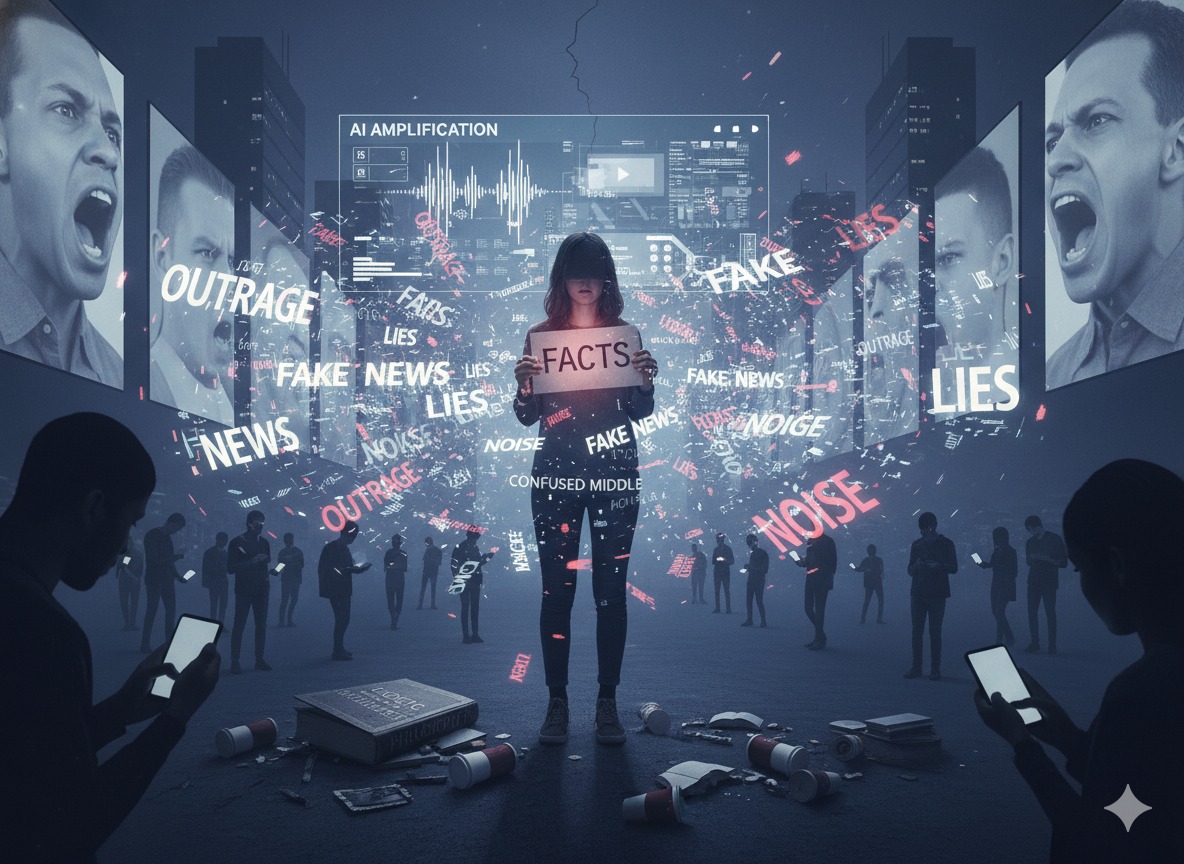
Lately, as I watch videos, read headlines and observe how people react every single day, one uncomfortable thought keeps returning to me: we are slowly reaching a point where we can no longer tell the difference between a doer and a noisemaker. And that scares me.
I’m not saying this as a political analyst or an academic. I’m saying this as someone on the ground, watching how narratives are formed, how emotions are triggered and how quickly people accept what suits their feelings rather than what stands on facts.
Natural stupidity used to hide. Now it walks around like it owns the place. And artificial intelligence does not correct it. It amplifies it.
Noise is rewarded. Anger spreads faster than understanding. Outrage travels further than truth.
We live in a time where the loudest voice is mistaken for leadership, where popularity is confused with competence and where those who shout the most are assumed to be doing the most. Social media has turned reaction into relevance.
- Sign up for Aliran's free daily email updates or weekly newsletters or both
- Make a one-off donation to Persatuan Aliran Kesedaran Negara (ALIRAN), Maybank a/c 507246118995 or CIMB a/c 8004240948
- Make a pledge or schedule an auto donation to Aliran every month or every quarter
- Become an Aliran member
A ten-second clip, ripped out of context, now matters more than a decade of actual work.
Corruption does not even shock anyone anymore. It is debated, justified, rationalised.
But look at what actually happens when corruption takes root. Prices do not just rise slightly. They explode – ten times, fifty times. I have even seen cases where things cost a hundred times more.
So, inflation does not happen by accident. Public suffering does not come from nowhere.
Someone made decisions, someone benefited and too many people were distracted.
What worries me more than corruption itself is how easily people are diverted from questioning it.
And that is where I start to see something darker – something many political and sociological thinkers have warned about for years, though rarely spoken about openly. It is the slow, deliberate weakening of a nation’s ability to think.
This is happening not by force and not by censorship alone – but by exhaustion, distraction and emotional manipulation.
Think about education. It slowly shifts away from teaching people how to think and focuses instead on what to memorise. Critical questioning becomes uncomfortable.
Meanwhile, logic, philosophy and deep reasoning are sidelined. People are trained to pass exams, not to challenge narratives.
When thinking becomes shallow, manipulation becomes child’s play.
Meanwhile, information gets polluted. Much of the media prefers sensation over substance. Trivial scandals dominate attention whilst serious policy discussions fade into the background.
Misinformation is repeated so often that people no longer know what is real. Algorithms feed users what they already believe, trapping them in echo chambers where opposing views feel like attacks instead of opportunities to reflect.
This is why I keep reminding people – speak with facts and do your research. Don’t just watch and listen. Verify, question and stop to reflect.
Not too long ago, we saw how dangerous this can be when false claims about land and sovereignty involving Sabah spread rapidly online. Emotions ran ahead of facts. Anger arrived before understanding. By the time explanations surfaced, the damage had already been done.
This is how trust dies – not because truth disappears, but because people stop waiting for it.
Then there are the culture wars. Race, religion, identity – sensitive issues are constantly reignited, not to resolve anything, but to keep people fighting each other.
When society is busy arguing horizontally, no one looks upward. Emotion and loyalty replace logic and accountability. Religion, which should guide humility and conscience, becomes a tool to provoke and divide.
Dependency creeps in. Economic pressure limits independence. Small players struggle, people rely more on systems they don’t understand and survival becomes the priority.
When society is tired and dependent, it does not think long term. It reacts – and reaction is the easiest thing to control.
Even institutions hollow out. Competence is replaced with loyalty. Yes-men rise. Systems still exist on paper, but their spirit dies. Checks and balances weaken not with a bang, but with silence.
None of this happens overnight, and none of it works unless society allows it.
The real danger is not the loud manipulators. They have always existed.
The real danger is the confused middle – fence-sitters who no longer know who is genuine, young minds who think views equal value, people who forward content without checking facts because ‘it feels right’.
Weak minds are not born but shaped.
Repetition makes lies feel familiar. Familiarity makes them feel true.
And when noise is constant, silence begins to feel suspicious.
So what happens to us? We do not suddenly lose freedom but trade it away slowly – for convenience, for emotional comfort and for the illusion that ‘as long as I’m OK, it’s not my problem’.
By the time a society realises what it has lost, the surrender has already happened internally.
You want to know the most dangerous moment for any nation? It is not when people are angry. It is when people are confused – when they can no longer separate action from performance, leadership from popularity, truth from noise.
If we lose the ability to recognise a doer, we will end up celebrating the very people who are hollowing society out from within.
This is not pessimism. This what I am seeing – and observations, when ignored long enough, become consequences.
AI will continue to grow smarter, and that is inevitable.
The real question is whether humans will – whether we choose thinking over shouting, facts over feelings, substance over spectacle.
When intelligence, whether natural or artificial, is separated from ethics, empathy and accountability, what we get is not progress. We get noise.
And noise, left unchecked, does not just confuse a society, it destroys it.
AGENDA RAKYAT - Lima perkara utama
- Tegakkan maruah serta kualiti kehidupan rakyat
- Galakkan pembangunan saksama, lestari serta tangani krisis alam sekitar
- Raikan kerencaman dan keterangkuman
- Selamatkan demokrasi dan angkatkan keluhuran undang-undang
- Lawan rasuah dan kronisme
