
My late father was an active man in his 60s. He drove to the Penang Botanic Garden every morning to exercise with friends.
Those routines – driving, walking, socialising, charity work – were the pillars of his independence and purpose in life.
Then, at 70, he slipped and fell while walking from the car park to the lift of his apartment. It seemed minor at first, but then he lost his mobility and independence, became depressed and his health deteriorated. Eventually he suffered a stroke.
The last decade of his life was marked by isolation and misery.
Mobility is not just about driving from point A to point B. It complements mental health, social connection and self-worth.
The illusion of permanent driving
- Sign up for Aliran's free daily email updates or weekly newsletters or both
- Make a one-off donation to Persatuan Aliran Kesedaran Negara (ALIRAN), Maybank a/c 507246118995 or CIMB a/c 8004240948
- Make a pledge or schedule an auto donation to Aliran every month or every quarter
- Become an Aliran member
Many people in Malaysia assume they will drive for as long as they live. Our cities are built around this assumption. Wide roads, narrow or broken walkways, disconnected cycling paths and bus stops without shelter all send the wrong message: you are expected to drive.
The government subsidises Ron 95 petrol at RM1.99 per litrefor eligible Malaysian citizens under the Budi 95 scheme, while the unsubsidised market price sits at around RM2.60 per litre for Ron 95 and higher for Ron 97.
But ageing does not negotiate. Friends in their 50s and 60s are already dealing with aching joints, deteriorating night vision and slower reflexes. Some avoid driving at night while others limit long-distance travel. Few talk openly about the anxiety of losing their licence or confidence.
Yet we rarely plan for this stage of life. We talk about retirement savings, medical insurance and Employee Provident Fund withdrawals. But we do not talk about how we will get to the clinic, the market or a friend’s home when we can no longer drive safely.
If our answer is “depend on a partner or family”, then we have failed both older people and the younger generation who must shoulder that burden.
Why active mobility?
I regularly commute from Taman Desa to KLCC and back, passing through Old Klang Road, Mid Valley, Pasar Seni, Chinatown and KL Sentral.
For this 25km round trip, I have three options: drive my own car, take the bus and monorail, or cycle door to door. As I already own a car, I do not consider ride-hailing because of its high fares for a single commuter.
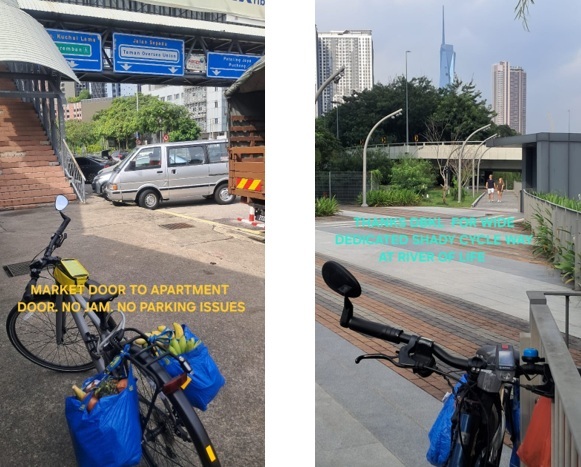
Twice a week, I choose to cycle. Some friends ask why I put myself through the heat, the traffic, the “danger” and the occasional impatient honk.
The answer is simple: I am training for that day I can no longer drive, while cycling keeps me healthy enough to delay that day.
Cycling is one of the most sustainable, efficient and predictable forms of active mobility. Taman Desa to KLCC takes a predictable 60 minutes, or a slower 80 minutes when tired.
The benefits include exercise, mental relaxation, door-to-door convenience, no parking hassle, a predictable journey time independent of traffic – all while listening to podcasts.
On some days I use another form of active mobility: walking, then bus and monorail.
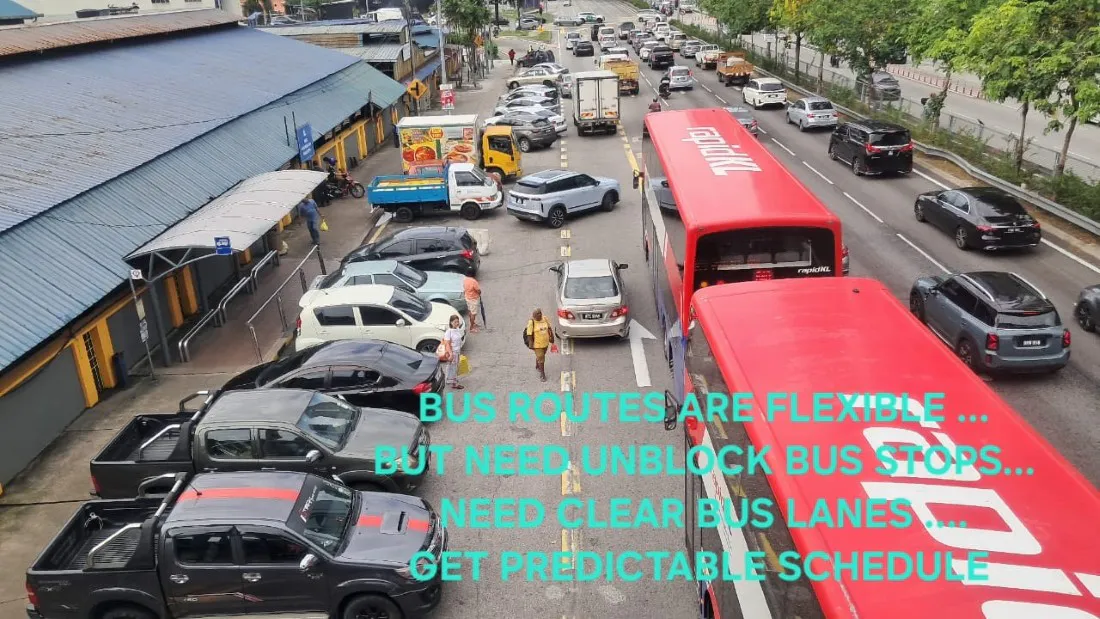
From my apartment door, I walk 10 minutes (300m) to the nearest bus stop, wait an average of 15 minutes for a Rapid KL Route 650 bus from Taman Desa to Pasar Seni, then transfer to the monorail or elevated light rail to KLCC and back. The door-to-door time can range from 60 to 100 minutes one way.
The benefits are low cost and the ability to be productive – or simply nap. The drawbacks are unpredictable arrival times because of long waits and buses getting stuck in Brickfields or in the bus lane.
When I need to carry bulky things, I have to drive, which can take 30 to 80 minutes door to door, depending on traffic and parking. Driving is stressful, unproductive, energy-inefficient and environmentally costly.
Active mobility as preparation
At my mid-60s, this is no longer an abstract concern. It is a practical reality. Active mobility is not a lifestyle accessory. It is preparation for sustainable independence, better health and social participation.
Cycling twice a week is my small act of preparation. It keeps my legs strong, my balance intact and my cardiovascular system active. More importantly, it keeps me confident, navigating streets without a car.
Walking to the bus stop, waiting under a proper shelter and taking public transport should not be seen as a last resort. It should be a normal, dignified option.
From personal practice to public advocacy
My concern with mobility is not limited to my personal commute. Over the years, I have learnt from NGOs and civil society groups that advocate active mobility.
The Penang Transport User Association (Petua) advocates for active mobility under the banner of “moving people, less cars”, using modes that are “better, cheaper, faster (to implement)” – buses, vans and ferries – alongside shady and inclusive bus shelters, safer walkways and crossings.
Without safe, comfortable and convenient first-and-last-mile connectivity, public transport will always lose to the private car.
Congestion is not solved by building more roads but by giving people viable alternatives such as more frequent and reliable buses and ferries.
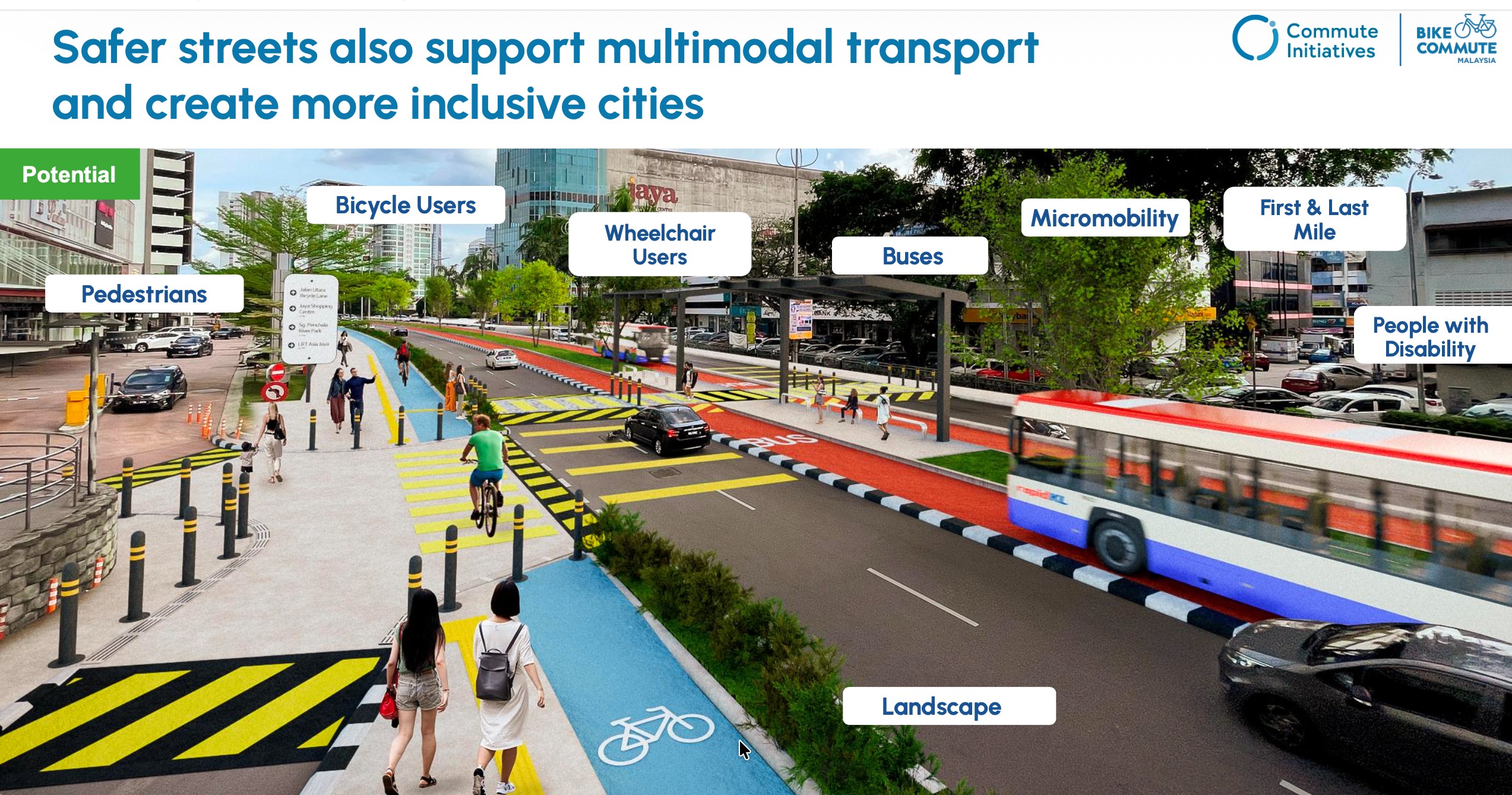
Bike Commute Malaysia (BCMY) promotes safer street design by empowering local councils to build safer, more sustainable and efficient streets, featuring traffic calming and speed limits enforced through infrastructure and design.
Streets made safer for people with disabilities, older people elderly and schoolchildren benefit everyone.
Do support BCMY’s current campaign for 30kph school zones. If we do not design our streets properly now, we are designing isolation into our future.
Greenpeace reminds us that active mobility is also about clean air and a sustainable environment. Every unnecessary car trip adds to the pollution that harms our lungs and worsens the climate crisis.
Aliran, the first NGO I joined, has long provided a platform to write about justice, democracy, inclusivity, equity and sustainability. Active mobility touches on all of these.
What the people really need
The debate about transport is often framed around congestion, infrastructure projects, highways, trains, petrol subsidies or car prices.
But we need to ask a deeper question: what kind of sustainable mobility do the people need? Do we want to live in neighbourhoods where we can walk to the shops, cycle to school and take a bus to work without feeling vulnerable?
When my late father stopped going out, his world shrank to the size of his apartment. That is a fate many people in Malaysia may face if we continue to build car-dependent cities.
Active mobility is not anti-car. It is pro-choice. Twice a week, as I cycle that 25km from Taman Desa to KLCC and back, I am not only exercising but also rehearsing for the future.
This people’s mobility series is our collective rehearsal, building towards a civil society people’s manifesto on mobility and transport. The real question is whether our cities will rehearse with us.
AGENDA RAKYAT - Lima perkara utama
- Tegakkan maruah serta kualiti kehidupan rakyat
- Galakkan pembangunan saksama, lestari serta tangani krisis alam sekitar
- Raikan kerencaman dan keterangkuman
- Selamatkan demokrasi dan angkatkan keluhuran undang-undang
- Lawan rasuah dan kronisme

To summarise;
1) The illusion of permanent driving?
2) Why active mobility?
3) Active mobility as preparation for sustainable independence, better health and social participation.
4) From personal practice to public advocacy in PETUA, Bike Commute Malaysia, Greenpeace & Aliran.
5) What the people really need to be Mobile?
As Conclusion, Active mobility is not anti-car. It is pro-choice. Twice a week, as I cycle that 25km from Taman Desa to KLCC and back, I am not only exercising but also rehearsing for the future … moreover when i can’t cycle, hopefully i can still walk safely to take the bus. When Active Mobility enpower elderly it helps everyone .