

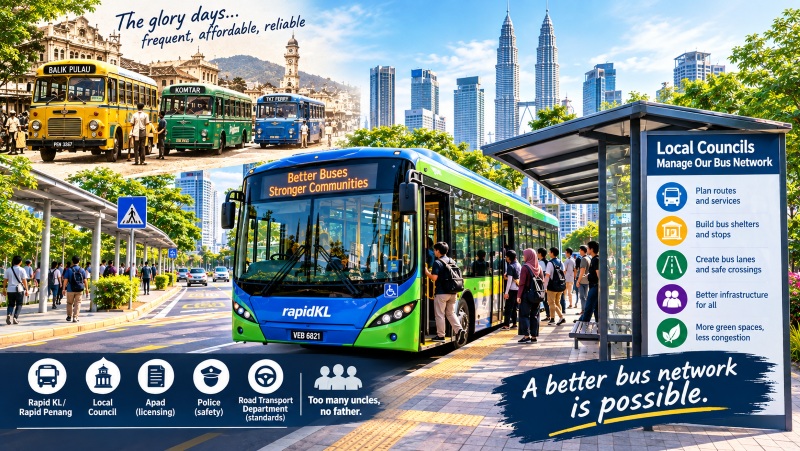
The recent outrage on social media after phase 3 of the Selangor elevated light rail (LRT3) opened showed the same old problem: uncoordinated policy, planning and delivery.
Consider as well the hot, dangerous pedestrian walkways, the risky road crossings and the lack of feeder buses.
Why wasn’t this basic infrastructure built in the first place?
We often blame Rapid KL and Rapid Penang for slow buses and for apartment blocks with no bus stop within 500m.
But that’s not really their job. Local councils are meant to design and build bus shelters, mark out bus stops and lanes, and stop them being blocked.
Bus routes, meanwhile, are licensed centrally by the land public transport agency Apad (formerly Spad), which has neither the power nor the capacity to plan a proper network.
The result is what I’d call a ‘too many uncles, no father’ problem – Rapid, the local council, Apad, the police, the road transport department, and no one in charge overall.
- Sign up for Aliran's free daily email updates or weekly newsletters or both
- Make a one-off donation to Persatuan Aliran Kesedaran Negara (ALIRAN), Maybank a/c 507246118995 or CIMB a/c 8004240948
- Make a regular pledge or periodic auto-donation to Aliran
- Become an Aliran member
The glory days
It wasn’t always like this. During Penang Island’s “glory days” in the 1960s to 1980s, Penang Island’s city council licensed routes to a handful of profitable private operators – the yellow, green and blue buses.
Competition meant Air Itam commuters got frequent buses and low fares.
Yellow buses even carried newspapers and parcels from Komtar to Balik Pulau.
Blue buses ran a special service for students between the ferry terminal and the Penang Chinese Girls High School. Every secondary school had a route passing by.
Ridership was high because the service was predictable, frequent and fast. In 1970, the fare from Balik Pulau to Prangin Road was 65 sen, while a bowl of noodles cost 20 sen.
Those glory days ended in the 1990s, when another operator moved in on the profitable routes with an uneven playing field. Urban sprawl, car dependency and fuel subsidies made things worse.
| Authority/Region | Peak frequency | Off-peak Frequency | Service hours | Max stop distance |
|---|---|---|---|---|
| 20 mins | 30 mins | 0530 to 2330 | 500m | |
| 40 mins | 60 mins | 0600 to 2100 | 800m | |
| 60 mins | 90 mins | 0600 to 1900 | 1,500m | |
| 15 mins | 20-30 mins | > 18 hours | 400m | |
| 8 mins | 20 mins | > 18 hours | 400m |
Put local councils in charge
Rather than each council, Rapid and Apad pulling in different directions, one body should be responsible for the whole network.
Local councils are best placed for this – they already hold ratepayers’ commuting data.
The law should be changed to make local councils the manager of a comprehensive bus network. That would mean planning routes and chartering bus services – like Georgetown’s CAT, GoKL and Petaling Jaya’s free MBPJ bus.
The target would be to meet the service levels in Table 1, to collect fares to pay for this, and to break even.
In some states, several councils could form a joint venture to manage the network together.
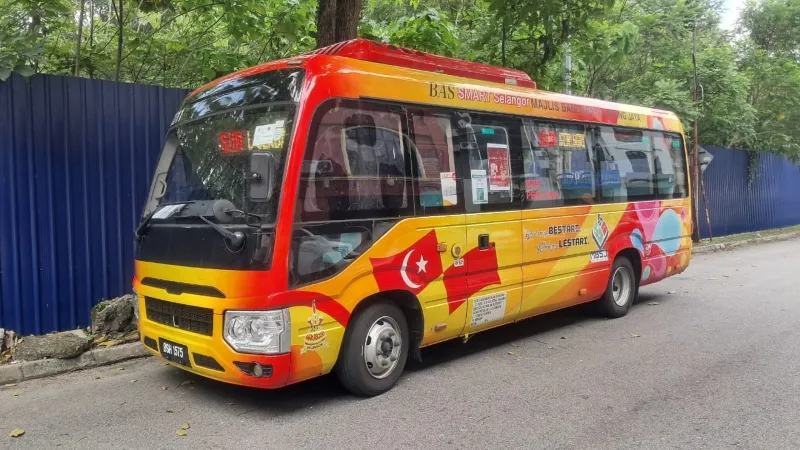
The Smart Selangor Bus already charters smaller buses from SKS Coaches to serve the crucial route between Serdang KTM and Serdang Hospital, showing this model can work.
Build for riders, not cars
To boost ridership, any council acting as a bus network manager should be rewarded for building better infrastructure: roads, bus shelters, lay-bys, road markings, sheltered walkways, safe crossings and clear schedules, shown both online and posted at bus stops.
Get this right, and people will switch from cars to buses, cutting congestion. That would save the council from having to build more expensive road lanes, new roads and car parks – all of which eat into land better used for pedestrian pavements, parks and green spaces.
A good network also needs to move smoothly. Councils should be incentivised to give buses priority at traffic signals, enforce dedicated bus lanes, keep bus stops clear of obstructions. They also need to plan sensible locations for stops, charging points, depots and interchanges.
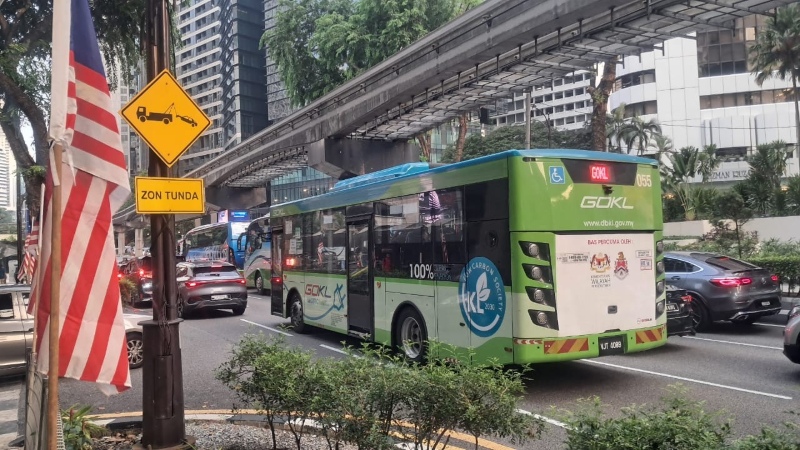
GoKL’s electric buses, chartered from SKS Bus, already run several short routes through densely populated areas.
Apad as ‘grandfather’
To keep councils accountable, Apad could take on a ‘grandfather’ role – similar to Singapore’s Land Transport Authority – providing checks and balances on the ‘father’ council, which would then be in charge.
Apad should also run a state-wide complaints system, letting the public raise issues through their state and federal representatives, instead of local councillors.

The above image from Ang Mo Kio in Singapore shows what this can look like in practice: an integrated bus stop with a sheltered walkway linking a pedestrian crossing, an overhead bridge and nearby flats, plus a ‘yellow box’ letting buses pull out of the bus stop quickly.
An election issue
Penang Island’s bus service was predictable, frequent and fast during its 1960s-80s glory days. It declined through the 1980s and 1990s, and has stagnated since Rapid Penang took over in 2008.
It is time for a better model: local councils managing a comprehensive bus network.
Councils would gain from higher ridership covering the cost of chartering buses, while spending less on new roads and lanes.
Everyone would benefit from smoother, safer, more reliable transport.
This approach can be adapted to suit each council’s own conditions, using the above table as benchmarks.
It will take real political will to make this shift.
As a start, at the next election, ask your prospective state and federal representatives to put the bus service benchmarks – and local councils as comprehensive bus network managers – into their manifestos. Then vote accordingly.
The views expressed in Aliran's media statements and the NGO statements we have endorsed reflect Aliran's official stand. Views and opinions expressed in other pieces published here do not necessarily reflect Aliran's official position.
- Tegakkan maruah serta kualiti kehidupan rakyat
- Galakkan pembangunan saksama, lestari serta tangani krisis alam sekitar
- Raikan kerencaman dan keterangkuman
- Selamatkan demokrasi dan angkatkan keluhuran undang-undang
- Lawan rasuah dan kronisme
