Dalilawati Zainal
Behind the dynamism of Malaysia’s food sector is a powerful yet unseen force driven by low-income women. Their determination keeps the informal food economy alive.
Working from cramped kitchens in low-income PPR housing and makeshift stalls, they sustain thousands of urban households and underpin entire low-income communities, even as their contributions go largely unrecognised.
According to SME Corp’s 2025 statistics, micro-enterprises make up about 70.1% of all micro, small and medium-sized enterprises in Malaysia, forming the core of the nation’s entrepreneurial landscape.
Although official breakdowns by gender or sector are unavailable, years of community engagement, NGO interventions and academic fieldwork consistently reveal that a significant share of micro-food businesses, especially in low-cost flat (PPR) communities, are run by women.
- Sign up for Aliran's free daily email updates or weekly newsletters or both
- Make a one-off donation to Persatuan Aliran Kesedaran Negara (ALIRAN), Maybank a/c 507246118995 or CIMB a/c 8004240948
- Make a pledge or schedule an auto donation to Aliran every month or every quarter
- Become an Aliran member
This is supported by the Department of Statistics’ 2024 findings, which show that the average Malaysian household has just 1.8 income earners. For low-income families, secondary income from self-employment is no longer optional. It has become a critical means of coping with rising living costs.
Within this reality, food micro-businesses are not mere supplements but financial lifelines.
Persistent cost pressures
Despite their economic relevance, PPR women operate inside an ecosystem that rarely matches their lived realities.
One of their most persistent obstacles is the unrelenting cost-margin squeeze. DoS data shows national inflation has eased. Headline inflation declined to 2.5–3.3% in 2022–23 and dropped further to around 1.8% in 2024. Food and beverages inflation stabilised at 1.5–2% percent in 2024–25.
But these figures hide the structural disadvantage faced by micro-entrepreneurs, who cannot buy in bulk.
Buying in small quantities at higher per-unit prices leaves them vulnerable, as even slight price shifts can tighten their already narrow margins. Although food inflation appears stable on paper, micro-entrepreneurs still shoulder structurally higher operating costs.
With customers who are equally cash-strapped, raising prices is rarely an option, leaving some women with margins as low as fifty sen per item.
Initiatives such as Menu Rahmah and targeted subsidies ease pressure for consumers, but the upstream cost challenges faced by micro-entrepreneurs largely remain unresolved.
Financing barriers
Financing remains another barrier. Bank Negara’s Financial Stability Review 2023 confirms that micro-enterprises continue to struggle accessing credit due to thin documentation, inconsistent cash flows and a lack of collateral.
Many PPR women mix household and business finances, rely on daily revenue to restock ingredients and lack formal cashbooks.
Without records or registration, they often do not qualify for schemes like Tekun, DanaNita Mara or BSN Micro/i programmes. This traps them in a cycle of insufficient working capital that prevents scaling, equipment upgrades or inventory building.
Cramped conditions
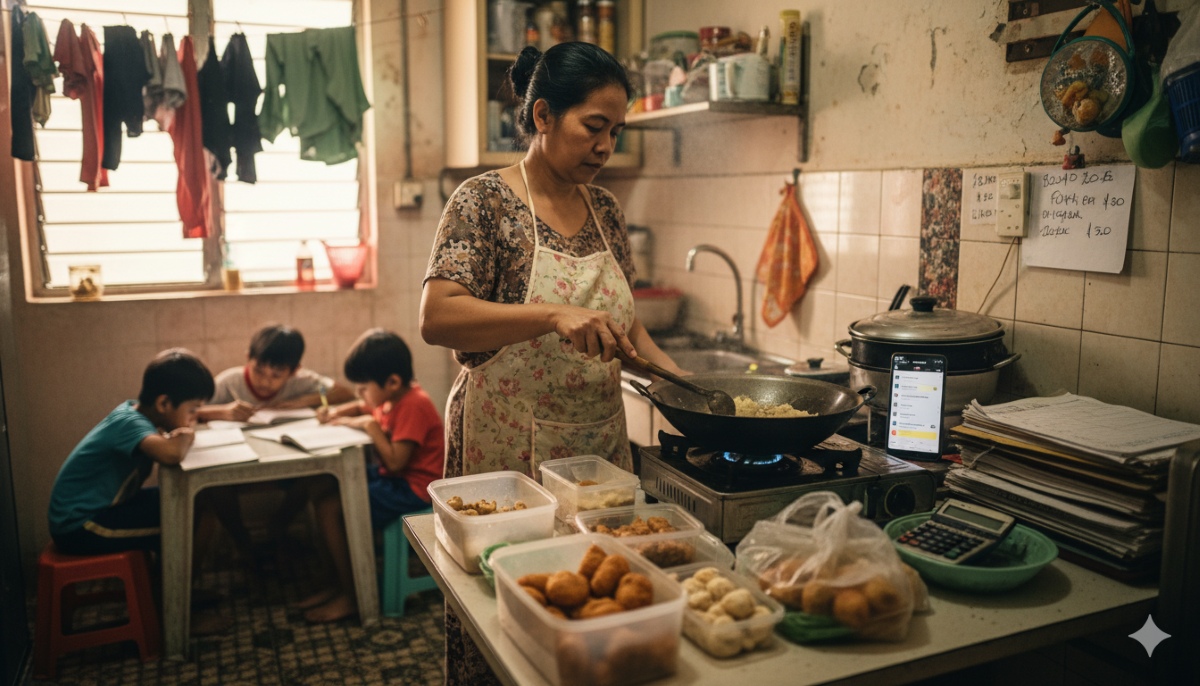
Physical conditions compound the problem. A typical low-cost flat measures 600 to 700 square feet and houses several family members.
Kitchens double as study areas, dining spaces and laundry zones. Food is prepared where children revise homework and laundry dries – conditions that create operational inefficiencies, limit production capacity and raise food-safety risks.
Several PPR flats have introduced shared kitchens to help micro-entrepreneurs prepare food more safely and efficiently.
Domestic responsibilities further constrain growth. Many women manage the full value chain, from sourcing, cooking, cleaning, packing, taking orders and occasionally delivering food – while also caring for children and older parents.
Workdays often stretch 14 to 18 hours. With no paid leave, childcare support or formal safety nets, burnout becomes almost inevitable, threatening both livelihood sustainability and family wellbeing.
Digital divide
Digitalisation – often hailed as the equaliser – presents its own obstacles. Unicef and UNFPA’s Families on the Edge study in 2021 found that low-income urban households frequently rely on a single mobile phone shared among multiple family members and often with unstable internet access.
This severely restricts women’s ability to use digital tools to manage and grow their businesses.
Programmes such as PEDi and MDEC’s eUsahawan offer important foundations, but meaningful digital adoption requires ongoing mentorship, simplified tools and community-level support. One-off workshops rarely translate into lasting digital capability when devices are inadequate and digital confidence is low.
Hidden costs
Adding to these barriers is the lack of basic financial record-keeping. Without tracking daily sales, cost of goods sold, packaging expenses, transport costs or customer credit, entrepreneurs cannot accurately evaluate their profitability.
Many assume they are doing well because cash moves daily, only to realise – once basic records are reconstructed – that hidden costs have eaten into most of their earnings.
This reflects not negligence, but the absence of practical and accessible accounting tools tailored to micro-business realities.
Market saturation
Competition within PPR communities has intensified since the pandemic.
As households sought alternative income sources, many turned to food sales, often producing similar items such as nasi lemak, kuih (sweets and pastries), budget meals and frozen snacks, within small and saturated markets, where purchasing power is limited.
Local saturation depresses prices and weakens viability.
The emotional toll is significant, with many women experiencing high levels of stress, anxiety and fatigue. Balancing childcare, household survival and fragile micro-businesses creates an invisible burden that often goes unacknowledged.
Untapped potential
Despite these challenges, the potential of low-income women in PPR flats remains significant.
Their creativity and adaptability show in the way they overcome daily constraints with limited resources. What they lack is not motivation, but an ecosystem built for their realities.
With targeted support such as accessible micro-financing, shared kitchens, simple digital tools, basic accounting systems and sustained coaching, they can transition from survival-mode to sustainable entrepreneurship.
To date, the government has provided support for women entrepreneurs through SME Corp, Kuskop and targeted PPR programmes like Dapur Digital (Digital Kitchens), but coverage remains limited.
With low-cost flats nationwide and many women still excluded by documentation, location and formality barriers, current initiatives still fall short of reaching those at the margins.
If Malaysia wants an inclusive and strong economy, its policies must fully reflect the lived realities of low-income women in low-cost flats.
They are essential to community stability and the national food sector. When they progress, their families progress – and so does Malaysia.
Dr Dalilawati Zainal is a senior lecturer at the Faculty of Business and Economics, University of Malaya.
AGENDA RAKYAT - Lima perkara utama
- Tegakkan maruah serta kualiti kehidupan rakyat
- Galakkan pembangunan saksama, lestari serta tangani krisis alam sekitar
- Raikan kerencaman dan keterangkuman
- Selamatkan demokrasi dan angkatkan keluhuran undang-undang
- Lawan rasuah dan kronisme