

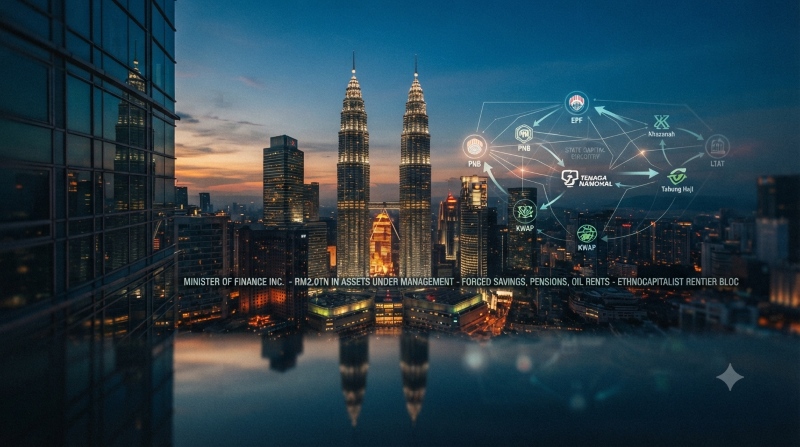
When political economist Edmund Terence Gomez published Minister of Finance Incorporated in 2017, he detailed how a handful of government-linked investment companies controlled nearly half of Malaysia’s stock market.
The message was clear: the state had become Malaysia’s biggest player in business.
The OECD is making a similar point today. In its 2026 Economic Survey of Malaysia, it said Malaysia should adopt competitive neutrality principles to ensure that government-linked companies operate on equal terms with private firms, particularly in government procurement and access to finance.
The prime minister, who is also finance minister, holds the levers.
In Malaysia, government-linked investment companies are the state funds. Government-linked firms are the companies they own, such as Petronas or Tenaga Nasional.
Nearly a decade later, the picture has grown increasingly complex. Malaysia’s six largest government-linked investment companies now sit on roughly RM2.0tn in assets.
The Employees Provident Fund alone has passed RM1.4tn.
- Sign up for Aliran's free daily email updates or weekly newsletters or both
- Make a one-off donation to Persatuan Aliran Kesedaran Negara (ALIRAN), Maybank a/c 507246118995 or CIMB a/c 8004240948
- Make a regular pledge or periodic auto-donation to Aliran
- Become an Aliran member
Permodalan Nasional Berhad, the bumiputra equity vehicle, holds over RM360bn, according to its 2024 integrated report.
Khazanah Nasional, Retirement Fund Inc (KWAP), the Hajj pilgrims fund Tabung Haji and the Armed Forces Fund Board (LTAT) together add hundreds of billions more. Khazanah alone booked RM5.1bn in profit for 2024, while KWAP’s assets grew by a further RM15.8bn that year, by their own accounts.
These are not abstract numbers. They are the forced savings of workers, the religious savings of pilgrims, and the pensions of civil servants and soldiers. They are also the oil rents of Petronas – all pooled under state control and deployed as investment capital.
Minister of Finance Incorporated showed us the architecture.
How the money moves
What has happened since is the further financialisation of that architecture.
The government-linked investment companies no longer merely own local companies. They now act like sovereign fund capitalists.
They invest globally, outsource billions to Wall Street fund managers, and partner with giant firms like BlackRock and Abu Dhabi’s investment authority. PNB now parks nearly a quarter of its money overseas. The EPF channels record sums to external fund managers. Khazanah talks of “catalytic global partnerships.”
This looks like modernisation. But critics argue it is not. It is the deepening of what world-systems theorists call a semi-peripheral trap.
Malaysia remains stuck between the wealthy core nations and the poor periphery states. We manufacture, but we do not innovate. We invest, but we do not escape.
Why? The government-linked investment companies system was never designed to build productive, worker-owned wealth. It was designed to capture and circulate surplus – oil rents, workers’ savings, pension funds.
These flow through state-controlled financial circuits that enrich a narrow ethnicised elite, while wages and productivity stay low.
Consider the capital circuit.
Petronas’ own financial reports show it still hands the government RM32bn to RM50bn a year in dividends. That’s roughly a fifth to a quarter of federal revenue.
The government does not tax the wealthy to fund itself; it relies heavily on oil and workers’ compulsory savings.
Petronas revenue spikes when global oil prices rise, and the state spends more. When prices fall, the country scrambles to stabilise the economy.
This is classic rentier behaviour – a state that lives off natural resource rents, rather than building a broad tax base accountable to the people.
Then comes the second circuit of capital.
Your EPF contributions – 7.5% to 11% of your salary every month – are locked in for decades.
The EPF uses this giant pool of money to buy shares in government-linked companies, government bonds and global equities. In 2024, it announced record returns.
But who controls the EPF? The government appoints the board. Who decides which companies get the capital? State-linked committees.
The worker’s savings become the fuel for a corporate structure the worker neither owns nor controls democratically. The wealth is extracted from the working class and circulated through state financial institutions.
The accumulated worker’s (and employer’s) contributions and modest annual dividends are returned, decades later – if the worker survives to retirement.
Tabung Haji performs a similar extraction under religious cover. Pilgrims deposit savings for their hajj (pilgrimage). Its own 2024 results put assets under management at close to RM100bn. It invests in property, plantations and sukuk (Islamic bonds). The depositor gets a profit distribution; the state keeps the power to decide where the capital flows.
The spiritual aspiration of the ordinary Muslim worker is financialised into a state investment vehicle.
Ethnicity and the elite
This is where ethnocapitalism enters.
The government-linked investment companies were created to lift bumiputra corporate ownership to 30%. Five decades later, bumiputra equity stands at roughly 17-18% – far below target, as noted by research institutions like the Iseas-Yusof Ishak Institute.
The New Economic Policy (NEP) and its successors have fallen short by their own measure of corporate equity targets.
Yet the system persists because it serves a different purpose: the creation of an ethnocapitalist rentier bloc.
This bloc is not a broad bumiputra middle class. It is a narrow layer of corporate professionals, retired officials and politically connected entrepreneurs. They sit on government-linked company boards, receive procurement carve-outs and manage the flow of rents.
The PuTERA35 plan, launched in 2024 by the Malaysian government, instructs government-linked companies and investment companies to set aside funds for bumiputra entrepreneurs.
Legal commentary at the time noted that these firms also reserve vendor contracts and channel state capital along ethnic lines.
The prime minister chairs the oversight body. The finance minister controls the purse strings.
Gomez’s warning about conflicts of interest has become institutional routine.
The result is a structural paradox.
Workers of every ethnic background – Malay, Chinese, Indian, Iban, Kadazan and others – pay into the EPF and the Social Security Organisation (Socso).
Their savings finance government-linked companies that dominate utilities, banking, transport and construction. These firms enjoy preferential access to government contracts and cheap financing, which crowds out genuine private-sector competition.
Researchers at the Australian National University, and separately Malaysia’s own Institute for Democracy and Economic Affairs, have both found that when government-linked firms dominate a sector, private investment by other firms falls.
Our economy becomes ossified. Productivity stagnates.
The Asian Development Bank has long argued Malaysia remains trapped in middle-income status, unable to break into high-value innovation.
As the economist Wing Thye Woo has put it, the state-corporate elite has little incentive to risk change – it already controls the rents.
A trap that repeats itself
The semi-peripheral condition explains why this trap is structural, not merely corrupt.
In the global economy, core nations capture the highest value through technology and finance.
Peripheral nations export raw labour and resources.
Semi-peripheral states like Malaysia try to escape by using state power to build domestic champions.
But Malaysia’s state champions are organised around ethnic rent distribution, not industrial upgrading. They accumulate financial assets without building the human capital or technological depth needed to join the core.
The government-linked investment firms grow bigger. The nation stays stuck.
Workers are told to trust the system. The EPF promises retirement security. Tabung Haji promises spiritual reward. Petronas promises national pride.
But the underlying movement stays the same: wealth is extracted from the many and concentrated in state-controlled financial circuits. It is then deployed to sustain an ethnocapitalist rentier bloc that manages power, but does not share it.
The working class funds its own exclusion.
Gomez gave us the map. The territory has only grown larger.
If ordinary people in Malaysia want an economy that serves the workers, rather than extracting from them, the government-linked investment companies-government-linked companies complex cannot simply be reformed. It must be democratised – or dismantled.
The views expressed in Aliran's media statements and the NGO statements we have endorsed reflect Aliran's official stand. Views and opinions expressed in other pieces published here do not necessarily reflect Aliran's official position.
- Tegakkan maruah serta kualiti kehidupan rakyat
- Galakkan pembangunan saksama, lestari serta tangani krisis alam sekitar
- Raikan kerencaman dan keterangkuman
- Selamatkan demokrasi dan angkatkan keluhuran undang-undang
- Lawan rasuah dan kronisme
