

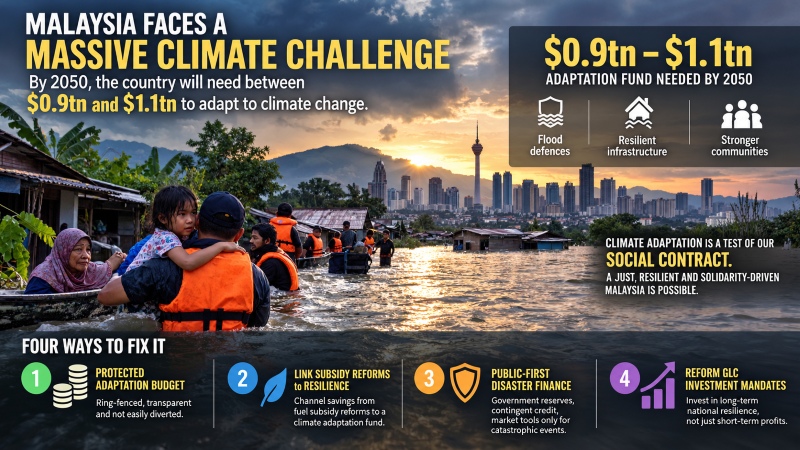
Malaysia faces a massive climate challenge.
By 2050, the country will need between $0.9tn and $1.1tn to adapt to climate change.
That money would go towards flood defences and resilient infrastructure for communities. [See also: Malaysia Country Climate and Development Report, World Bank, 2026].
Not just a money problem
Financial leaders have pointed out that this is not a shortage of money, but a “return problem”.
Projects like seawalls or community drainage systems do not generate direct profits. Because they are public goods, private investors naturally avoid them.
Financial entities often propose market-based models instead. Tools like ‘blended finance’ or ‘resilience-linked sukuk’ are used to attract private capital.
This model is deeply flawed. It treats the symptom rather than the root cause. Relying on market mechanisms to solve a public crisis ignores the fundamental purpose of climate adaptation: caring for people, not accumulating capital or protecting profitable assets.
- Sign up for Aliran's free daily email updates or weekly newsletters or both
- Make a one-off donation to Persatuan Aliran Kesedaran Negara (ALIRAN), Maybank a/c 507246118995 or CIMB a/c 8004240948
- Make a regular pledge or periodic auto-donation to Aliran
- Become an Aliran member
Malaysia is a society committed to justice, freedom and solidarity. A market-first approach that shields capital while leaving the most vulnerable behind goes against those values. It is deeply unfair to the people.
Malaysia’s fiscal reality makes fixing this even more urgent. The country is already operating under severe budget constraints.
National debt has crept above 65% of gross domestic product (GDP). The cost of servicing this debt is rising. RM17 of every RM100 collected now goes towards debt repayments.
Meanwhile, development spending is shrinking as a share of the economy, falling from 4% to 3.8%.
Fuel subsidies add to this strain. Ron 95 subsidy costs, driven by global oil price volatility, have surged from roughly RM0.7bn to RM3.2bn a month in early 2026 – a jump that threatens to push the deficit past its 3.5% target (Lee C, Iseas Perspective no. 2026/39).
In this tight fiscal environment, climate adaptation projects cannot be left to compete for the same shrinking pool of development funds. That is a recipe for failure.
A recipe for inequality
The social justice implications of a market-driven adaptation strategy are stark.
Floods already make up 85% of all recorded disasters in Malaysia. When disasters strike, the burden falls heaviest on low-income households and marginalised communities.
Historical data shows that only about 10% of economic losses from major floods are covered by insurance. Why? Simply because the most vulnerable families simply cannot afford it.
If we rely on private finance, capital will naturally flow to ‘bankable’ projects. This means protecting high-value industrial parks, commercial real estate and wealthy neighbourhoods first.
Meanwhile, poorer communities in flood-prone areas will be deemed ‘unbankable’ and left exposed. When these communities inevitably suffer, the government would have to step in as the ‘insurer of last resort’.
This would happen precisely when the government’s own finances are most stretched, creating a vicious cycle of debt and inequality.
A market-based approach to adaptation finance would not just fail to solve the problem, it would actively reproduce and worsen existing inequality.
Four ways to fix it
To build a truly resilient and just Malaysia, we must move beyond financial gimmicks and implement deep, structural reforms. A critical reassessment points to four essential changes.
First, adaptation must have its own protected fiscal classification. We cannot continue to compete for climate resilience funding against routine debt payments or subsidy overruns.
Malaysia needs a dedicated, ring-fenced adaptation and resilience budget category. This would ensure that funds for protecting communities are guaranteed, transparent and not easily diverted.
Second, fiscal consolidation must be linked directly to social resilience. The government has made partial attempts to rationalise fuel subsidies. However, the savings from these reforms must not simply disappear into general government accounts.
A defined, legally protected share of these savings should be redirected into a national climate adaptation fund. This connects the difficult task of budget management directly to the urgent need for community protection.
Third, disaster-risk finance must be built as a layered public system, not handed over to capital markets. The foundation of our disaster response must be public.
Frequent, low-severity events should be covered by government budget reserves and dedicated disaster funds. Medium-scale shocks can be managed through contingent government credit. Only for rare, catastrophic events should we consider complex market instruments.
The public good must always come before private profit.
Fourth, government-linked investment companies must realign their mandates. Institutions like the Employees Provident Fund, the civil service pension fund KWAP and Khazanah hold trillions of ringgit in public wealth.
Currently, their mandates prioritise short-term financial dividends, which discourage investment in long-term, low-cash-flow adaptation projects.
Government-linked investment firms must therefore reform their mandates to recognise that long-term national resilience is a prerequisite for long-term economic returns. They must be required to invest in the safety and survival of ordinary people.
Climate adaptation is not simply a technical or financial issue. It is a profound test of our social contract.
Malaysia can build a fiscal architecture rooted in justice, freedom and solidarity – by ring-fencing adaptation budgets, linking subsidy reforms to resilience, building public-first disaster finance and reforming its government-linked investment companies.
Our communities’ survival depends on getting this right. We cannot allow capital to dictate who is protected from climate disasters and who is left to drown.
The views expressed in Aliran's media statements and the NGO statements we have endorsed reflect Aliran's official stand. Views and opinions expressed in other pieces published here do not necessarily reflect Aliran's official position.
- Tegakkan maruah serta kualiti kehidupan rakyat
- Galakkan pembangunan saksama, lestari serta tangani krisis alam sekitar
- Raikan kerencaman dan keterangkuman
- Selamatkan demokrasi dan angkatkan keluhuran undang-undang
- Lawan rasuah dan kronisme
