

Zulfikar Abdul Aziz
Penang is not developing badly because it is developing too fast. It is developing in the wrong way.
Much of the wrongness traces back to two missing documents: a gazetted local plan and a proper mobility plan for how people actually move around. Penang has neither. This is the case even though the present government has ruled Penang since 2008, for four consecutive terms.
A local plan is not the same as the 2030 Penang Structure Plan, which the state finally gazetted in 2019. A structure plan sets policy in broad strokes. A local plan is the legally binding map – density, land use, infrastructure requirements, street by street – before a single project gets approved.
Without it, each development is judged on its own. Nobody has to weigh what it adds to the drains, roads and hillsides already straining under everything approved around it.
Floods show this most clearly. In Tanjung Bungah, I have seen natural rivers concreted over at new project sites, and grass verges paved beside public roads. Unregulated hillside farming. Approved hill-slope building. Rainwater surging down to crowded plains never designed to take it.
A working model already exists nearby. The century-old Guillemard Reservoir in the Tanjung Bungah hills catches hill rainfall and feeds it by gravity to a treatment plant. That eases flood risk while supplying water. Hillside development and flood control can coexist – if the planning is done upfront. This approach should be repeated along the hill range from Teluk Bahang to Gertak Sanggul.
- Sign up for Aliran's free daily email updates or weekly newsletters or both
- Make a one-off donation to Persatuan Aliran Kesedaran Negara (ALIRAN), Maybank a/c 507246118995 or CIMB a/c 8004240948
- Make a regular pledge or periodic auto-donation to Aliran
- Become an Aliran member
State and council authorities do not publish figures comparing what they collect in development-related fees against what they spend on drains, slope stabilisation and roads. That silence tells its own story.
No plan for how people move
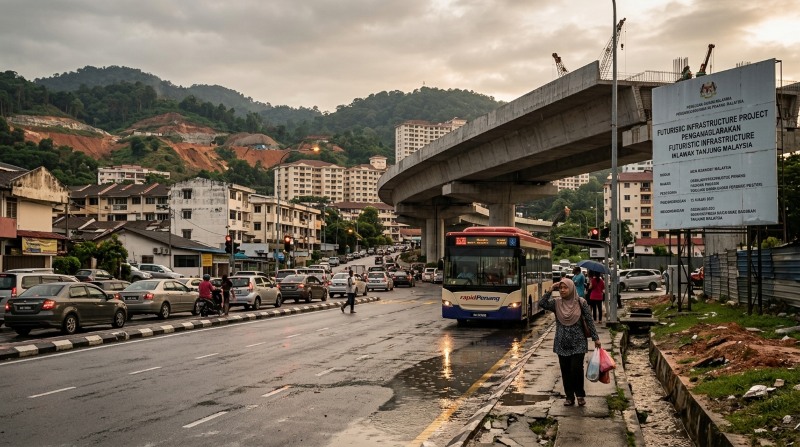
Traffic tells the same story from a different angle. The state leans on elevated light rail transit (LRT) as its answer to congestion. That is misleading. Even if the line opened tomorrow, the jams would not clear. A peak-hour survey I carried out found at least 80% of cars had only the driver inside.
Buses used to work well in Penang, run sustainably by private operators and the council. That history proves bus transport can succeed here if pursued seriously. Ridership data backs this: with a fleet of 400 buses, use was far higher than with today’s fewer than 250 buses.
Reliability beats ‘free buses’ every time. But buses will only be reliable with a proper mobility plan and network, along with supporting infrastructure.
Nearly every journey or commute starts or ends at home. Relatively few people are likely to live close to LRT station when they are built.
Since 2008, the state has failed to build a proper first-and-last-mile bus network – the obstacle-free pedestrian walkways, feeder routes and bus stops that actually get people from their front door to a bus that runs on time. Neither the council nor the state has a real champion for buses. Plenty for the LRT, though.
A sustainable mobility plan would force these choices into the open: which mode gets priority, where the buses run, how density and transport capacity are matched before, not after, a project is approved. Penang has no such plan either. Roads and rail get built while buses get an afterthought.
Congestion and floods hit low-income households hardest. Longer commutes eat into time bus-dependent workers could spend earning. Many low-income homes sit in poorly drained areas, where flood damage recurs, forcing unpaid leave for repairs on top of lost income. Wealthier areas flood too, but better drainage and road networks soften the blow.
Without a local plan, residents fighting individual projects have only the State Appeals Board to turn to, one project at a time. There is no single document they can hold the state to, on land use or on transport. Objections have been rising – people are noticing, even without the tools to challenge the bigger picture.
Even getting information project by project is hard. Penang has a freedom of information law, but it offers less protection than it should. For instance, residents fighting the Karpal Singh Drive reclamation project won a ruling ordering documents released. More than a month on, only part of the material has been handed over, with a “confidential” stamp on the cover letter.
The state’s One-Stop Centre portal is difficult for the public to use, and its hearings are closed even to observers.
Eighteen years after Pakatan’s ‘CAT’ pledge of competence, accountability and transparency, that bigger picture is still missing and people have not yet been fully empowered.
Three changes needed
Gazette the outstanding local plans for Penang Island and Seberang Perai without further delay, with binding density, land-use and drainage requirements attached – not just broad policy statements.
Adopt a binding sustainable mobility plan that puts buses and first-last-mile connections first, and suspends mega-rail and road projects until it exists.
Make councillors answerable to residents, not just appointed by the state. Since the law does not allow binding local elections, a mock poll among ratepayers could still identify who deserves appointment, giving councils real legitimacy.
Zulfikar Abdul Aziz is the secretary of the public transport users’ group PeTUA and chair of the Tanjung Bungah Residents’ Association (TBRA).
The views expressed in Aliran's media statements and the NGO statements we have endorsed reflect Aliran's official stand. Views and opinions expressed in other pieces published here do not necessarily reflect Aliran's official position.
- Tegakkan maruah serta kualiti kehidupan rakyat
- Galakkan pembangunan saksama, lestari serta tangani krisis alam sekitar
- Raikan kerencaman dan keterangkuman
- Selamatkan demokrasi dan angkatkan keluhuran undang-undang
- Lawan rasuah dan kronisme

How frustrating – I’m wishing long suffering Penang well.