

Malaysia’s labour market is robust, according to the World Bank’s Malaysia Economic Monitor 2025: Raising the Ceiling, Raising the Floor.
Labour force participation reached a record 70.9% in 2024. Unemployment is at its lowest since 2014. The economy expanded by more than 5% for the year.
By any macroeconomic standard, the condition of workers in Malaysia should inspire confidence.
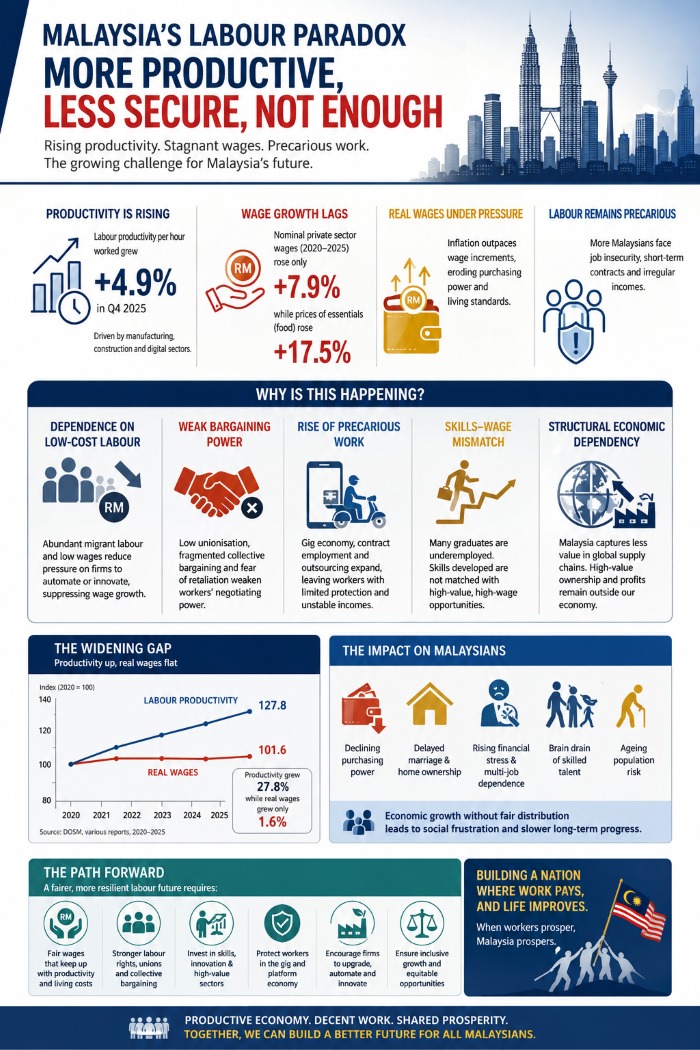
However, the same World Bank report punctures that satisfaction bubble. While real median wages rose by about 43% between 2010 and 2024, economic growth over the same period maintained nearly double that pace. This means workers, particularly those at the middle of the income distribution, did not grow with it.
This is the peculiar anomaly of a tight labour market in a growing economy producing structurally inadequate wage outcomes. Typically, low unemployment tightens labour supply, raises bargaining power and pushes wages upwards. But in Malaysia, that is simply not happening.
It is a signal, flagging a labour market that channels growth upwards and outwards towards capital returns and foreign shareholders – rather than downwards and inwards towards working people.
The hollowed middle
When the World Bank disaggregates wage growth by income decile using the real median wage index (base year 2010 = 100), the structural picture comes sharply into focus.
- Sign up for Aliran's free daily email updates or weekly newsletters or both
- Make a one-off donation to Persatuan Aliran Kesedaran Negara (ALIRAN), Maybank a/c 507246118995 or CIMB a/c 8004240948
- Make a regular pledge or periodic auto-donation to Aliran
- Become an Aliran member
The bottom deciles, D1 and D2, record index values of about 200 and 176 respectively by 2024, driven primarily by successive minimum wage increases applied from an extremely low base.
The top decile, D10, reaches about 150, reflecting the premium for high-skill, high-productivity roles.
The middle deciles, from D4 to D9, cluster between 128 and 140: a narrow, stagnant band.
This is no accident. An economy optimised to attract global capital through wage arbitrage cannot simultaneously deliver the broad-based, productivity-linked wage growth that a high-income transition demands. The two objectives are structurally at odds.
The World Bank’s productivity benchmarking also situates Malaysia’s wage stagnation in a troubling regional context.
In 2010, workers in China were about half as productive per worker as their counterparts in Malaysia. By 2024, that gap had closed entirely.
Meanwhile, the productivity differential with Singapore has widened: workers in Singapore were 4.4 times more productive than those in Malaysia in 2010 and are now 4.6 times more productive.
Productivity is the only durable basis for sustained wage growth. When productivity stagnates, wage growth either stagnates too or becomes inflationary and unsustainable. Malaysia has chosen the former path, largely by design.
The World Bank identifies a critical structural mechanism: frontier firms – the high-productivity enterprises, often foreign-linked, that pay employees about times the median firm wage – have seen their market share and labour absorption capacity decline over the past decade. These firms are not disappearing. They are simply not scaling.
What fills the gap are firms in the lower half of the productivity distribution, competing not on innovation or quality but on cost minimisation. Low wages are not a consequence of these firms’ strategy. They are the strategy.
Development by dependency
To understand why this structural condition persists, we must acknowledge the political economy of Malaysia’s position in the global capitalist system.
Immanuel Wallerstein’s world-systems framework offers a precise lens. Malaysia occupies a semi-peripheral position: neither a raw commodity exporter wholly dependent on Global North demand, nor a technology-generating economy capable of extracting value through intellectual property and financial instruments.
The semi-periphery’s competitive proposition is wage arbitrage, offering manufacturing and service delivery at labour costs below developed nations while maintaining sufficient infrastructure to attract foreign direct investment.
Any wage increase risks eroding that comparative advantage. Capital can then extract surplus without upgrading productivity, preserving short-run competitiveness at the cost of long-run transformation.
Successive administrations have navigated this through plentiful tax incentives, freely available industrial zones, flexible labour regulations and investment facilitation infrastructure, consistently prioritising mobile capital over immobile workers.
The high-income aspiration expressed in successive Malaysia Plans has remained aspirational precisely because the institutional and policy infrastructure required – industrial policy with genuine labour-market upgrading mandates, robust skills-matching systems, spatial economic rebalancing — has never been resourced at the scale the task demands.
Graduate underemployment
The World Bank’s data on graduate underemployment transforms a wage stagnation story into a structural indictment.
Nationally, 36% of tertiary-educated workers are employed in jobs below their qualification level, up from about 30% in 2015.
In Terengganu and Pahang, more than half of all tertiary-educated workers are employed beneath their qualification level.
These are not isolated anomalies. They point to the labour market reality of a substantial portion of the interior and east coast of the peninsula, reflecting a spatial failure of productive employment that no amount of individual educational credentialling or skills upgrading will resolve without prior structural change in those states.
The wage penalty for this mismatch is precisely quantified: graduates working below their qualification level face a penalty of 49.3% compared with equivalently educated peers in well-matched roles.
A family that borrowed under the PTPTN study loan scheme, which redirected years of household income towards a child’s university education, is receiving less than half the wage return that education was designed to deliver. The initial educational investment is being confiscated at the point of employment – not by fraud, but by structural demand failure.
Gig informalisation
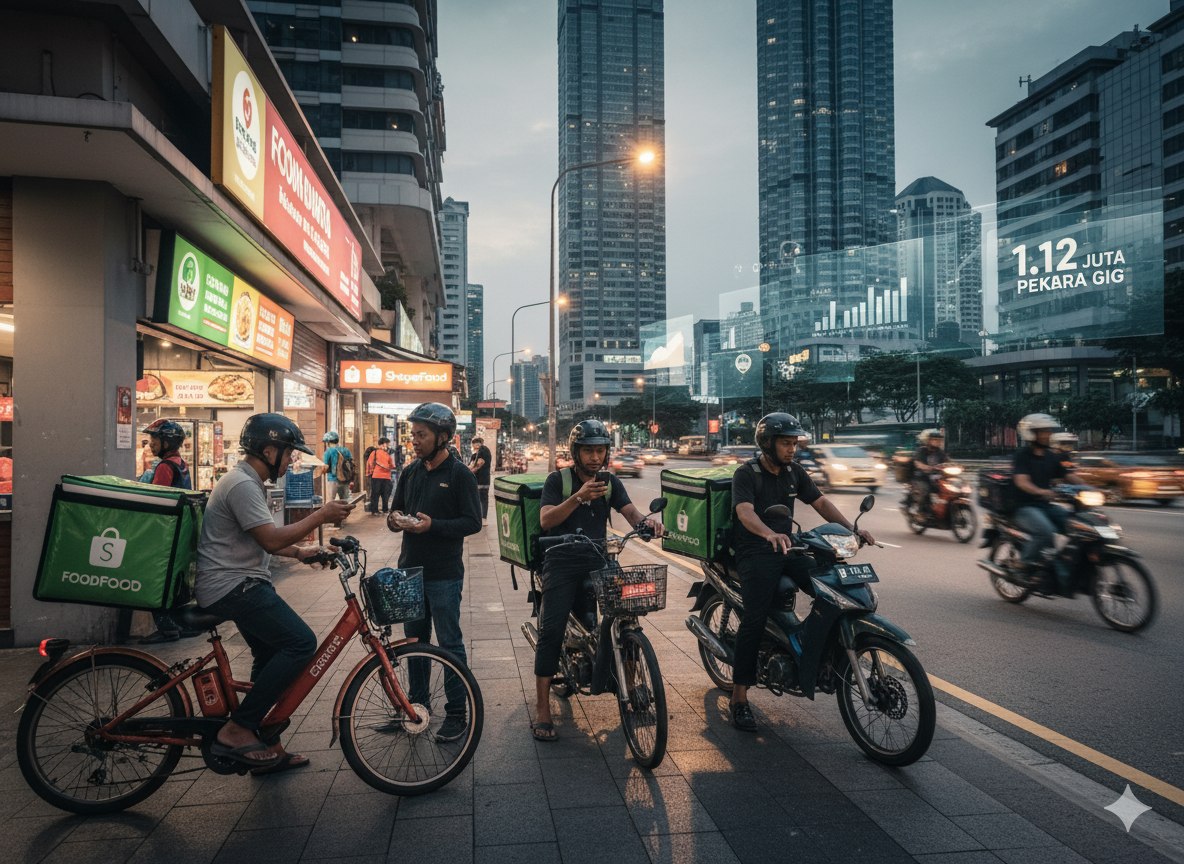
The emergence of platform-mediated gig labour – Grab, Lalamove, FoodPanda and the expanding ecosystem of app-brokered task work – is often framed in the language of entrepreneurship and flexible income.
But the gig economy does not disrupt the existing labour market. It informalises it, systematically stripping away the protections that formal employment relations, however inadequately, previously provided.
When a worker shifts from formal employment to platform-based gig work, the transaction is asymmetric.
The platform captures the value of coordination and matching.
The worker absorbs costs previously borne by employers: the motorcycle, fuel, data plan, vehicle maintenance.
Employees Provident Fund contributions, social security (Socso) coverage, minimum wage protections, annual leave entitlements – none of these follow the worker into platform work.
The employer-employee relationship is dissolved and replaced by a client-contractor fiction that insulates the platform from employment obligations while extracting the benefits of a managed workforce.
A gig worker is not a micro-entrepreneur. The worker has been made to purchase their own means of production and accept all the risk of capital ownership, while surrendering the wage-setting power that formal employment, imperfect as it was, at least nominally provided.
Think of the digital platform as an enclosure act – in the tradition that social theorist David Harvey describes. The commons being enclosed is not land but the social wage: the accumulated institutional protections of formal employment that took generations of labour struggle to establish.
With some four million gig workers, and up to 66% of the country’s knowledge workers maintaining secondary income through gig and freelance platforms – one of the highest rates globally – many of these are workers displaced from formal manufacturing and service employment. This is a regression in employment quality dressed up as innovation.
The World Bank’s wage indices do not fully capture this cohort: workers who have exited formal wage employment are often invisible in decile-level data.
What this represents is the informalisation of existing low-wage work, which is empirically more accurate for Malaysia’s context than the Silicon Valley mythology.
What connects minimum wage floors suppressed by migrant labour competition, middle-income wage stagnation, geographic concentration of productive employment, graduate credential penalties, declining frontier firm absorption and gig informalisation?
Each is a component of a coherent, if unacknowledged, system: a labour extraction architecture that treats workers in Malaysia primarily as cost inputs to be minimised rather than productive assets to be developed.
This architecture did not emerge by accident. It reflects the accumulated outcome of policy choices made consistently in favour of mobile capital over immobile labour:
- investment facilitation frameworks that do not require technology transfer or skills upgrading as conditions of approval of foreign investments
- labour regulations that restrict collective bargaining in pioneer industries
- immigration policies that supply structurally disempowered migrant workers, by suppressing their organising rights without addressing their exploitation
- an absence of sectoral wage-setting mechanisms to connect productivity gains to compensation
- spatial development policies that have concentrated economic dynamism in narrow urban corridors while leaving the majority of the country
Malaysia’s macroeconomic indicators tell a story of success. But its labour market data tells a story of structural extraction.
Both are true simultaneously. The growth that generates the headline figures is organised to minimise its passage through working households and to maximise its accumulation by capital – domestic, foreign and increasingly platform-mediated.
The World Bank frames this as a jobs agenda that should become a productivity agenda.
That is technically correct but politically insufficient. Productivity upgrading without institutional reform of labour market power – without genuine collective bargaining rights, portable worker benefits, enforceable skills-transfer conditions on foreign investments, and spatial industrial policy with bite – will produce gains that accrue to shareholders rather than workers, as they have for the past decade.
The Madani administration’s high-income aspiration will remain aspirational until the state confronts the extraction architecture it has helped construct.
Malaysia’s ceiling will not rise until it stops designing its floor to remain where it is.
The views expressed in Aliran's media statements and the NGO statements we have endorsed reflect Aliran's official stand. Views and opinions expressed in other pieces published here do not necessarily reflect Aliran's official position.
- Tegakkan maruah serta kualiti kehidupan rakyat
- Galakkan pembangunan saksama, lestari serta tangani krisis alam sekitar
- Raikan kerencaman dan keterangkuman
- Selamatkan demokrasi dan angkatkan keluhuran undang-undang
- Lawan rasuah dan kronisme
