
By Ahmad Ibrahim
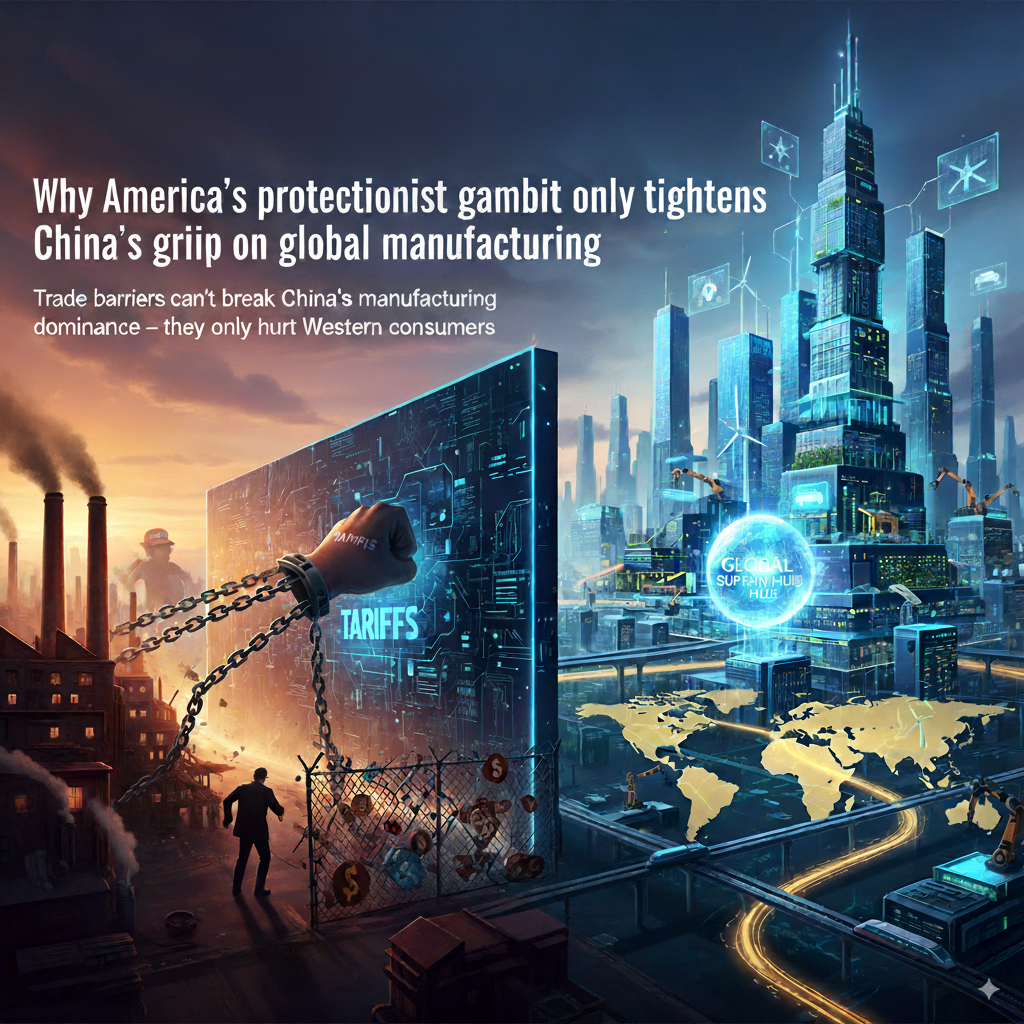
Tariffs haunt the global economy once more. Washington under Donald Trump, driven by a potent mix of economic anxiety and political nostalgia, slaps high duties on imports coming from countries worldwide, dreaming of smokestacks rising again across the Rust Belt.
It is all about making America great again, Maga. Many see it as a desperate lunge to reclaim a manufacturing supremacy, which the US once ruled over but now perceived as lost to the East, primarily China.
Yet, economists rightly warn this is an impossible path. Why? Because the past three decades haven’t merely shifted factory jobs, they have forged an industrial ecosystem in China so vast, integrated and advanced that tariffs are less a strategy and more a self-inflicted wound for the West.
China has executed a masterful long-term strategy to become the world’s indispensable factory. It took decades to reach this position. Catching up by the West is a massive task. The country was once labelled as a copycat of the West.
- Sign up for Aliran's free daily email updates or weekly newsletters or both
- Make a one-off donation to Persatuan Aliran Kesedaran Negara (ALIRAN), Maybank a/c 507246118995 or CIMB a/c 8004240948
- Make a pledge or schedule an auto donation to Aliran every month or every quarter
- Become an Aliran member
Not anymore. China isn’t just about individual factories; it’s about clusters. Shenzhen isn’t just electronics; it’s an entire universe of suppliers, component makers, prototyping labs and logistics hubs within a few square miles.
This ‘agglomeration economy’ creates unparalleled efficiency and speed. Trying to replicate a single factory in Ohio ignores the critical mass of supporting industries – the resin suppliers, precision toolmakers and specialised engineers – that took decades to coalesce in China. Tariffs can’t rebuild this intricate web overnight, or even over a decade.
China’s domestic market is a behemoth. This massive internal demand allows Chinese manufacturers to achieve economies of scale unimaginable elsewhere, driving down unit costs to levels Western producers, even without tariffs, struggle to match. It also provides a resilient base when global demand fluctuates.
So China is highly resilient. Tariffs might make some Chinese goods slightly more expensive in the US, but they do nothing to dent China’s overall scale advantage globally or domestically.
The “cheap labour” trope is obsolete. China has invested massively in engineering talent, vocational training, and science, technology, engineering and maths (Stem) education. It now graduates more engineers and scientists annually than the US, EU and Japan combined.
This deep talent pool fuels relentless innovation and sophisticated manufacturing, moving far beyond simple assembly into high-value sectors like green tech, renewable energy, electronics and advanced materials. Tariffs don’t magically conjure up a comparable skilled workforce in the West.
China has vertically integrated critical supply chains, especially for clean energy and electronics. It dominates the processing of rare earths essential for electric vehicles and phones. It controls vast portions of battery component manufacturing. It leads in solar panel production from polysilicon to finished modules.
Tariffs on finished goods often simply increase costs for Western consumers and manufacturers.
While the West debated industrial policy, China implemented it with ruthless focus. Massive state-backed investment in R&D and strategic acquisitions propelled Chinese firms to the forefront in key technologies. Huawei in 5G, BYD in electric vehicles, CATL in batteries – these are not low-cost copycats, they are global leaders in innovation and production efficiency. Tariffs might slow their US market access slightly, but they accelerate their push into other global markets and deepen China’s technological lead.
China isn’t just exporting to the world. It’s integrating with the world on its terms. The Belt and Road Initiative builds infrastructure tying economies closer to Chinese supply chains. Investments in Africa and Southeast Asia secure raw materials and create new markets.
While the US erects tariff walls, China builds bridges, further entrenching its position as the central node in global manufacturing networks.
Is the West collapsing?
Stagnation is the greater threat. Predicting Western ‘collapse’ is hyperbolic. The US and the EU possess immense reserves of capital, institutional strength and innovation potential.
However, strategic stagnation fuelled by misguided policies like blanket tariffs is the real danger. Tariffs act as a regressive tax, fuelling inflation and harming the very industries they aim to protect. China and others respond with their own tariffs, harming Western exporters, particularly farmers.
The US tariff gambit is less a bold strategy and more a symptom of denial. It fails to grasp that China won the manufacturing crown not through temporary tricks, but by patiently, systematically building an industrial ecosystem of unparalleled scale, integration and sophistication over decades.
Tariffs are a blunt instrument wielded against a deeply entrenched system. They risk hurting the West more than China.
The West isn’t collapsing, but its refusal to move beyond protectionist whack-a-mole towards a coherent, investment-driven vision for future industrial competitiveness ensures China’s manufacturing dominance will persist and is likely to grow.
Winning requires building, not just barricading. The time for delusion is over.
Prof Dato Ahmad Ibrahim is affiliated with the Tan Sri Omar Centre for STI Policy Studies at UCSI University. He is also an associate fellow at the Ungku Aziz Centre for Development Studies, University of Malaya.
AGENDA RAKYAT - Lima perkara utama
- Tegakkan maruah serta kualiti kehidupan rakyat
- Galakkan pembangunan saksama, lestari serta tangani krisis alam sekitar
- Raikan kerencaman dan keterangkuman
- Selamatkan demokrasi dan angkatkan keluhuran undang-undang
- Lawan rasuah dan kronisme
