

Major high-speed train tragedies are rare. So, the crash near Urda, Toledo, in Spain on 28 October shocked not only the people of Spain but the whole world.
A Renfe high-speed train crashed into the rear of a stationary Iryo train. Sixty-nine people died. It was Spain’s second fatal high-speed train collision this year and its deadliest rail disaster since 2013.
Millions of people around the world who commute daily by train will have been shaken.
Transport Minister Óscar Puente said the crash happened after a Renfe service was authorised to proceed despite a red signal.
Preliminary reports indicate that a failure in communications affecting the train protection system caused several trains to stop. The railway control centre subsequently authorised the Renfe train to resume normal operation, despite the Iryo train still occupying the line.
Puente described the order as “inexplicable”. It is still unclear why it was given, and investigators are examining the circumstances surrounding the decision.
Prime Minister Pedro Sánchez said: “If we need to further strengthen safety in order to rebuild confidence in our high-speed rail system, we will do so, because what is unacceptable for a country like Spain is to suffer two high-speed rail accidents in the same year.”
- Sign up for Aliran's free daily email updates or weekly newsletters or both
- Make a one-off donation to Persatuan Aliran Kesedaran Negara (ALIRAN), Maybank a/c 507246118995 or CIMB a/c 8004240948
- Make a regular pledge or periodic auto-donation to Aliran
- Become an Aliran member
A Castilla-La Mancha government spokesperson said 147 people were on the Iryo train and 397 on the Renfe service. The collision happened at 08:53 local time and derailed two Iryo carriages.
A Reuters analysis of data from Spain’s competition authority showed about 25 million passengers used a high-speed train in Spain in the first half of 2026. That was a drop of about 14% from the same period last year.
Meanwhile, European Commission data shows Spain’s maintenance investment in its roughly 4,000km of high-speed lines has lagged other large European countries.
Spain spent about €1.5bn a year on the network between 2018 and 2022 – more than any other European country. But most of that went on new construction. Only about 16% was earmarked for maintenance, renewals and upgrades.
Lessons for train operators
Passenger safety must never be compromised. Safety-critical decisions should be subject to clear, independent authorisation procedures. In Spain, the Renfe train was authorised to proceed despite the signalling failure.
Human error should always be anticipated. Contingency measures must be ready the moment a serious problem arises.
Technology cannot replace the human brain, not even AI. Technology can fail, so human oversight, clear procedures and robust contingency planning remain essential. Back-up systems and emergency procedures must be capable of dealing with unforeseen failures.
Maintenance must be continuous. As noted above, only about 16% of Spain’s high-speed spending went on maintenance, renewals and upgrades.
Is Malaysia’s railway safe for commuters?
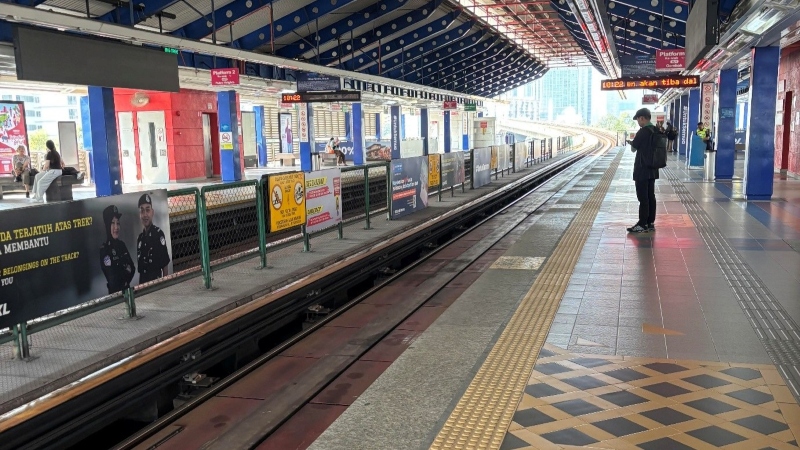
Malaysia can learn valuable lessons from the Spanish tragedy. Our elevated light rail (LRT), mass rapid transit (MRT), monorail and intercity lines must be checked constantly and upgraded periodically. Safety procedures must be followed and audits carried out regularly.
KTM commuter and intercity trains, LRT, MRT, monorail and KLIA Ekspres must undergo independent safety inspections and regular safety audits to prevent any untoward incident in our country.
Platform screen doors at the MRT stations reduce the risk of passengers falling onto the tracks. The doors only open once a train has stopped safely and is correctly aligned with the platform.
Some older LRT stations, including Bangsar, KL Sentral and Pasar Seni, still lack platform doors or barriers. Open platforms without barriers can be hazardous at peak times, when passengers surge forward as a train arrives.
LRT operators should fit barriers at all open stations without automatic doors, like the ones at Masjid Jamek’s Kelana Jaya Line platforms.
Rapid KL has begun installing platform safety barriers across the Kelana Jaya and Ampang-Sri Petaling lines. These are intended to reduce the risk of passengers falling onto the tracks, although they are not necessarily equivalent to the full-height automatic platform screen doors at MRT stations.
As a train reaches a station, regular announcements should advise commuters to queue. Security personnel should walk along the platform to ensure orderly exit and entry. Announcements should also be made while passengers wait.
Commuters have a moral duty to report any safety concerns. Feedback boxes should be placed at all stations, alongside accessible digital reporting channels. Complaints should be addressed directly to the transport minister, as well as the relevant railway operators and safety authorities.
Travellers should never be complacent about the safety and security of trains and passengers. Every commuter’s life is at risk if safety concerns are not addressed.
Everyone would like to travel by the fastest train, but safety must always come first. Malaysia should take Spain’s tragedy as a warning, especially as we expand our national railway network.
Better safe than sorry.
The views expressed in Aliran's media statements and the NGO statements we have endorsed reflect Aliran's official stand. Views and opinions expressed in other pieces published here do not necessarily reflect Aliran's official position.
- Tegakkan maruah serta kualiti kehidupan rakyat
- Galakkan pembangunan saksama, lestari serta tangani krisis alam sekitar
- Raikan kerencaman dan keterangkuman
- Selamatkan demokrasi dan angkatkan keluhuran undang-undang
- Lawan rasuah dan kronisme
