

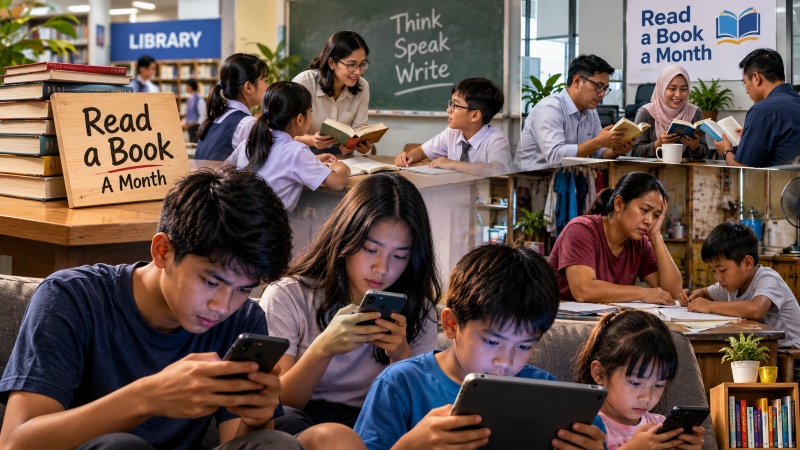
The reading habit has long since vanished from homes, offices and schools.
In this age of the internet, digital pursuits and social media browsing have become an addiction. People of all ages are glued to their mobile phones and tablets.
In fact, many parents are guilty of telling their children: “Don’t waste time reading story books – go and study.”
This also explains why young people increasingly show a shortage of critical thinking, writing and speaking skills. Even adults suffer a similar deficit.
Communications Minister Fahmi Fadzil has raised this very problem. He wants children encouraged to read physical books to curb excessive digital use.
The concern is valid, urgent and timely. But it will take more than encouragement.
Perhaps the government needs to go beyond incentives to promote reading – and with it critical thinking, speaking and writing.
- Sign up for Aliran's free daily email updates or weekly newsletters or both
- Make a one-off donation to Persatuan Aliran Kesedaran Negara (ALIRAN), Maybank a/c 507246118995 or CIMB a/c 8004240948
- Make a regular pledge or periodic auto-donation to Aliran
- Become an Aliran member
Schools and workplaces
Schools and universities should allocate more hours for reading, critical thinking, speaking and writing exercises.
Public libraries closer to residential areas, in cities and in malls can go a long way to revive the habit.
Workplaces, including government offices, should prioritise a ‘Read a book a month’ campaign. Staff could share what they have read during working lunch hours, with time set aside in the work calendar.
Homes and poverty
Next, it is time to seriously re-look at our housing industry.
Apart from high-end homes that the wealthy can own, houses for the low-income and middle-income groups rarely come with space designed as reading corners.
In fact, many have no study area at all. Children grow up doing homework on the dining table, on lounge floors or on their beds.
Many who can afford it take pride in grand kitchens, covered driveways, large sofas and big-screen TVs. Yet there is not a foot of space for reading and writing, let alone a mini library or shelves for books.
But space is only part of the problem. Many low-income families also lack time. Parents work long hours to keep the household afloat. Many children are latchkey kids, raised by single mothers on a single income. When survival comes first, reading comes last.
Incentives and libraries are not new, but they often do not reach these homes. Policies to eradicate poverty must come first. Then, we can talk about restructuring education.
Critical thinking also needs room to grow. Young people will speak their minds only if they feel safe doing so.
Incentives and slogans alone cannot revive reading, writing and speaking. We need the national will to change living and working conditions and reset policies – so that these skills can return.
The views expressed in Aliran's media statements and the NGO statements we have endorsed reflect Aliran's official stand. Views and opinions expressed in other pieces published here do not necessarily reflect Aliran's official position.
- Tegakkan maruah serta kualiti kehidupan rakyat
- Galakkan pembangunan saksama, lestari serta tangani krisis alam sekitar
- Raikan kerencaman dan keterangkuman
- Selamatkan demokrasi dan angkatkan keluhuran undang-undang
- Lawan rasuah dan kronisme
