
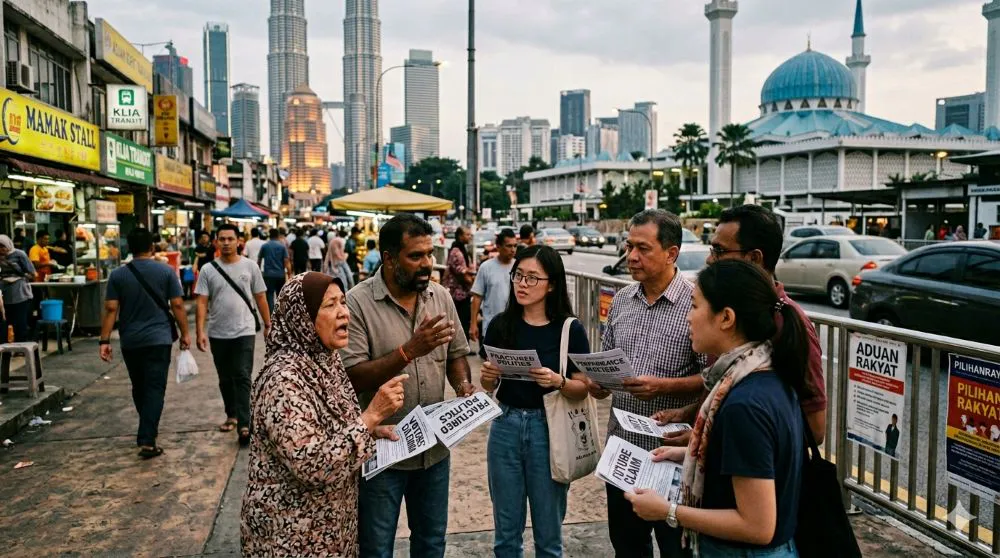
The rumblings continue within all political parties.
The noises emanating from within Umno are all visible and audible. These stem from the challenges posed by events in Negeri Sembilan and the party’s plan to go solo in the upcoming Johor state election.
Then you have the DAP and the rumbling in Penang over issues raised between the chief minister and a former chief minister.
There are also issues in Selangor with PKR, as well as issues raised by the sultan and the responses from DAP members.
Into all this walk a couple of newcomers: Rafizi Ramli’s Bersama and former opposition leader Hamzah Zainudin’s Wawasan. The field is being fractured by these new entries.
- Sign up for Aliran's free daily email updates or weekly newsletters or both
- Make a one-off donation to Persatuan Aliran Kesedaran Negara (ALIRAN), Maybank a/c 507246118995 or CIMB a/c 8004240948
- Make a pledge or schedule an auto donation to Aliran every month or every quarter
- Become an Aliran member
Other parties, like Pas, components of Barisan Nasional and Pakatan Harapan, are also staking their claims.
All of these parties have a claim on my vote. Some people will vote based on ethnicity. Others will vote based on religion. Yet others will vote for the candidate, whatever the party.
One important criterion remains: performance to date by the incumbent in power. The other consideration is the cry for change.
Weighing up the record
Consider the performance of the incumbent multi-coalition government that has been with us for the last four years.
While perfection is not the agenda, have they made any progress, and if so, what might this be?
If we benchmark against November 2022, when the last general election was held, inflation was high at 4-5% in the post-pandemic period. Today, it has been reduced to 1.7-2.0%. As for the cost of living and prices of goods felt by ordinary people, the rate of increase may seem slower but prices remain elevated.
Back then, the value of the ringgit ranged between RM4.50 to RM4.70 to one US dollar. Today it hovers around RM3.90-4.00 per dollar. The ringgit has been one of the best-performing currencies in the region.
Our international reserves, which hovered around $105-110bn in 2022, have risen to US$128bn today.
There has been an emphasis on subsidies, with a shift from broad-based subsidies to targeted subsidies. At the everyday level, many have experienced this in the revamped petrol and diesel subsidies.
Unemployment has seen a slight improvement from 3.6-3.7% dropping to around 2.9%.
As for foreign direct investment, the post-pandemic era was one of recovery. This government has since seen strong technology and manufacturing inflows.
The debt-to-gross domestic product (GDP) ratio has not improved, inching up from 60-61% to 62-65%.
The initiatives surrounding the implementation of the Malaysia Agreement 1963 have seen some progress and admissions. But several commitments remain unresolved.
A patchy reform record
As for reforms, some have been addressed. But many, like the separation of the attorney general and public prosecutor roles, still need to be tackled.
While targeted fuel subsidy reforms have been implemented, progressive wage policy initiatives have been introduced. Fiscal consolidation and deficit reduction efforts are ongoing. Digital economy and investment incentives are being implemented.
Anti-corruption and governance initiatives have seen partial implementation, while civil service reforms remain slow. The government’s delivery service can be improved with more stakeholder dialogues. Response to the auditor general’s report is, at best, lukewarm.
One awaits the setting up of the ombudsman to see if it can make a difference in government delivery. Most issues seem to be top-down, and there is very little dialogue with those affected. Written communication rarely secures a reply, and the office telephones remain an ornament. Communication is difficult. Who you know often seems to make the difference.
Compared with the performance of Muhiaddin Yasin and Ismail Sabri Yaakob, the present government has lasted four years. That, in itself, is an achievement.
The performance of Prime Minister Anwar Ibrahim on the global arena and in Asean should be lauded.
Unlike his predecessors, the present PM has not been linked to corruption allegations nor has unaccounted money been found in his or his associates’ possession. While there are issues with personalities close to him, like his political secretary, none has really smeared his personal standing.
A difficult choice
All of the above makes the casting of my vote challenging. Should it be one based on performance, or should it be for the candidate, even if he or she will be on the opposition benches?
Who can make a difference? And what is the value of my vote? Some voters might prefer to vote against the incumbent on principle: to keep politicians accountable and show that change is part of the democratic process.
Yet, look at the crowded political field today. Perhaps change should only be the obvious choice if the present government has performed terribly. By all standards, they could have done better, but their performance cannot be described as poor or bad.
The present government is led by an alliance of different coalitions. Nevertheless, one should give credit to the leadership of the present prime minister. Despite all the flaws and challenges, some tangible progress has been made. This “unity government” has brought stability and progress.
The government could have done better in ethnic relations. It should emphasise the Rukun Negara, and have as the unity minister someone with clout to make a difference. Issues of ethnicity and religion have to be handled immediately. Dialogues should be initiated.
The one portfolio that could have made a huge difference is education. Here, I hold the PM responsible for this failure. Our passing marks are so low that so many students score a string of distinctions. We continue to bluff ourselves, and when evaluated against international Pisa standards, we fail miserably.
It would be good for the ruling coalition to publish a report card on each minister’s performance. This should also include the attendance record of all MPs representing the coalition. Let us introduce a measure of accountability.
The government should also set out a dashboard for voters. This should show its successes and failures, as well as its work in progress.
We need clarity, and the message must inspire us to vote. It is in this context that all parties have to come out honestly and stake their claim with voters.
And vote we must, to stake a claim in the future.
AGENDA RAKYAT - Lima perkara utama
- Tegakkan maruah serta kualiti kehidupan rakyat
- Galakkan pembangunan saksama, lestari serta tangani krisis alam sekitar
- Raikan kerencaman dan keterangkuman
- Selamatkan demokrasi dan angkatkan keluhuran undang-undang
- Lawan rasuah dan kronisme
