

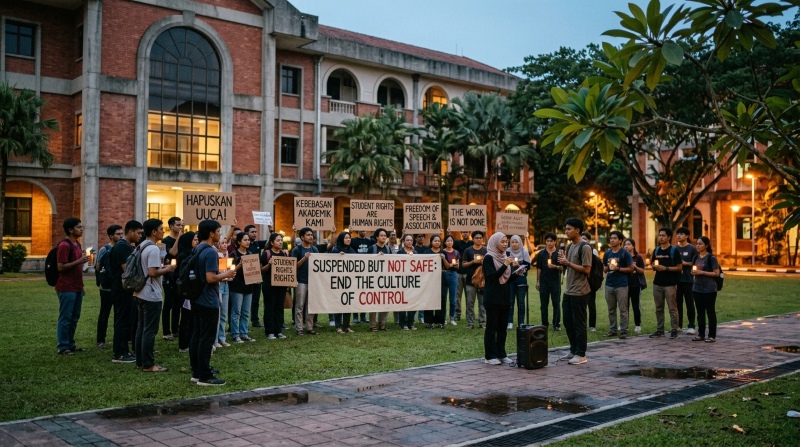
The Ministry of Higher Education (MoHE) announced today that it has begun implementing immediate measures to strengthen students’ freedom of speech and freedom of association.
This follows the prime minister’s statement at the Forum Ilmuwan Malaysia Madani (FIM) Series 13, on the abolition of the Universities and University Colleges Act 1971 (UUCA).
The statement is a welcome acknowledgement of the prime minister’s direction. Malaysian universities must move towards a position where student rights, academic freedom and institutional autonomy are treated as constitutional norms – not administrative privileges.
The announcement of an immediate suspension of disciplinary proceedings tied to student speech and peaceful assembly is significant. It recognises that the existing enforcement culture has long clashed with democratic principles.
However, the statement contains a fundamental contradiction. Reform – and even these interim measures – will lack credibility unless this contradiction is addressed.
The MoHE says it is “committed to ensuring that improvements to student rights are implemented without waiting for the full legislative process to conclude”. It lists freedom of association, the organising of activities, expression, communication and publication as rights that can be acted upon immediately.
Yet the same statement concludes by insisting these freedoms “must be exercised responsibly and in accordance with the law”.
- Sign up for Aliran's free daily email updates or weekly newsletters or both
- Make a one-off donation to Persatuan Aliran Kesedaran Negara (ALIRAN), Maybank a/c 507246118995 or CIMB a/c 8004240948
- Make a regular pledge or periodic auto-donation to Aliran
- Become an Aliran member
This is precisely the problem.
The phrase “in accordance with the law” points to the very legal and regulatory framework that has historically restricted student freedoms – including the Statutory Bodies (Discipline and Surcharge) Act 2000, university statutes and disciplinary rules.
The UUCA is not the only law controlling student expression and association. Students and academics remain subject to nearly 20 other laws, including:
- The Sedition Act 1948
- The Printing Presses and Publications Act 1984
- The Communications and Multimedia Act 1998
- Various public order, assembly and security laws and regulations
Unless students and academics get blanket immunity when exercising academic freedom, repealing the UUCA will only fix a small part of the restrictive legal environment. The machinery of control remains intact.
A moratorium on disciplinary proceedings – even if it can legally be implemented – does not dismantle the framework that enables overreach. It only pauses one part of it. Offenders could still be charged in a court of law.
So the MoHE is doing two things at once: expanding rights while reinscribing the conditions that limit them. This contradiction weakens the announcement. It explains why students, academics and civil society have consistently argued that abolishing the UUCA alone is not enough.
Without structural reform of the wider legal system, ‘responsible freedom’ risks becoming a euphemism for continued administrative discretion.
The prime minister has set out a rights-driven vision for higher education.
To deliver it, the MoHE must move beyond symbolic gestures. It needs to confront the deeper legal and governance structures that have constrained academic freedom for decades.
Anything less will just reproduce the same culture of control under a different name.
The views expressed in Aliran's media statements and the NGO statements we have endorsed reflect Aliran's official stand. Views and opinions expressed in other pieces published here do not necessarily reflect Aliran's official position.
- Tegakkan maruah serta kualiti kehidupan rakyat
- Galakkan pembangunan saksama, lestari serta tangani krisis alam sekitar
- Raikan kerencaman dan keterangkuman
- Selamatkan demokrasi dan angkatkan keluhuran undang-undang
- Lawan rasuah dan kronisme

Well put