

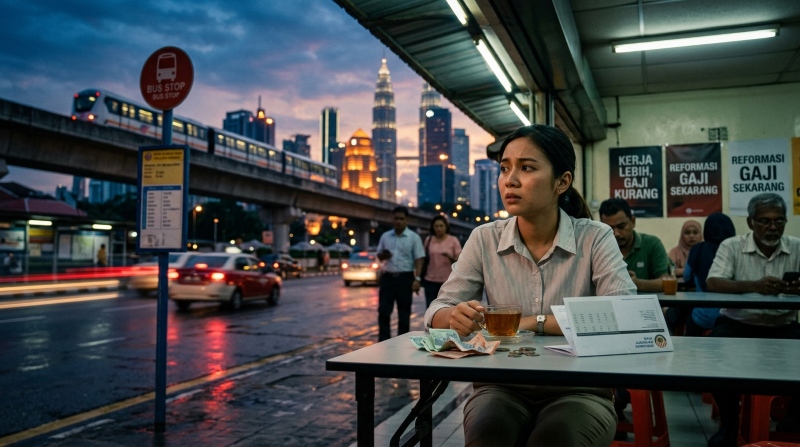
Low wages. Wage compression. Graduates starting close to the minimum wage. High underemployment. Prices climbing faster than pay.
These are the realities facing many workers in Malaysia today.
Productivity keeps rising, but real wages are not keeping pace. Employees’ share of economic growth remains low. That means smaller retirement savings in the Employees Provident Fund.
Add a cost-of-living index that does not fully capture prices on the ground, and household debt running at about 84% of gross domestic product (GDP), and the picture is clear. Many workers are trapped in a cycle of low pay.
Breaking it will take structural reform.
An index that needs fixing
The Consumer Price Index is the natural place to start.
Speaking in Parliament, the prime minister said the Consumer Price Index “is not perfect” and that “current times call for changes”. He added that the government was developing a new cost-of-living index with a wider basket of goods (The Star, 3 July 2024).
- Sign up for Aliran's free daily email updates or weekly newsletters or both
- Make a one-off donation to Persatuan Aliran Kesedaran Negara (ALIRAN), Maybank a/c 507246118995 or CIMB a/c 8004240948
- Make a regular pledge or periodic auto-donation to Aliran
- Become an Aliran member
That was more than two years ago. There has been little visible progress since.
Reform matters because the index is used well beyond the cost-of-living debate. The Industrial Court, for instance, uses it as a benchmark for wage adjustments, despite the prime minister’s own admission that it is flawed.
Wage compression bites
The second problem is the minimum wage system itself.
Raising the wage floor helps the lowest earners. But it does nothing for workers already earning slightly more, whose pay then gets squeezed towards the new minimum. Economists call this wage compression or income bunching.
A fairer approach would set wages on a time scale, based on experience, so pay stays in proportion across the workforce.
Annual wage reviews would also help tackle wage stagnation. Employers rarely raise pay voluntarily. So a formal mechanism is needed, tied to both the cost of living and GDP growth.
The scale of the problem is stark. The current minimum wage is RM1,700 a month. The national household poverty line is RM2,705.
A 2018 study by Bank Negara put the living wage for an individual at RM2,700. Against those benchmarks, RM1,700 looks grossly inadequate, even pathetic.
The case for a living wage
Only a shift to a living wage would give workers a meaningful income.
Government-linked companies and government investment-linked companies already pay a basic monthly wage of RM3,100. That is close to Bank Negara’s 2018 living wage figure, once adjusted for eight years of inflation. It is a useful benchmark for reform.
Higher wages, through a reformed living wage structure, would mean higher EPF savings, easing the squeeze on retirement. Right now, low pay means low savings, which forces many retirees back into work, often at low wages again. It is a trap that feeds on itself.
Higher pay would also raise Social Security Organisation payouts too, whether for disability or under the Employment Insurance Scheme. With an ageing population, that safety net matters more each year.
Household debt at 84% of GDP tells a similar story. Strong consumer spending does not mean households are getting richer. It means most households in Malaysia use about a third of their income – a median debt-servicing ratio of 33% – just to service debt.
A living wage would ease that burden and might help bring down national household debt, now estimated at RM1.7tn.
The urgency is clearest among the young. Workers aged 25 to 29 still earn less than they did before the pandemic. Their median monthly salary has not yet returned to 2019 levels (The Star, 24 August 2026). Figures from the Department of Statistics back this up: the median for that age group was RM2,095 in 2024, down 5% from RM2,206 in 2019.
That is not a promising start for people entering the workforce, at a time when the cost of living, work-life balance, career progress, education and housing all weigh on their minds.
There may even be a political dimension. Some analysts have pointed to the turnout of 18-to-30-year-old voters in the last general election as a factor in the result. Seats where they made up at least 30% of voters tended to favour Perikatan Nasional, followed by Pakatan Harapan and Barisan Nasional.
It is a reasonable reading that many young voters were signalling frustration, with low wages and higher living costs among their biggest concerns.
Taken together, these are compelling reasons for the government to move faster on reforming the wage and employment system.
The views expressed in Aliran's media statements and the NGO statements we have endorsed reflect Aliran's official stand. Views and opinions expressed in other pieces published here do not necessarily reflect Aliran's official position.
- Tegakkan maruah serta kualiti kehidupan rakyat
- Galakkan pembangunan saksama, lestari serta tangani krisis alam sekitar
- Raikan kerencaman dan keterangkuman
- Selamatkan demokrasi dan angkatkan keluhuran undang-undang
- Lawan rasuah dan kronisme
