

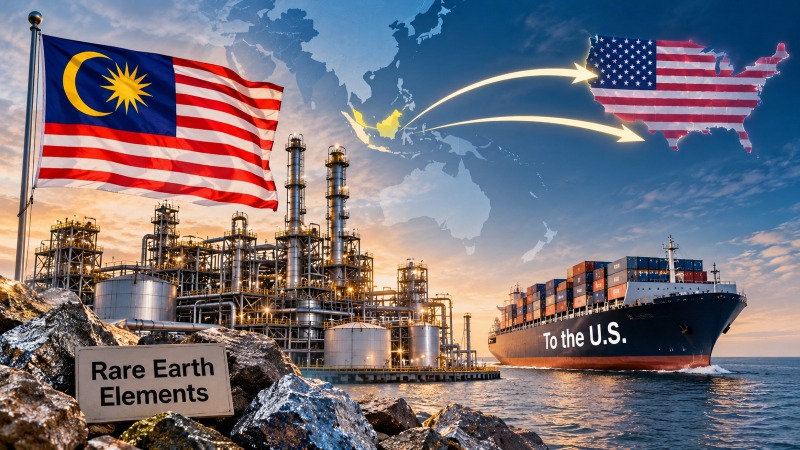
Malaysia is becoming a potential heavy rare earth processing hub with products intended to be shipped to the US. This is changing the Asia-Pacific critical minerals architecture.
A year ago, the White House signed the ‘Agreement on Reciprocal Trade’ with Malaysia. Separately, on the same day, the two governments signed a memorandum of understanding (MoU) committing both states to coordinate protection of “critical minerals and rare earths markets from non-market policies” (White House, 2025).
About a week earlier, the US and Australia signed a ‘Critical Minerals Framework’, pledging at least US$1bn towards priority projects, within an $8.5bn pipeline of potential critical minerals investments (White House, 2025a; Australian government, 2025).
The planned DTEC Mineral and Metal Technology refinery in Malaysia is 51% owned by US citizens, including Malaysian-born chief executive Milan Perlly. Malaysian firm DTEC Engineering and Construction holds the remaining 49%. The company says it is eligible for potential financing from US sources. The venture is geared towards exports to the US.
What are the implications?
Critical minerals such as dysprosium and terbium are indispensable to defence platforms and electric vehicles. They are regarded collectively as “chokepoint commodities”.
They are mined widely but processed by few. China controls about 97% of heavy rare earth oxide separation capacity (IMF, April 2026).
The DTEC venture is the first to receive approval to ship rare earth carbonate to the US. The first batch is 30 tonnes for research, with a total approved quantity of up to 700 tonnes (Business Times, 2025).
- Sign up for Aliran's free daily email updates or weekly newsletters or both
- Make a one-off donation to Persatuan Aliran Kesedaran Negara (ALIRAN), Maybank a/c 507246118995 or CIMB a/c 8004240948
- Make a regular pledge or periodic auto-donation to Aliran
- Become an Aliran member
The venture could enable the US defence industry to make strategic purchases of heavy rare earth elements in the future, though commercial production has yet to begin.
DTEC is not the only such project.
Since May 2025, the ‘Lynas Advanced Materials Plant’ in Kuantan has produced separated dysprosium oxide. This is the first commercial production of separated heavy rare earth elements outside China. By June 2025, the plant had also added terbium to its production line (Northern Miner, 2025; ListCorp, 2025; WSJ, 2024). The feedstock for these products comes from Lynas’s Mount Weld deposit in Western Australia.
The DTEC venture could further strengthen this emerging US-led supply-chain architecture. It intends to develop Malaysian ionic clay resources using US-backed investment and technology.
Together, these ventures could expand Malaysia’s role as a regional processing centre serving US and allied markets, reducing their dependence on China’s dominance in rare earth processing.
An unequal deal
The Malaysia-US trade agreement, signed last year, keeps a 19% tariff on Malaysian exports.
It grants exemptions to only 1,711 product lines. These zero-rated items made up 12% of Malaysia’s exports to the US, worth roughly $5.2bn in 2024, including aerospace-linked electronics, chemicals, palm-oil products and pharmaceuticals.
Malaysia, arguably, miscalculated in signing the agreement. The agreement’s wording is lopsided. “Shall” obligations fall on Malaysia, while “may” discretion rests with the US. Former attorney general Tommy Thomas reportedly described the agreement as “neo-imperialism at its worst“.
As the agreement appears to lock Malaysia into the role of a raw material supplier for the US economy, it would fit into a pattern of ‘extractivist colonialism’ – a concept put forward in the Monthly Review (2024).
The agreement’s section 5, particularly articles 5.1 and 5.2, contains provisions requiring Malaysia to align with certain US economic and national security measures against third countries and US unilateral export controls.
This may constrain China’s offer of technology assistance for heavy rare earth elements processing and production.
Dependency and Asean
Malaysia introduced a raw rare earth ore export ban in 2023, with the prohibition on unprocessed ores and concentrates taking effect in January 2024. The government frames this as resource nationalism to compel downstream investment (Reuters, 2023; Yean, 2023).
The country has an estimated 16.1 million tonnes of rare earth resources although much of this remains commercially unproven.
Now that Malaysia’s heavy rare earth elements sector is increasingly oriented towards US supply chains, the stated ambition of DTEC’s Perlly is to make Malaysia “the rare earth elements processing hub for ionic clay in the region” (Business Times, 2025). The end use is American.
Keohane and Nye (1989) argue that supply-chain frameworks with conditions on technology transfer, finance and market access can reproduce dependency.
This also fits Cardoso and Faletto’s idea of “dependent development” (1979), where growth is structurally subordinated to core-country interests (Frank, 1966).
As a result, national sovereignty remains, but the country’s independence is restricted.
Malaysia’s commercial alignment with the US may also erode Asean centrality.
Asean lacks a collective critical minerals framework. Each member negotiates bilaterally with Washington or Beijing. This enables the divide-and-rule dynamic central to dependency analysis.
The Lee Kuan Yew School of Public Policy warns that intensifying US-China rivalry “has transformed routine resource-sector decisions into geopolitical choices” – in effect, which country to choose.
The Quad’s July 2025 Critical Minerals Initiative (The Register 2025), the US-Australia critical minerals framework and the US-Malaysia ‘reciprocal’ agreement together reinforce a US-led mineral-security architecture designed to reduce China’s dominance in critical minerals processing.
Malaysian heavy rare earth elements processing will feed US defence platforms. In any Taiwan contingency, this could potentially draw Malaysia indirectly into a conflict in the Taiwan Strait (CSIS, 2026).
Viewed through world systems analysis (Wallerstein, 1974), the DTEC venture deepens Malaysia’s semi-peripheral position within a US-Australia mineral-security monoculture, embedded in a US Asia-Pacific strategy.
In this context, a “comprador bourgeoisie” – a local business class that acts as an intermediary for foreign capital – can emerge to facilitate foreign capital generation (Amin, 1976).
Baran and Sweezy (1966) wrote of “monopoly capital”, in which state power can be mobilised to secure external raw materials for metropolitan industries.
Malaysia’s rare earth resources thus risk becoming a conduit for foreign value extraction rather than an asset for national development.
The views expressed in Aliran's media statements and the NGO statements we have endorsed reflect Aliran's official stand. Views and opinions expressed in other pieces published here do not necessarily reflect Aliran's official position.
- Tegakkan maruah serta kualiti kehidupan rakyat
- Galakkan pembangunan saksama, lestari serta tangani krisis alam sekitar
- Raikan kerencaman dan keterangkuman
- Selamatkan demokrasi dan angkatkan keluhuran undang-undang
- Lawan rasuah dan kronisme
