

The recent United States-Australia Critical Minerals Framework, alongside a new US-Malaysia trade agreement, has intensified a long-running debate in Malaysia: is the country a sovereign partner or a subordinate in the global economy?
On the surface, the pacts promise technology transfer, green transition funding and foreign investment. Yet they create a deepening dependency, subsuming Malaysia’s resource nationalism under the needs of global finance and US security interests (STORM, October 2025).
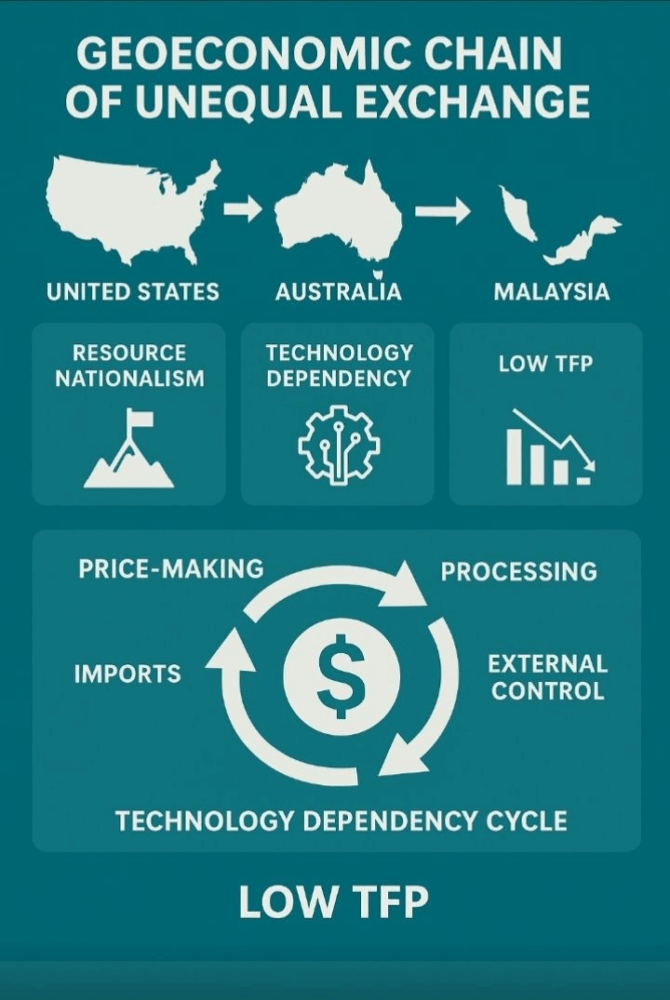
These developments exemplify the continuity of neo-imperialism through economic integration. In this view, control over technology, capital and process knowledge sustains a global hierarchy of unequal exchange (Amin, 1976; Sweezy, 1997).
Malaysia’s participation in the rare earth and critical minerals supply chain, particularly via the Lynas Advanced Materials Plant in Kuantan, is emblematic of this dependency.
What appears as ‘value addition’ through downstream processing is, in reality, a peripheral role in a transnational production network controlled by foreign capital, foreign standards and foreign technology.
Western supply chains and ‘collective imperialism’
- Sign up for Aliran's free daily email updates or weekly newsletters or both
- Make a one-off donation to Persatuan Aliran Kesedaran Negara (ALIRAN), Maybank a/c 507246118995 or CIMB a/c 8004240948
- Make a pledge or schedule an auto donation to Aliran every month or every quarter
- Become an Aliran member
The US-Australia Critical Minerals Framework consolidates Western supply chains for strategic minerals like rare earths, lithium, nickel and cobalt. It is framed within a security rationale to counter China’s export restrictions.
While presented as a diversification strategy, this framework reproduces what the late economist Samir Amin (1980) termed “collective imperialism” – a bloc of advanced capitalist states aligning to maintain control over resources from the Global South.
In this structure, Australia provides the extraction base, the US coordinates financial and technological command, and Malaysia, strategically located, becomes the compliant processor.
This is in light of Lynas’ recent production milestones. The plant has begun producing dysprosium oxide and terbium oxide in Malaysia. Its new circuit can separate up to 1,500 tonnes of heavy rare earths annually.
The recent US-Malaysia trade agreement, ostensibly a ‘reciprocal’ pact, functions as an economic codicil to this arrangement. Its clauses on “non-discriminatory treatment” and “open investment regimes” restrict Malaysia’s policy space for measures like export controls, state-led procurement or digital taxes.
These limitations mirror the broader neoliberal project to align developing states with US capital interests. As the political theorist Nicos Poulantzas (1978) warned, the capitalist state under such arrangements becomes “a condensation of class relations”. It mediates foreign capital accumulation while claiming national development.
Illusion of technology transfer
The rhetoric of “technology transfer” in both pacts is perceived as concealing the real flow of knowledge – from Malaysia outwards.
Malaysia provides cheap labour, land and logistical subsidies. But the intellectual rents – engineering designs, refining patents and environmental risk management protocols – remain within the US and Australian consortiums.
This asymmetry ensures that Malaysia remains a low ‘total factor productivity’ (TFP) economy. Growth is mainly driven by increases in capital and labour rather than by improved efficiency due to technological innovation.
Despite decades of industrial policy rhetoric, productivity gains have stagnated due to imported capital goods and externally controlled innovation (Bank Negara Malaysia, 2024).
The political theorist Antonio Gramsci’s concept of hegemony explains this consented dependency. The state apparatus, intertwined with comprador technocrats and government-linked companies, is seen as reproducing foreign domination not through coercion but through the ideological language of ‘modernisation’, ‘green growth’ and ‘strategic partnerships”.
This ideological consent allows monopoly-finance capital to extract super-profits through what analysts like Foster and McChesney (2012) term “global rentierism” – profits from controlling intellectual and technological property, rather than productive reinvestment locally.
Sovereignty undercut by structure
Malaysia’s periodic assertions of “resource nationalism” – such as federal-state debates on local rare earth licensing and environmental rules – are undercut by the structural realities of its economy (compradore capitalism). The state’s industrial agencies function more as facilitators for foreign investment approvals than as custodians of national resources.
Meanwhile, the environmental costs – including waste tailings, potential groundwater contamination and community displacement – remain localised burdens of a globalised value chain, as highlighted in a STORM analysis on 11 May.
This form of extraction echoes dependency theory’s warning: when peripheral economies fail to control the technological and financial terms of trade, ‘sovereignty’ becomes a rhetorical performance (Dos Santos, 1970).
The neo-colonial bargain is clear – Malaysia’s rare earths and refining capacity secure Western supply chains. But the nation remains excluded from the high-value upstream capital and downstream technological rents that define true industrial autonomy.
Persistent productivity gap
Malaysia’s persistent low TFP underscores its structural position in global production. Productivity is constrained by imported technologies, limited research and development absorption, and financialised foreign investment that prioritises shareholder returns over local reinvestment.
The government’s latest masterplans proclaim ambitions for “high-value” industrial upgrading.
But without breaking the foreign monopoly on process control, the nation remains trapped in what economists Paul Baran and Paul Sweezy (1966) termed “the underdevelopment of development” – an accumulation process that expands capital but impoverishes autonomy.
Trading autonomy for integration
In the wake of Malaysia’s diplomatic overtures to Washington – the PM’s jig with US President Donald Trump – the nation risks trading strategic autonomy for ephemeral capital inflows.
The ‘ride to a beastly unequal exchange’ is not merely metaphorical; it captures the structural violence of dependency.
The more Malaysia integrates into Western-led mineral security frameworks, the less policy autonomy it retains – over fiscal, environmental and industrial matters.
Reclaiming genuine resource nationalism requires strategic delinking – not isolation, but calibrated autonomy.
This requires asserting state control over technological licensing, renegotiating contract terms for environmental costs, and developing indigenous process knowledge through cooperative R&D with Global South partners.
Otherwise, Malaysia will continue to refine rare earths for the world while refining away its own sovereignty.
AGENDA RAKYAT - Lima perkara utama
- Tegakkan maruah serta kualiti kehidupan rakyat
- Galakkan pembangunan saksama, lestari serta tangani krisis alam sekitar
- Raikan kerencaman dan keterangkuman
- Selamatkan demokrasi dan angkatkan keluhuran undang-undang
- Lawan rasuah dan kronisme
