
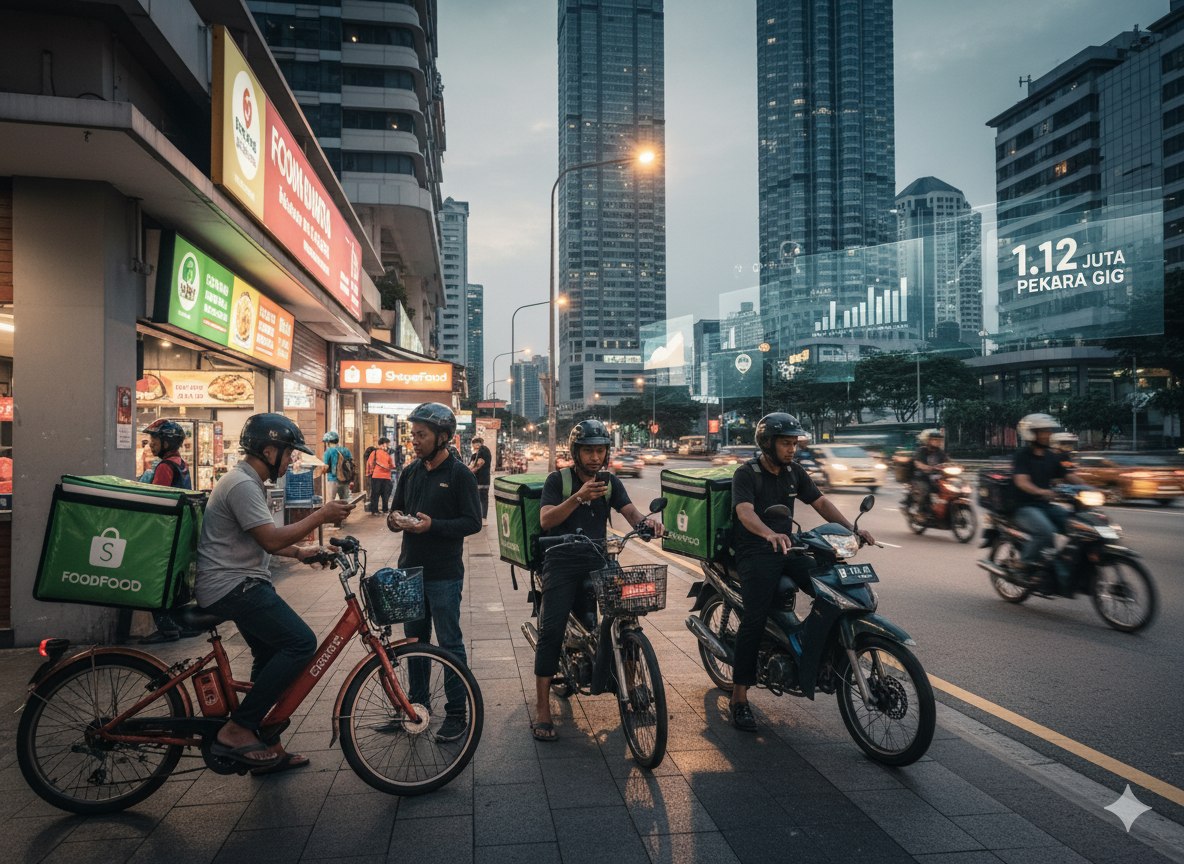
We live amidst sweeping changes driven by technology. Nowhere are these changes more visible than in the world of work, which goes to the heart of human life.
Traditional careers are giving way to flexible, task-based arrangements. Digital platforms redefine how labour is organised and rewarded. In such a landscape, awareness is essential for survival.
To adapt and manage our lives, we must first recognise the scope of these transformations, including new laws that attempt to deal with these changes. Only by understanding these can we safeguard the dignity of work, demand fairness and ensure that progress strengthens rather than weakens the foundations of our future.
Labour’s legal framework
For over a century, the global legal organisation of labour has rested upon a rigid, binary foundation. On one side stood the first category: the employee.
Governed in Malaysia by the Employment Act 1955, this relationship is defined by a “contract of service”. It is characterised by high degrees of managerial control and a reciprocal wage-for-work bargain.
- Sign up for Aliran's free daily email updates or weekly newsletters or both
- Make a one-off donation to Persatuan Aliran Kesedaran Negara (ALIRAN), Maybank a/c 507246118995 or CIMB a/c 8004240948
- Make a pledge or schedule an auto donation to Aliran every month or every quarter
- Become an Aliran member
In exchange for their subordination, the state granted these workers a comprehensive ‘social wage’ – mandatory retirement savings (EPF), paid leave and security of tenure. Equally important are the Trade Union Act 1959 and the Industrial Relations Act 1967.
The Industrial Court, established under the latter act, regards itself as a court of equity protecting employee rights.
On the opposite pole stood the second category: the independent contractor. These autonomous actors of the “contract for services” operate under the Contracts Act 1950.
They are viewed as mini-entrepreneurs who negotiate on an equal footing and bear their own professional risks. In this category, the law remains silent on welfare; the contractor’s safety net is their own profit margin.
A third category emerges
However, the digital revolution has given birth to what jurists describe as the tertium genus or third category: the gig worker. These individuals do not fit the traditional mould.
The Gig Workers Act 2025 represents Malaysia’s attempt to institutionalise this status. By providing statutory protections such as the Gig Workers Tribunal and mandatory Socsco (social security) coverage, the act attempts to integrate this rising workforce into the formal legal system.
This approach avoids the disruptive reclassification seen in Western jurisdictions.
Gig work – short-term, flexible, task-based arrangements mediated through platforms or informal contracting – has become a defining feature of modern economies. Ride-hailing drivers are the most visible example.
They are neither employees with full rights nor independent entrepreneurs with complete autonomy. Instead, as mentioned earlier, they occupy a tertium genus, a third category of work that falls between traditional employment and self-employment.
This ambiguous status has left gig workers vulnerable. They often face delayed or arbitrary deductions in earnings, sudden deactivation without due process, and exclusion from social security and occupational safety protections.
Without statutory safeguards, their livelihoods remain precarious. Their bargaining power is minimal against large platforms that dictate terms unilaterally.
Statutory protection and dangers
The Gig Workers Act responds to these vulnerabilities by embedding rights and protections into law:
- fair payment and transparency in earnings
- due process in termination or deactivation
- the right to association and collective representation
- access to dispute resolution through conciliation and a dedicated tribunal
- inclusion in social security and occupational safety regimes
In doing so, the act affirms the dignity of gig workers. It ensures that flexibility does not become a cover for exploitation.
Yet the importance of this legislation extends beyond individual protection. Without regulation, gig work risks becoming a cheaper substitute for standard employment.
Employers – including universities and higher education institutions – may increasingly rely on part-time or gig arrangements to avoid obligations such as EPF and Sosco contributions, medical benefits or paid leave.
Another danger, not covered by the act, is that young entrants to the workforce may also be drawn to gig work for its immediate income.
But this comes at the cost of long-term career development, professional identity and organisational loyalty.
Over time, this erodes Malaysia’s ability to build a strong, cohesive workforce. It undermines the sustainability of social protection systems and entrenches inequality.
Protection with vigilance
The Gig Workers Act is more than another labour law. It is legislation responding to the social change that is altering the nature of work.
By recognising gig work as a distinct category and extending statutory protections to it, Malaysia has taken a bold step. The act recognises and safeguards a new category of workers who would otherwise remain invisible in the legal system.
Its significance lies not only in protecting individual gig workers but in preserving the integrity of Malaysia’s workforce.
But without vigilance, the act could unintentionally accelerate the shift towards precarious employment.
This could encourage employers to abandon traditional obligations such as EPF and Sosco contributions, medical benefits and structured career pathways.
If gig work becomes normalised as the cheaper default, Malaysia risks damaging its labour market.
It risks weakening social protection systems and undermining the nation’s long-term capacity to build a strong, cohesive workforce.
The challenge ahead is not only to enforce the law but to guard against its misuse.
This would ensure that the promise of justice and dignity for gig workers is not overshadowed by the dangers of a fragmented and insecure workforce.
This essay is the first in a series examining Malaysia’s Gig Workers Act, a landmark law that seeks to regulate one of the fastest-growing sectors of the economy.
Over the coming weeks, follow-up essays will analyse the act’s provisions in detail – covering service agreements, workers’ rights, dispute resolution mechanisms and the establishment of new institutions such as the tribunal and consultative council.
Together, these essays will explore how the act may reshape Malaysia’s labour landscape, for better or for worse. They will examine whether it truly safeguards the nation’s workforce or risks entrenching insecurity in the name of flexibility.
AGENDA RAKYAT - Lima perkara utama
- Tegakkan maruah serta kualiti kehidupan rakyat
- Galakkan pembangunan saksama, lestari serta tangani krisis alam sekitar
- Raikan kerencaman dan keterangkuman
- Selamatkan demokrasi dan angkatkan keluhuran undang-undang
- Lawan rasuah dan kronisme
