

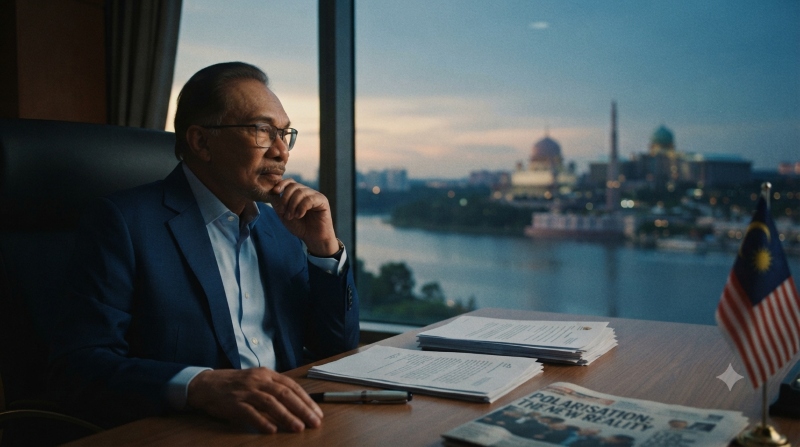
A recent Merdeka Center survey suggests voters are still willing to believe in the ‘unity government’.
The prime minister’s personal approval rating stands at 52%, the highest of all the leaders tested.
But belief alone may not be enough at the general election ballot box. Some 73% of voters say the economy is their single biggest problem, and only 46% are satisfied with the government’s handling of it, against 51% who are dissatisfied.
With 16 to 20 months before the general election, the government faces an existential bottleneck. It must convert personal charisma into political reality and structural delivery.
This piece draws on the Bertelsmann Stiftung Transformation Index (BTI 2024) and analysis from the Iseas-Yusof Ishak Institute. Together, they suggest the government’s tasks ahead are not simply policy challenges – they are urgent political survival strategies.
Making growth feel real
Economic growth figures mean little on their own if household finances remain strained. The BTI 2024 report notes that while Malaysia’s economic fundamentals are stable, rising living costs and wage stagnation are severe vulnerabilities.
The task now is to make growth feel real. Subsidy rationalisation, while economically necessary, is politically toxic unless it is offset by targeted cash transfers and visible wage growth for lower-income households.
- Sign up for Aliran's free daily email updates or weekly newsletters or both
- Make a one-off donation to Persatuan Aliran Kesedaran Negara (ALIRAN), Maybank a/c 507246118995 or CIMB a/c 8004240948
- Make a regular pledge or periodic auto-donation to Aliran
- Become an Aliran member
Infrastructure projects, too, must move from blueprints to reality within the next 18 months. The political payoff of mega-projects such as LRT3 or the East Coast Rail Link will only land if voters see more jobs – not just more concrete being poured.
Winning back Malay confidence
The ‘Green Wave’ of the 2023 state elections triggered a catastrophic haemorrhaging of ethnic Malay support. Iseas analysts say the prevailing sentiment among Malay voters is not necessarily racial supremacy, but a deep anxiety about economic marginalisation (Faisal Hazis, 2023).
Philosophical platitudes about multiracialism will not counter this. What is needed is targeted bumiputra delivery. Initiatives such as Majukan Ekonomi Rakyat and the push to empower bumiputra small and medium-sized enterprises (SMEs) must yield measurable outcomes.
The government must prove its multiracial framework is not a zero-sum game for the Malay majority, but a rising tide that lifts marginalised bumiputra households too.
The coming general election risks a 20-year setback for Pakatan Harapan if the Barisan Nasional-Perikatan Nasional pact keeps up its momentum and turns its ‘Malay unity’ wave into a tsunami.
The Negeri Sembilan election suggested BN-PN voters were highly motivated by the pact’s communal agenda, driven by anti-DAP sentiments and perceptions that the PH-led Madani government had not made life better.
Reforms still moving too slowly
Perhaps the most damning critique from the BTI (2024) is its assessment that democratic reforms under Anwar have been “slow-moving and compromised” – the result of having to appease conservative coalition partners.
The ‘anti-hopping’ law was a significant win. But subsequent missteps – including the controversial conditional pardon issue and the delayed tabling of key anti-corruption frameworks – have blurred the line between the ‘New Malaysia’ and old oligarchic norms.
To win over urban middle-class and civil society voters, the government must pass at least one or two watershed institutional reforms – such as political financing laws or local government elections – before the general election, to prove it is structurally distinct from its predecessors.
Keeping East Malaysia onside
The unity government’s survival rests on East Malaysian blocs such as Gabungan Parti Sarawak and Warisan. As Iseas commentator James Chin (2023) notes, East Malaysian politics has little ideological romance – it is fiercely transactional.
Promises of equal partnership under the Malaysia Agreement 1963 (MA63) must be turned into cash and decentralised power. The federal government must deliver hard cash: more infrastructure grants, the long-promised 20% oil royalty, or fewer federal bureaucratic hurdles for state-led projects.
If East Malaysia feels shortchanged by Putrajaya, the unity government could collapse before the general election is even called.
Talking pocketbook economics
Many voters feel a rhetorical mismatch.
Anwar often speaks in macro-economic and philosophical terms – referencing global supply chains, Islamic civilisation or democratic renewal.
Yet Iseas-Yusof Ishak Institute’s surveys consistently show that the average voter in Malaysia is focused on grocery prices, electricity tariffs and wage stagnation (Weiss, 2024).
The government’s communication must abandon abstract philosophy and speak plainly about its achievements: “We kept cooking oil prices stable”, “We raised your take-home pay”, and “We fixed your local drainage”.
Potential versus proof
The strategic calculus for the general election is fraught. If the government calls an early election in late 2026, it will be asking voters for a renewed mandate based on programmes still under way. As the BTI assessment implies, ‘started’ can look a lot like ‘compromised’ to a cynical electorate – a harder sell.
The safer bet is to run the full five-year term, using 2026-27 as an ‘execution sprint’. By entering the general election in 2027 or 2028, the government would arm itself with proof of completion rather than the promise of potential.
The unity government is navigating a political minefield in which the ticking clock is its greatest enemy. The Merdeka Center data is not a death sentence but a stark warning: personal charisma has an expiry date.
The five critical tasks – tangible economic growth, targeted Malay delivery, uncompromised institutional reform, transactional East Malaysian outreach, and grounded economic communication – cannot be tackled one after another. They must happen at the same time.
If Anwar gives in to the temptation of an early election in late 2026, he risks betting his legacy on ‘potential’.
Malaysia’s unity government will survive only by resisting that urge, embracing the gruelling execution sprint of 2026-27, and arriving at the general election with proof, not promise.
The views expressed in Aliran's media statements and the NGO statements we have endorsed reflect Aliran's official stand. Views and opinions expressed in other pieces published here do not necessarily reflect Aliran's official position.
- Tegakkan maruah serta kualiti kehidupan rakyat
- Galakkan pembangunan saksama, lestari serta tangani krisis alam sekitar
- Raikan kerencaman dan keterangkuman
- Selamatkan demokrasi dan angkatkan keluhuran undang-undang
- Lawan rasuah dan kronisme
