Malaysia’s national digital economy blueprint, MyDigital, has catalysed unprecedented investment inflows.
Data centre-related projects drew RM185bn ($44bn) between 2021 and 2024 (Iseas-Yusof Ishak Institute).
Yet, this surge mirrors a deeper structural paradox – massive capital allocation with negligible productivity returns.
Often, developing nations in the Global South are enamoured by IT promises from the Global North.
A McKinsey report projects that data centres will invest $6.7tn to meet surging demand globally. The capacity needs for AI and non-AI are expected to triple by 2030.
- Sign up for Aliran's free daily email updates or weekly newsletters or both
- Make a one-off donation to Persatuan Aliran Kesedaran Negara (ALIRAN), Maybank a/c 507246118995 or CIMB a/c 8004240948
- Make a pledge or schedule an auto donation to Aliran every month or every quarter
- Become an Aliran member
However, another study found that 95% of US firms report zero measurable returns on AI investments (MIT, 2025). This reflects a widening ‘productivity paradox’ phenomenon emerging even in an economy like Malaysia’s.
A Gramscian lens examines how power operates through cultural control, not just force. Through this perspective, such digital dependency is the result of a form of passive revolution by Global North tech giants and their domestic allies. Hegemony is exercised through technological control rather than direct coercion.
Foreign capital, infrastructure and tech workers
Between 2021 and 2024, Malaysia’s digital financial services and AI expansion relied heavily on external capital. Energy-intensive data centres serve as the infrastructural nucleus of digital growth.
Tenaga Nasional reports maximum demand agreements totalling 5.9GW for current and pipeline data centre projects, against a total contracted capacity of 13.8GW – representing 43% of the nation’s available supply.
This dependence on electricity (and even imported rare earth elements) exposes the material fragility of Malaysia’s digital ambition.
Hegemony sustains itself through cultural and technological production (Gramsci, 1971). This reproduces dependency, in this case, through tech workers trained to serve foreign technological systems.
Digital financial platforms – who profits?
The rapid growth of fintech platforms has intensified wealth extraction rather than spreading technological democratisation or benefits.
Big Tech firms and multinational platform operators capture most of the value.
Meanwhile, domestic fintech startups remain constrained by foreign software dependencies, licensing costs and data storage obligations.
The concentration of capital in a few infrastructural monopolies resembles what political sociologist Nicos Poulantzas described as “internal bourgeoisie collusion” with global monopoly-finance capital.
Malaysia’s fintech ecosystem largely sends value outwards, reinforcing global inequalities and neo-imperial hierarchies.
How financialisation and data create dependency
Malaysia’s digital dependency has multiple consequences:
- heightened exposure to external shocks
- erosion of informational sovereignty and
- deepening financialisation of everyday life
Fintech platforms now mediate transactions once handled by community-based financial institutions, embedding algorithmic governance into daily economic life.
Dependency theory, as articulated by economist Samir Amin (Amin, 1976), warns of this structural entrapment. Peripheral economies supply the raw data and tech workers that sustain the digital core of advanced economies. This is when the World Bank’s “New Digital Frontier” creates digit labour in a digitalised economy.
This information extraction enriches global monopolies while leaving Malaysia technologically dependent.
When the state loses control: policy options
A crisis of hegemony emerges if the state’s consent-based governance model breaks down under economic pressures.
Malaysia’s pursuit of digital modernity – through its national semiconductor strategy, a national AI office, its national digital economy blueprint, and the World Bank’s ‘Digital Frontier’ – risks reproducing dependency.
National sovereignty could become subordinated to infrastructural control by foreign monopolies such as Amazon, Google, Meta, Microsoft, Meta and Nvidia.
An input-output-outcome-impact analysis reveals what real reform requires. Malaysia must invest more in domestic research and development, ensure digital services reach all communities fairly, and foster inclusive innovation.
The ultimate goal should be technological self-reliance rather than continued dependency.
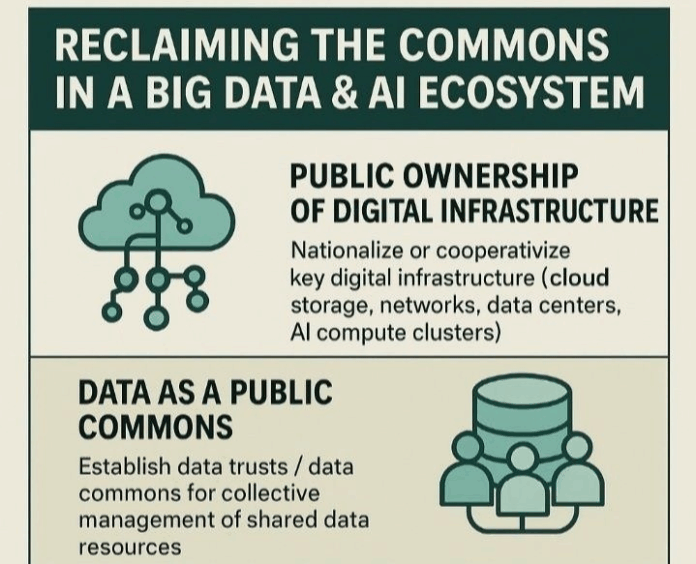
Policy solutions should include publicly owned data infrastructure (a national data commons), Malaysian-controlled AI computing centres and cooperative digital ownership models. These can counter the neo-imperial capture (foreign control) of Malaysia’s digital future.
Foreign data centres are no more than the digital colonisation of a nation. Malaysia becomes a source of raw data, which is processed, analysed and commodified by companies in the Global North.
This extraction of data makes global inequalities worse, increasing the wealth and power of digital monopolies in the Global North.
AGENDA RAKYAT - Lima perkara utama
- Tegakkan maruah serta kualiti kehidupan rakyat
- Galakkan pembangunan saksama, lestari serta tangani krisis alam sekitar
- Raikan kerencaman dan keterangkuman
- Selamatkan demokrasi dan angkatkan keluhuran undang-undang
- Lawan rasuah dan kronisme