

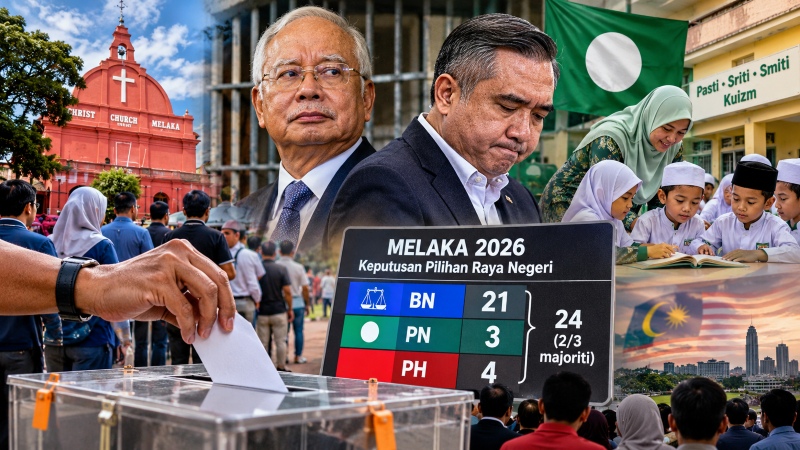
Malacca voters went to the polls on 14 November in an atmosphere few people in Malaysia could have imagined a year ago.
The state election came four days after former Prime Minister Najib Razak began serving the remainder of his SRC International sentence under house arrest.
On 18 September, the Federal Territories Pardons Board had granted him conditional house arrest. On 10 November, the Kuala Lumpur Hight Court allowed that arrangement to take effect.
The next day, Transport Minister Anthony Loke resigned from the federal cabinet, after earlier announcing he would resign on 19 September. Loke said he was resigning over what many saw as a backdoor pardon for a convicted former prime minister.
His offer exposed a crack inside the Pakatan Harapan-led coalition.
The political fractures
Critics had long argued that the DAP had grown quiet on corruption since Pakatan Harapan formed the unity government in 2022. In many supporters’ eyes, Loke’s resignation confirmed that the party had hit a brick wall, as how one Malacca tycoon later described it.
That tycoon is Lee Kim Yew, the veteran developer. On the eve of polling, he posted a Facebook post titled ‘The dilemma of the Chinese‘.
- Sign up for Aliran's free daily email updates or weekly newsletters or both
- Make a one-off donation to Persatuan Aliran Kesedaran Negara (ALIRAN), Maybank a/c 507246118995 or CIMB a/c 8004240948
- Make a regular pledge or periodic auto-donation to Aliran
- Become an Aliran member
His message spread quickly among ethnic Chinese voters in Malacca. He said they faced a bitter choice: stay and bow, or leave and lose. They could remain inside the system and accept its compromises. Or they could walk away and surrender what little voice they still had.
On integrity, ethnicity and religion
Lee listed four grievances.
First, the law no longer felt equal after Najib was moved home.
Second, even a respected leader like Loke could not change the system from within.
Third, Chinese community leaders spent more time fighting one another than uniting against common threats.
Fourth, ordinary voters stayed silent after casting their ballots. They feared being called racist, unpatriotic or divisive.
Lee’s words captured a mood that the official campaign never addressed.
The Malacca contest became far more than a simple fight for 28 state seats. It became a referendum on the Anwar Ibrahim government’s handling of integrity, ethnicity and religion.
By the end of polling night, that question had received a blunt electoral answer. Barisan Nasional won 21 of Malacca’s 28 seats and Perikatan Nasional three, giving the BN-PN partnership 24 seats and a two-thirds majority. PH was reduced to four.
Pas education network
While Chinese voters weighed whether to vote at all, another force was reshaping the Malay heartland: the Pas education network.
Pas does not only seek votes. It builds minds.
For decades the party has run a party-linked education network.
The network begins with Pasti, the Islamic preschools, which had expanded to nearly 2,500 centres nationwide by 2024.
Children then move to Sriti, the Islamic integrated primary schools. There, standard subjects such as maths and science are taught alongside additional Islamic education, including Quranic studies and Kaffah (the basic curriculum covering individual and communal religious obligations).
At secondary level, students enter Smiti, the Islamic core integrated secondary schools.
Beyond that, Pas has links to tertiary institutions such as Kolej Universiti Islam Zulkifli Mohamad (KUIZM), although these are not necessarily part of a single progression route.
The network is overseen by Pas-linked education bodies, including its youth wing and dedicated party education departments. The party has also developed its own teacher-training arrangements.
Pas-linked materials and teaching can carry the movement’s worldview. For many pupils, faith and politics may therefore be presented as closely connected.
The long-term impact is rarely discussed in campaigns. Yet it may matter more than any single result.
Considere, a child who enters Pasti aged five and leaves a Pas tertiary college aged 22 has spent 17 years inside an environment shaped by party-linked religious education. Federal schools teach the same national syllabus, but Pas schools add a layer of religious and political meaning on top.
Consider a child who enters Pasti aged five and eventually graduates from a Pas-linked tertiary institution aged 22. That is potentially 17 years in an educational environment shaped by the movement’s religious outlook and institutional values. [Not every pupil follows this route, but the existence of institutions at successive educational levels gives Pas a long-term presence in the lives of some families.]
Federal schools teach the national syllabus, while Pas-linked schools supplement the academic curriculum with additional religious education and the party’s own educational programmes.
Some graduates become teachers, civil servants, business owners and voters who carry that framework into public life.
Running such schools is not new. Private and religious schools have long existed in Malaysia. What stands out is the degree of organisational integration between the Pas education network and the political party itself.
This raises questions that few in Barisan Nasional or PH seem willing to ask.
What kind of nationhood emerges when a growing share of young people are schooled in a curriculum shaped by party and faith as well as the national syllabus? How does a plural society hold together if its children are taught different versions of our history and the national story?
The Malacca results will not answer these questions.
The DAP’s transport minister has shown that cabinet protest can carry a political cost but may change little. The Chinese tycoon has shown that silence is no longer sustainable. The Pas education network shows that the next generation of voters is being formed outside the political headlines.
Building a disciplined Islamic political movement, however, is not necessarily the same as building a viable national governing coalition.
What Malacca reveals, in the end, is a country pulled in three directions at once.
A government that campaigned on reform now faces questions over a pardon for a convicted former prime minister.
Many in a minority community that once believed in reform now question whether voting matters.
A religious movement whose schools rarely make the headlines is gaining ground in the country’s classrooms.
Elections come and go. Classrooms will continue to exist for a long time.
The house arrest of one man has shaken the system this November. The schools will shape the nation’s politics long after he is gone.
The views expressed in Aliran's media statements and the NGO statements we have endorsed reflect Aliran's official stand. Views and opinions expressed in other pieces published here do not necessarily reflect Aliran's official position.
- Tegakkan maruah serta kualiti kehidupan rakyat
- Galakkan pembangunan saksama, lestari serta tangani krisis alam sekitar
- Raikan kerencaman dan keterangkuman
- Selamatkan demokrasi dan angkatkan keluhuran undang-undang
- Lawan rasuah dan kronisme
