

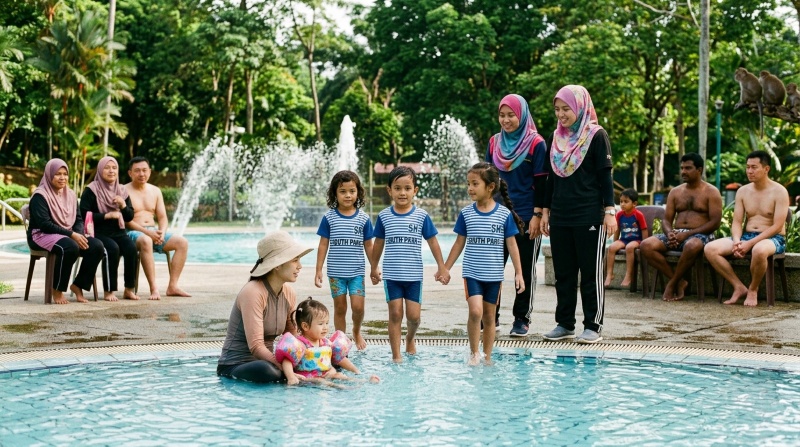
There is a pool in our apartment complex. But today, my daughter and I are swimming at the Penang City Park – formerly known as Youth Park – instead.
Here, the foaming fountains and teeth-baring macaques provide a steady source of adrenaline for a curious 29-month-old toddler.
The lively atmosphere reminds us we are not alone. Visitors from all walks of life share our affection for the wildness of monkey poop and sunbathing monitor lizards.
We join a crowd of ethnic Malay and Indian families. Their children shriek and run barefoot around the pool, while glassy-eyed parents reel in exhaustion, regardless of ethnicity or religion.
The pool has become a ‘third space’ for inter-ethnic and intercultural mingling, where different communities meet and interact.
Ordinary people coexist peacefully in such spaces that resist the boundaries drawn by official categories of religion and ethnicity.
At public pools and playgrounds, our children pull dangerous stunts worthy of Tom Cruise in Mission: Impossible. They throw tantrums in different languages, too.
- Sign up for Aliran's free daily email updates or weekly newsletters or both
- Make a one-off donation to Persatuan Aliran Kesedaran Negara (ALIRAN), Maybank a/c 507246118995 or CIMB a/c 8004240948
- Make a regular pledge or periodic auto-donation to Aliran
- Become an Aliran member
We dine together in restaurants at malls and queue to use public bathrooms at highway rest stops.
Our little ones crawl over shared play areas at paediatric clinics in hospitals. Mothers and fathers wait awkwardly in line for the baby-changing room, which doubles as a breastfeeding station.
Yet while all seems well on the surface, racial rhetoric and xenophobia in national discourse threaten to divide the people.
A well-known religious figure recently questioned the use of a particular language on flags and banners for a festival at a junction in Taman Kosas, Ampang.
Tackling corruption, an ageing population, rising living costs and healthcare would serve as more useful topics for national conversation.
Consider the case of Alice, a 64-year-old Indian Malaysian. Kind, stoic and a staunch Christian, she has a knack for reading people like a book.
Alice works long 12-hour shifts, day and night, in a full-time role at a non-profit organisation. She also holds down a part-time job so she can buy “something nice” for herself and her siblings, she says.
Several years ago, Alice’s husband died from long-term health problems. A year later, her son, barely 21, was killed in a motorcycle accident.
As a single older adult, Alice is eligible for RM150 a month under the government’s STR cash aid programme. She says the support is invaluable, even if it is, sadly, not enough. She has three dependent, ageing and chronically ill siblings to help.
Once, Alice’s RM150 payment was delayed. She looked worried as she told me about it over dinner at a hawker centre.
“This one RM9, is it OK?” Alice pointed to the char koay teow she had ordered. The prawns on her plate were large, but the portion seemed small for RM9.
I write about Alice with her permission, but I cannot claim to speak on her behalf. After all, I am an upper-middle-class Chinese Malaysian who had the chance to pursue higher education. I also don’t have to think about my next meal or electricity bill.
When Alice complained about the long queues at a public hospital, I said, without thinking, that private hospitals could be just as slow. It revealed my bias and my privileged background.
Then I realised what my thoughtless comment meant. My comfortable life had blinded me to the realities of public healthcare, which 75% of inpatients rely on. Only 25% of specialists with over five years’ post-specialisation experience work in the public sector.
The mismatch is stark. Patients in government hospitals face long waits just to see a specialist.
Alice’s sister is currently battling cancer. Alice has probably seen how patchy palliative care is in Malaysia. Funding is inadequate to develop infrastructure, and the system leans heavily on informal caregivers to fill the gap.
As ordinary people, we share third spaces in hospitals, swimming pools and eating outlets. But invisible lines of class still shape how we experience and view our realities.
Public discourse led by political elites amplifies our differences. As a result, ordinary people are beginning to view each other with suspicion.
A recent Free Malaysia Today article by A Kathirasen looks at how insularity is creeping into the way we relate to one another.
Kathirasen tells the story of two neighbours, Joe and Ahmad. Their friendship began with warmth and hospitality, but over the past decade it slowly unravelled – ending with Ahmad refusing to accept a gift of mangoes from Joe.
Joe had left the fruit on Ahmad’s gate pillar for him to enjoy. Three days later, the mangoes were still there, uncollected.
“If we do not consciously choose to step out of our exclusive zones and bridge these widening gaps, the fences between us will soon become too high to ever scale again,” writes Kathirasen.
Change does not come from griping about our neighbours or leaders. If some mangoes fail to make it past the gate pillar of caution, that doesn’t mean we stop sharing luscious fruit altogether. It just means we have to forgive and try again.
While my daughter and I were at the Penang City Park pool one sunny day, we met some Malay children wearing their kindergarten’s shirts. Their teachers, wearing the tudung (Muslim headscarf), stood nearby.
Some of the children seemed curious about my toddler. They had been playing at the deep end, but waded across the pool to join us in the baby pool, just so they could gawk at her.
The gazing that followed was prolonged, mutual and entirely unprejudiced. We adults giggled awkwardly, and it made for an effective icebreaker.
As we inhabit third spaces, we can choose openness despite our fears. Making embarrassing mistakes or feeling shy around difference is part of being human.
But we can wade across the pool of our discomfort anyway, towards open-hearted curiosity.
Happy Merdeka!
The views expressed in Aliran's media statements and the NGO statements we have endorsed reflect Aliran's official stand. Views and opinions expressed in other pieces published here do not necessarily reflect Aliran's official position.
- Tegakkan maruah serta kualiti kehidupan rakyat
- Galakkan pembangunan saksama, lestari serta tangani krisis alam sekitar
- Raikan kerencaman dan keterangkuman
- Selamatkan demokrasi dan angkatkan keluhuran undang-undang
- Lawan rasuah dan kronisme

Well said, Wu Jia. We just need to keep trying – again and again.
To start over there must be 2 things that need to occur.
1. That race based political parties be banned .
2. NEP be directed at the ‘ poor’ and ‘needy’ who qualify – decision made by an independent board setting policy standards . 6 decades of supporting one race is sufficient and needs to end.
3. That term limits for PM
4. That all ministers declared publicly all their assets – advertised in national newspapers .
5. The AG , auditor general is not a member of the governing – complete discretion to prosecute.
6. Jury system be brought back .