
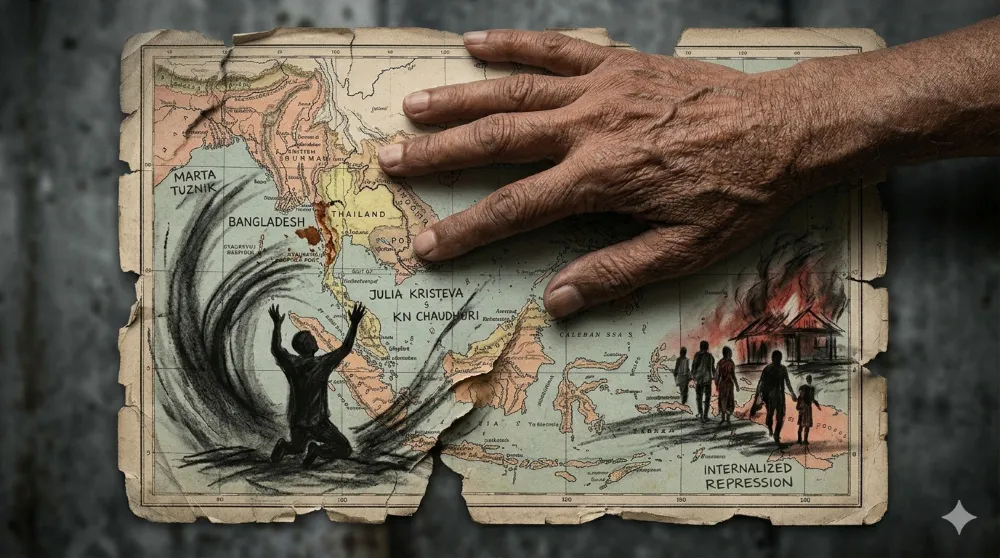
Much of postmodern art features the grotesque. When something threatens our sense of order, disgust rises within us.
Blood and faeces are a part of us, yet we instinctively recoil from them. Tears, menstrual fluids and urine that cross our body’s boundaries become “estranged and unfamiliar”, as Marta Tuznik writes in Blood, Death and Fear – Philosophy and Art in Relation to the Myth of Womanhood.
Julia Kristeva coined the idea of abjection – the instinct to cast out whatever threatens our sense of self. The “abject”, she writes, is simply “opposed to I”.
Societies work the same way: they define themselves by what they exclude. Languages, laws and cultures become shaped by what they repress. LGBT identification, for instance, challenges clear definitions of sex and gender.
This brings to mind the plight of the Rohingyas in Malaysia. They have been labelled opportunist criminals with hygiene problems, accused of stealing jobs and burdening public resources.
- Sign up for Aliran's free daily email updates or weekly newsletters or both
- Make a one-off donation to Persatuan Aliran Kesedaran Negara (ALIRAN), Maybank a/c 507246118995 or CIMB a/c 8004240948
- Make a pledge or schedule an auto donation to Aliran every month or every quarter
- Become an Aliran member
Rohingyas – whom some describe as “dirty”, “revolting” and “foreign” – are cast as the opposite of what is tidy: the purity of citizenship and the neatness of the nation’s borders.
Yet the borders across Southeast Asia and their stability owe their existence to colonisation.
Farish A Noor, drawing on KN Chaudhuri’s book Asia Before Europe, points out that Asia was once a polynuclear region where cultures, ideas and people moved freely across borders.
The Indian Ocean was not a source of contention nor did it divide the separate parts of Asia. It was instead a liminal space – a living crossroads – for the exchange of cultures, languages, religions, ideas and goods.
From the late 18th to mid-20th centuries, European powers carved up Asia, creating regional blocs such as “Southeast Asia” for the convenience of colonial rule.
Yet Southeast Asia’s development owes much to its local adaptation of outside cultures, languages and religions of the wider world. For centuries, people, ideas and goods mingled and crossed borders freely across Asia.
Southeast Asian languages share striking similarities, and many native tongues borrow heavily from Sanskrit roots, attesting to prolonged cultural hybridisation.
Colonial regimes introduced division and the policing of borders. They stemmed the flow and exchange of cultures, religions and ideas.
By the mid-19th Century, competing Western European navies had turned maritime Southeast Asia into a battleground for Empire. Southeast Asians could no longer move freely in their own waters.
Colonial powers controlled and policed Southeast Asian trade. Treaties signed by rival imperial powers – Britain, the Netherlands, France, Spain and Portugal – divided the region into territorial chunks and colonial enclaves belonging to their respective colonial regimes.
Colonisation still exists in various forms. Today, Myanmar’s military junta is clearing the Rohingyas from their homeland, Rakhine state, for infrastructure projects and natural resource extraction like oil and gas pipelines.
The Kyaukpyu deep-sea port in Rakhine gives China a vital supply of oil and gas for its inland provinces. The petroleum company from China could certainly do more to ensure its projects empower local communities in Myanmar.
While China provides significant infrastructure and some humanitarian support, there are real concerns about transparency and the lack of meaningful consultation with communities living in or near areas of active conflict.
The Myanmar government, for its part, needs to regulate these projects more responsibly and consult meaningfully with communities.
Rakhine is a battleground between Myanmar’s military junta and the Arakan Army.
Imagine what it is like to be stripped of your citizenship rights in your own homeland, then forced to flee because of armed conflict.
Or to witness your mother, wife or daughter being gang-raped by soldiers of security forces.
Imagine floating on a log as one of the lone survivors, having watched fellow refugees drown when a trawler carrying up to 250 people capsized in the Andaman Sea.
Doesn’t sound like an awful lot of fun.
Perhaps we need to look at ourselves as a country that seemingly gained independence from colonial rule.
When we spew hate at people who seem different from us, we unwittingly hinder efforts at holding the perpetrators of the Rohingya genocide accountable.
After all, the International Criminal Court’s prosecutor has applied for an arrest warrant for the Myanmar junta leader.
Let’s think about what we can do to support the Rohingya community here, given that their resettlement to third countries has slowed to a trickle.
AGENDA RAKYAT - Lima perkara utama
- Tegakkan maruah serta kualiti kehidupan rakyat
- Galakkan pembangunan saksama, lestari serta tangani krisis alam sekitar
- Raikan kerencaman dan keterangkuman
- Selamatkan demokrasi dan angkatkan keluhuran undang-undang
- Lawan rasuah dan kronisme
