
Chris Majella
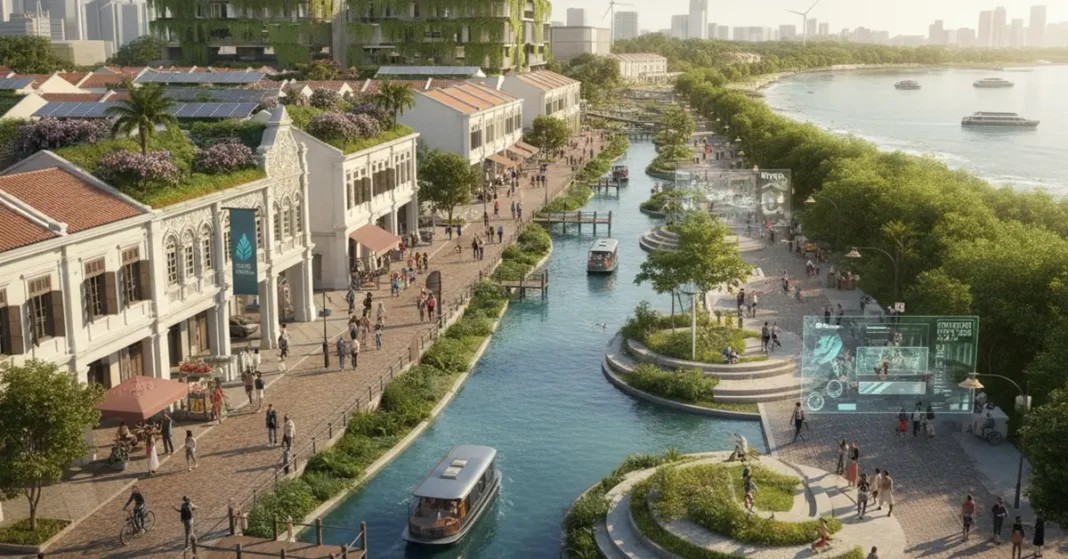
Penang Island could transform itself from a congested heritage island into Southeast Asia’s premier ‘sponge city of culture’.
It could become a resilient, people-first state – one that harmonises Unesco heritage with climate-adaptive innovation.
This could create a liveable model for 22nd-Century tropical cities.
Like Utrecht, Penang would need to undergo a values transformation for this to happen.
- Sign up for Aliran's free daily email updates or weekly newsletters or both
- Make a one-off donation to Persatuan Aliran Kesedaran Negara (ALIRAN), Maybank a/c 507246118995 or CIMB a/c 8004240948
- Make a pledge or schedule an auto donation to Aliran every month or every quarter
- Become an Aliran member
Instead of measuring progress in highway lane-kilometres, it could measure progress differently.
A blue-green index would count hectares of water-absorbent public space per capita.
A heritage vitality score would track active uses in heritage structures.
Mobility freedom would measure the percentage of trips under 20 minutes without private cars.
The vision
The Unesco World Heritage Site in George Town could be turned into pedestrian and cycle zones, with clean public transport options – eg electric shuttles and trishaws – providing added mobility.
Penang’s historical canal network could be resurrected and expanded as green-blue corridors. They would serve as transit routes, monsoon drainage and public spaces
Electric water taxis could connect George Town to Butterworth and Bayan Lepas. These could integrate ferries, autonomous electric buses and a congestion-charge zone.
Flood-prone areas could be converted into wetland parks that would absorb significantly more stormwater.
All new buildings could incorporate water-capturing green roofs. Historic buildings could receive rainwater harvesting systems.
Waterfront plazas could be designed to safely flood during high tide. They could also become community gathering spaces·
Around 5km of coastal mangroves could be restored to act as living seawalls and carbon sinks.
Under-used heritage buildings could be transformed into tropical design labs. They could also become immersive cultural-tech studios and social enterprise hubs.
Penang’s food heritage could be protected and digitised. Next-generation hawker innovation kitchens would preserve culinary traditions.
Select streets could become living heritage sites – ‘time capsules’ with augmented reality experiences that would overlay historical layers.
The pathway
Pilot canal restoration could begin with a 1km stretch. The first car-free zone could be implemented around Armenian Street.
A monsoon park prototype could be launched. A heritage innovation fund could be established.
The primary canal network (8km) could be completed. Private vehicle trips to the core could be reduced by 40%· Climate-resilient infrastructure standards could become mandatory.
Having amenities closer to people’s homes could be achieved. The state should aim to reach carbon-negative operations.
Penang could become a living lab. It would export tropical urban solutions.
The benefits
Over 50,000 new jobs could be created. These would be in climate tech, heritage restoration and sustainable tourism.
Cleaner air could reduce respiratory illnesses. Active mobility could improve public health.
Penang could become a global hub for heritage-led innovation.
A Penang regeneration bond could become Southeast Asia’s first municipal green bond to finance this transformation.
Community land trusts could protect heritage areas from speculation.
Living lab partnerships could be formed with universities, UN-Habitat and the private sector.
An urban lighthouse for the region
Penang’s transformation wouldn’t merely be about restoring canals or reducing cars.
It could demonstrate how tropical heritage cities can leapfrog the 20th Century to become climate-adaptive without sacrificing character. These cities could be economically vibrant without congestion. And they could be globally distinctive while locally rooted.
Like Utrecht’s rediscovered canal and waterfront transformation, Penang could reconnect with its rainforest-meets-sea essence. It could create a city that breathes, absorbs, adapts and inspires.
The concrete can retreat. The water can return. And the people can flourish.
Utrecht progressed by courageously admitting a past mistake. It returned to its human-scale, water-embracing roots.
Penang now has a chance to progress even further. It could avoid the mistake altogether by leaping directly to a people-centric, climate-resilient future.
Chris Majella is a former director of several Malaysian companies. He currently advises several organisations and NGOs.
AGENDA RAKYAT - Lima perkara utama
- Tegakkan maruah serta kualiti kehidupan rakyat
- Galakkan pembangunan saksama, lestari serta tangani krisis alam sekitar
- Raikan kerencaman dan keterangkuman
- Selamatkan demokrasi dan angkatkan keluhuran undang-undang
- Lawan rasuah dan kronisme





Penang is Penang. Utrecht is whatever it is!
I don’t see any relevance and connection between the two, and I certainly do not think Penang needs to even transform and reform itself to become Utrecht or whatever else. Both cities are built on entirely very different geographical and historical as well as cultural aspects.
One is an island, another in situation in a sinking country below sea level. Canal is the thing for the Netherlands, not Penang. Malacca would share bit more similarities instead.
My question is, why should Penang be expected to change to become something that is not what Penang is known and appreciated for? To be honest, how many non Dutch ppl actually even heard of Utrecht, I haven’t until now!