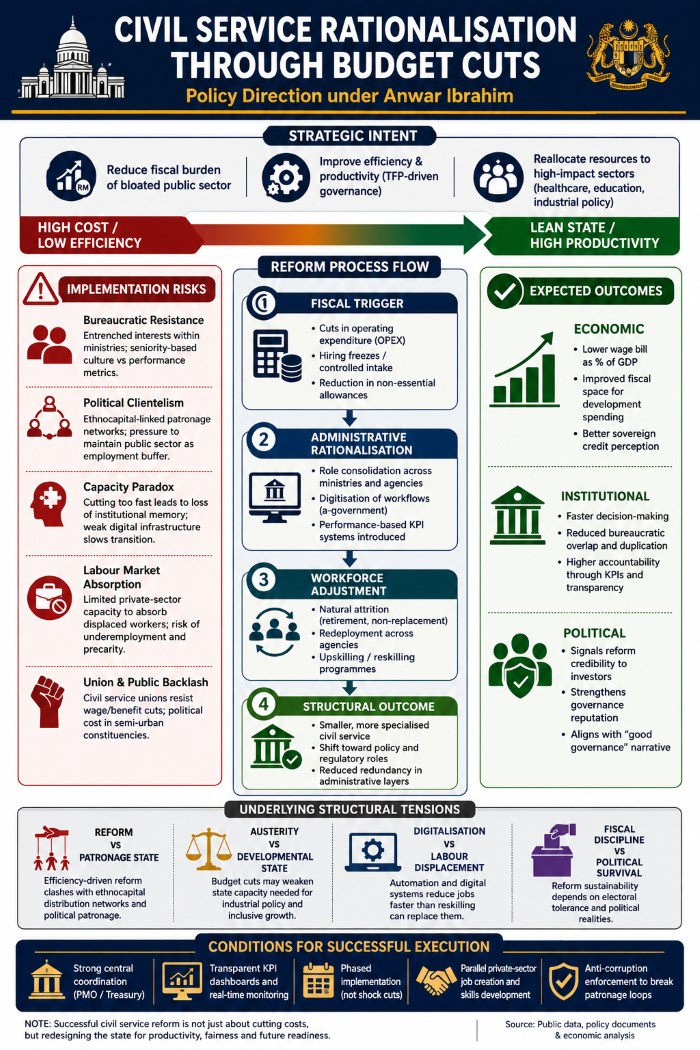
The recently announced civil service rationalisation programme has to be understood not just as administrative reform.
It is not about downsizing the government. It is a moment of structural contestation.
It attempts to recalibrate the balance between governing efficiency and political patronage, between fiscal discipline and political survival, and between geoeconomic pressures and domestic social obligations.
The reform depends not only on conceptual idealism, technical design and effective implementation. It must also confront these contradictions directly.
This process will encompass strengthening institutional transparency, enforcing anti-corruption measures and, vitally, redefining the role of the state beyond its present perception as a distributor of wealth among the people.
- Sign up for Aliran's free daily email updates or weekly newsletters or both
- Make a one-off donation to Persatuan Aliran Kesedaran Negara (ALIRAN), Maybank a/c 507246118995 or CIMB a/c 8004240948
- Make a pledge or schedule an auto donation to Aliran every month or every quarter
- Become an Aliran member
How the civil service can be reformed is well documented by two World Bank reports: Re-energising the Public Service (2019) and From Bytes to Benefits: Digital Transformation as a Catalyst for Public Sector Productivity (2025).
Whether such a reform can transcend the very system it seeks to change is a good question to ask. In Malaysia’s ethnocapitalist context, this remains an open and deeply political question.
Civil servants constitute a major voting bloc in semi-urban and rural constituencies. Any perception of job losses or even a spectre of insecurity, wage stagnation or loss of benefits may well translate into an electoral backlash.
Not infrequently, this places policymakers in an uncomfortable position: pursuing fiscal discipline while maintaining political support. Historically, such contradictions have led to partial reforms, reversals or the dilution of policy intent.
‘Lean’ for whom?
The concept of a “lean state” must therefore be interrogated more critically. Lean for whom, and at whose expense?
If budget cuts disproportionately affect lower and middle-tier civil servants while leaving higher-level patronage structures intact, the reform risks reproducing existing inequalities under the guise of efficiency.
Conversely, if the reform genuinely targets systemic inefficiencies and patronage networks, it requires a level of political will and institutional independence that is difficult to sustain within existing capital, class and clan power structures.
Furthermore, redirecting funds to healthcare, education or industrial policy has to address the underlying rent extraction mechanisms, capital accumulation processes and capital leakages. Funds can be redirected, but if governance structures remain compromised, the outcomes may still not differ significantly.
AGENDA RAKYAT - Lima perkara utama
- Tegakkan maruah serta kualiti kehidupan rakyat
- Galakkan pembangunan saksama, lestari serta tangani krisis alam sekitar
- Raikan kerencaman dan keterangkuman
- Selamatkan demokrasi dan angkatkan keluhuran undang-undang
- Lawan rasuah dan kronisme