
By Ahmad Chik
Following criticism of Penang’s proposed expensive elevated light rail system, Zairil Khir Johari’s response is typical of a politician.
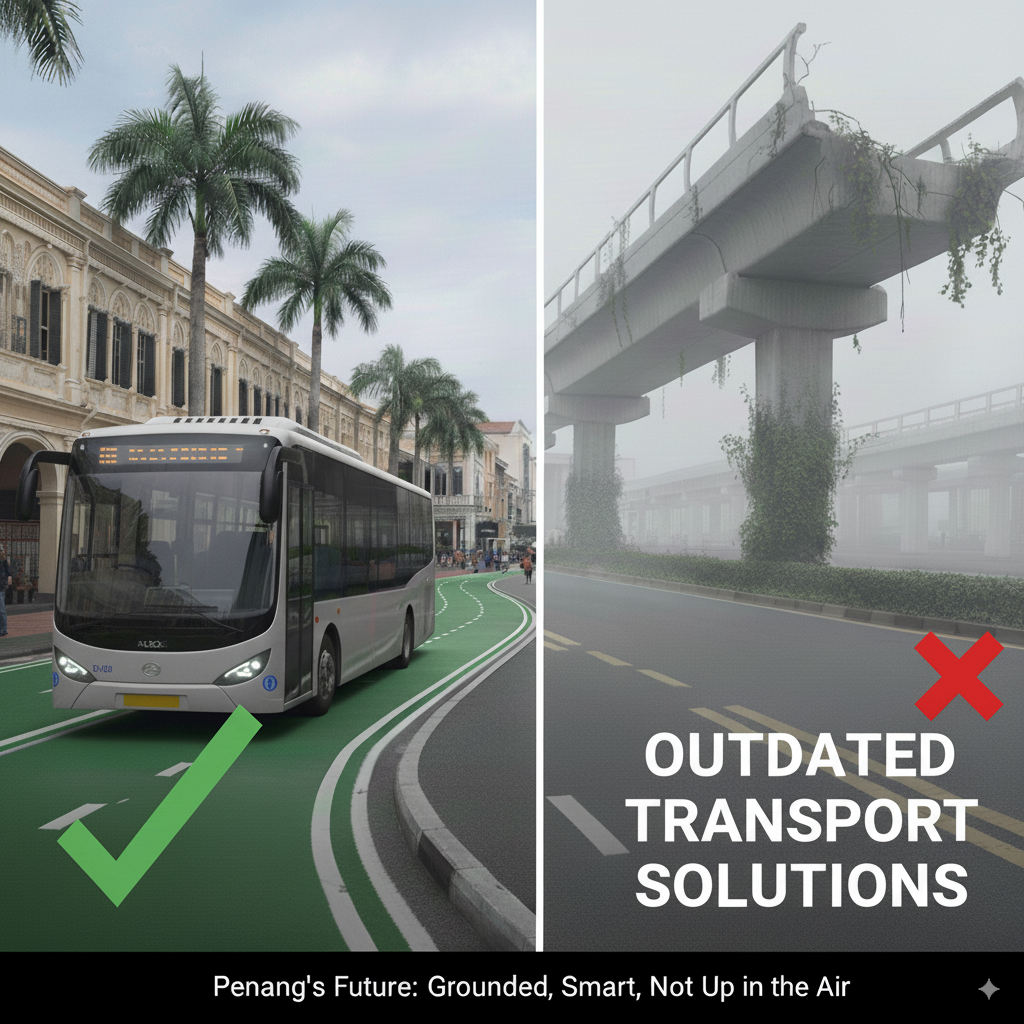
The state transport chief evades the issue and coins a flippant sound bite (“buses do not fly”). He then diverts attention by attacking economist Lim Mah Hui over the Spice convention centre.
Zairil avoids the major questions. How can this expensive project be economically sustained, given Penang’s small – and barely rising – population? Of the 1.8 million residents of Penang, the island has just 0.8 million and the mainland 1.0 million.
So where will the ridership come from for the overhead light rail to break even? Why is he ignoring the experience of the Klang Valley?
- Sign up for Aliran's free daily email updates or weekly newsletters or both
- Make a one-off donation to Persatuan Aliran Kesedaran Negara (ALIRAN), Maybank a/c 507246118995 or CIMB a/c 8004240948
- Make a pledge or schedule an auto donation to Aliran every month or every quarter
- Become an Aliran member
Zairil also has not explained how the elevated light rail system and the tunnel will improve traffic on the first Penang bridge, Ayer Itam, Masjid Negeri Road and Gottlieb Road, to name just a few.
Lim Mah Hui and civil society did not oppose the Spice project because it was economically unviable. They opposed it because the agreement was skewed heavily in the developer’s favour. That, however, is water under the bridge and not germane to this discussion.
Zairil does not seem to realise that the traffic mess we face today is a direct result of unplanned, developer-driven mega-projects that this government has allowed for 17 years. By the way, where is the long-promised Penang Island local plan?
One part of the government recklessly approves major traffic-generating, high-density projects, while another laments how severe the traffic problem is. The contradiction is almost absurd and would be laughable if it were not so serious.
Experience elsewhere clearly shows that traffic issues must be tackled holistically as part of overall development planning. Matters such as car parks, walkways and first-mile and last-mile connectivity must be considered. There is no evidence these issues have been factored in.
Given the government’s failure to tackle basic problems such as illegal parking and the poor walkability of pedestrian walkways, it is doubtful whether it has the will or the capacity to do so.
By doggedly clinging to the pricey elevated light rail system, isn’t Zairil trying to solve today’s problems with last century’s solutions? Why are recent technological developments not being considered?
Why are cheaper, more flexible autonomous bus systems being dismissed out of hand – because they “don’t fly”?
Dedicated bus lanes will cause disruption initially, but it would be no worse than the disruption caused by the elevated light rail system and tunnel construction.
Autonomous taxis, when fully developed, will also be a game changer for urban mobility. They are being trialled in many major cities and are likely to be common in Penang before the elevated light rail is ready. Isn’t there a danger the elevated rail system will be obsolete even before it is completed?
No, the elevated light rail system will not solve our traffic woes. Instead, it will be an expensive millstone around the necks of future generations.
Ahmad Chik, a long-time Aliran member, is a concerned resident of Penang.
AGENDA RAKYAT - Lima perkara utama
- Tegakkan maruah serta kualiti kehidupan rakyat
- Galakkan pembangunan saksama, lestari serta tangani krisis alam sekitar
- Raikan kerencaman dan keterangkuman
- Selamatkan demokrasi dan angkatkan keluhuran undang-undang
- Lawan rasuah dan kronisme


