

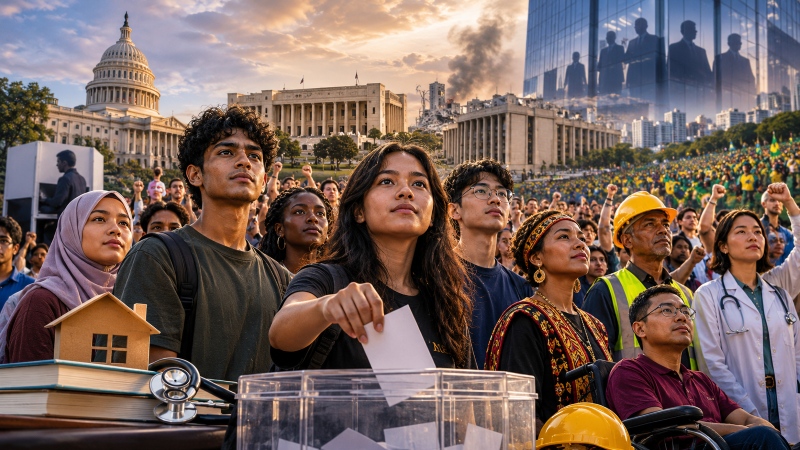
This is the season of elections. Many of us have followed news of the recent votes in the US, Brazil, Israel, New Zealand and Serbia – though perhaps not the local elections in China. Young people have often played critical roles.
I will discuss the American and Israeli cases, and mention Brazil in passing. Then, I will draw some lessons for us in Malaysia.
‘Blue wave’ in America
First, the US midterm elections were held on 3 November. The results were a major victory for the Democrats.
In the Senate, the Democrats won 22 of the 35 seats up for grabs. They will hold 56 seats to the Republicans’ 44 (previously 47 to 53) when Congress convenes in January 2027.
They also won control of the House of Representatives, where the Republicans previously had a slim majority of 218 to 214. The Democrats have won at least 259 seats to the Republicans’ at least 173, with three races still being counted – almost 60%.
The Democrats also won 24 of 36 governors’ races. Once they take office, they will hold 30 governorships to the Republicans’ 20 (previously 24 to 26).
Several winners made history.
- Sign up for Aliran's free daily email updates or weekly newsletters or both
- Make a one-off donation to Persatuan Aliran Kesedaran Negara (ALIRAN), Maybank a/c 507246118995 or CIMB a/c 8004240948
- Make a regular pledge or periodic auto-donation to Aliran
- Become an Aliran member
Keisha Lance Bottoms became the first black woman elected governor in US history, in Georgia. Deb Haaland became the first Native American woman governor in the entire US, in New Mexico. Gina Hinojosa became the first Latino/Hispanic person of any gender elected governor of Texas.
In the Senate, Peggy Flanagan became the first Native American woman elected to the chamber, in Minnesota, alongside Mary Peltola, who became the first Alaska Native elected to the Senate, in Alaska. Dr Abdul El-Sayed also won in Michigan, becoming the first Muslim US senator.
Earlier this year, Zohran Mamdani became New York City’s first Muslim mayor.
These victories are encouraging for an America that advertises itself as a land of opportunity for all and that has historically welcomed immigrants. There is no doubt that young people, especially Gen Z, have returned to politics, and several of the new faces are youthful.
The wave reflected anger at President Donald Trump’s second-term policies. His tariffs on imports from Canada, Europe, China and elsewhere pushed up the cost of living. His war in Iran raised diesel and petrol prices and cost the lives of US servicemen and women. Data centres built in neighbourhoods have stirred discontent over heavy water consumption and rising electricity bills.
Not surprisingly, Trump’s approval rating fell to near-record lows for his second term before 3 November, with some polls putting it in the low 30s.
Morphing into an oligarchy
Consider how Trump has used his powers as president. He has frequently bypassed Congress to govern by executive order, often rolling out policies unilaterally rather than bringing them to Congress – let alone consulting the people.
Among the most controversial policies has been the expanded role of ICE (Immigration and Customs Enforcement), which increasingly operates deep inside urban centres rather than near the borders. This large armed force has arrested people of colour suspected of entering or overstaying in the US, tearing them apart from their families. Several people have been killed by agents, and dozens more have died in ICE custody.
This is plain cruelty and contempt for human dignity. It is unexpected from a country that once prided itself on welcoming immigrants and offering opportunity to all who worked hard.
Bernie Sanders, the independent senator from Vermont, argues that the US is more of an oligarchy than a democracy. By that, he means rule by a small group of elites rather than by the people.
Sanders says the country has been “captured” by big business and an industrial oligarchy. The few at the top, especially Big Tech oligarchs, he argues, hardly pay their fair share of taxes. He calls this the worst concentration of wealth in history.
Yet the richest nation in the world does not offer universal healthcare. So people have to buy health insurance. Even those who can afford cover can lose their homes and face lifelong debt if they fall seriously ill, especially with illnesses such as cancer.
Rising housing distress is another sign. A prominent real estate analyst noted that 380,000 homes had received foreclosure filings so far in 2026. Another 34,472 were added in October, putting the projected full-year total at 440,000 – about 20-23% higher than in 2025. Large numbers of people are now living in tents and makeshift shelters in American cities.
Credit card debts and student loans are alarmingly high, and more people are late with car payments. Many live from payday to payday.
There are growing numbers of poor people in the richest country in the world. America has also lost, perhaps, millions of manufacturing jobs, partly because companies relocated production to China and elsewhere in the Global South, where labour is cheaper.
So the recent euphoria among the Democrats, after power shifted from the Republicans might not bring new change – unless policies shift too. Above all, the US must curb its drift towards oligarchy.
A capital gains tax on the richest 1%, including billionaires, would go a long way towards funding healthcare, decent housing, better education and safety from crime for ordinary working people.
The newly elected Congress, which takes office in January, will be controlled by the Democrats. It must be proactive and push a pro-democracy agenda. For this to happen, the leaders of the Senate and House must be persuaded to halt this drift.
That is why the battle has moved to preventing Chuck Schumer and Hakeem Jeffries for Senate majority leader and House Speaker. Critics note that both have received support from Aipac and other corporate lobbyists.
Several new Democrats in the Senate are gearing up for a fight with Schumer. Senator Chris Van Hollen of Maryland has said it is time for change and will challenge Schumer.
Alas, the fight to oust Jeffries from becoming House Speaker appears to have been ‘resolved’. Possible challengers such as Rep Ayanna Pressley and Rep Alexandria Ocasio-Cortez initially showed interest, but neither entered the race.
This will let Jeffries go down in history as the first black Speaker. He has promised to look into progressive concerns such as universal healthcare and school funding. So, will this be a plus or a minus for the reforms needed?
The end for Netanyahu?
Most of us know little about elections in Israel. Thanks to social media and Al Jazeera, which kept us informed about the genocide in Gaza, our attention is now on the outcome of the Israeli parliamentary elections held on 27 October. We see the ongoing difficulty of forming a new coalition government – for no single party won a majority in the 120-seat Knesset.
The opposition Yashar party, led by Gadi Eisenkot, a former army chief, was given the first chance by the president to form a coalition. Eisenkot has announced plans for a “national emergency” minority government if broader coalition talks fail.
But it can only succeed if the Palestinian Israeli parties, which won 19 of the 120 seats, do not oppose it. These parties oppose any attempt by Benjamin Netanyahu to form a so-called ‘unity government’ led by his Likud party.
Despite the name, Netanyahu’s proposed coalition would defend the “Jewish democratic state” and oppose any attempt to create a Palestinian state (made up of the West Bank and Gaza). (The creation of the Palestinian state is part of the ‘two-state solution’ under the Oslo Accords, signed by Israel and the Palestine Liberation Organisation in 1993. Shimon Peres, Yitzhak Rabin and Yasser Arafat shared the 1994 Nobel Peace Prize for their work towards peace.)
Netanyahu argues he needs to lead a unity government as Iran continues to pose an existential threat to Israel.
But Netanyahu has not been able to form a coalition, not only because of opposition from Palestinian Israeli parties. Many Jewish parties also oppose him. They say he manipulated and marginalised them when they served in his previous government.
We must also debunk Israel’s reputation, promoted in the West, as “the only democracy in the Middle East”. That is true only if democracy means holding regular elections. Having followed Al Jazeera and social media regularly since Israel started its genocide of Gaza, we know better. Elections do not a democracy make.
Indeed, the world has learnt that Palestinians in Israel, who make up 21% of the population, do not enjoy the same rights as Jewish citizens. The parties they back have just won 19 of the 120 Knesset seats.
Even if they and their forebears were born in Palestine/Israel, they are discriminated as non-Jews and are treated as second-class citizens. They face barriers to the best schools and top universities (like Hebrew University) and top positions in the civil service and decision-making. They are generally not conscripted into the army. In fact, a Jewish immigrant born in the US, Britain or Argentina can quickly gain full rights like other Jewish people in Israel. Not so the Palestinian Israelis!
Refusing to call Gaza a genocide, mainstream Western media, including the BBC and CNN, make a big deal about the Israeli election instead. They highlight the difficulties Netanyahu or Eisenkot face in forming a government.
In the process, they have conveniently ‘forgotten’ that the International Court of Justice has found enough basis in South Africa’s allegations to rule that Palestinians face a plausible risk of genocide in Gaza. (The court has ordered emergency measures while the full case proceeds.) This alone should tell the world that Israel is not worthy of being considered a democracy.
Israel continues to occupy the West Bank, where settlers are evicting Palestinians with impunity.
Israel is also engaged in military action in warfare in Lebanon, Syria and Iraq.
Lula’s wins a fourth term
On 25 October Luiz Inacio Lula da Silva won 51.8% of the votes, defeating Flavio Bolsonaro in the second round of Brazil’s presidential election. It is Lula’s fourth non-consecutive term as president.
Flávio, who had won the first round 47% to Lula’s 45.2%, is the son of former President Jair Bolsonaro.
Jair had lost the presidency to Lula in 2022 and then tried to plot a coup. He was later convicted and sentenced to 27 years in prison, serving it under temporary ‘house arrest’ on health grounds.
Flávio has contested the 2026 result on the grounds that election authorities extended voting hours in the south due to heavy rains and public transport problems. Flavio’s own team reportedly had backed the request. The authorities have dismissed his objections.
In the event, Lula polled about 4.4 million more votes than Flávio, thanks to his youthful digital team. Through a social media and WhatsApp network of over 10 million supporters, they helped bring nearly three million more people to the polls in the second round while millions of other voters shifted to Lula.
That said, Lula will not find governing easy. The country is deeply divided. Bolsonaro’s Liberal Party is the single largest in both houses of parliament and is backed by Big Business and industrialists.
The Bolsonaros are also close to Trump. Most of Brazil’s neighbours have elected right-wing governments, including Argentina, Chile and Peru. Regional governments opposed to Washington have faced high tariffs and even an economic blockade, as in the case of Cuba. Venezuela even had its leader, Nicolas Maduro, kidnapped by US forces.
Lessons for Malaysia
The lesson from the US is that midterm elections can change the leadership of Congress. That could change the everyday lives of ordinary working people if sound pro-people policies are passed.
However, we must consider the role of the president. He has considerable powers to bypass Congress and to veto policies he disagrees with.
We must also consider the Supreme Court, which is expected to be an independent third force. But presidents tend to nominate judges who share their values and views. The court today leans conservative because Republican presidents nominated most of its current judges when vacancies arose. That said, judges have occasionally surprised us by taking positions contrary to their general orientation.
Perhaps the most important lesson is that a change in Congress means little without pro-people policies. Even then, a president who disagrees might veto them.
Beyond the checks and balances between the three branches, there is the political and economic reality facing would-be reformers. The American economy is dominated by Big Tech, Big Pharma, the military-industrial complex, media moguls and Big Agribusiness. Special lobby groups such as the American Israel Public Affairs Committee (Aipac) and the National Rifle Association also wield influence.
Consider Aipac, which will keep lobbying Congress members to ensure the US continues to provide aid and sell arms to Israel.
Consider also the seemingly straightforward case of curbing the sale of arms, especially semi-automatic weapons. These arms have led to repeated, senseless killings of children in schools.
But no, the NRA has lobbied for the right to carry all types of arms for self-protection. It links this to the Second Amendment and the defence of freedom and civil liberties.
Next, consider how hard it was for Obamacare, or the Affordable Care Act, to become law in 2010. It has since been steadily weakened under Trump. Behind these manoeuvres, Big Hospital owners fight the expansion of public healthcare. Big Pharma protects its monopolies on particular drugs and impedes generics, even though prescription costs have become prohibitive for many.
The lesson from Israel is simple: elections do not a democracy make! Yes, Netanyahu and other Israeli leaders have been elected. But the election outcome has not stopped the genocide in Gaza. Nor has it stopped the expansion of the occupation of the West Bank, where, settlers have used violence to push out Palestinians, often living in areas first occupied by their parents and grandparents before World War Two.
We should not forget that the Israeli government and society at large discriminate against Palestinian Israelis, essentially treating them as second-class citizens.
In Brazil, elections can be used to legitimise domination. But Brazil also shows that elections can provide opportunities to break through barriers and push for reforms.
How did Lula win? His youthful teams combined mammoth rallies and social media to reach working people and young voters.
Will change come? The analyses we have read caution that it will be slow. The country is deeply divided. The Brazilian oligarchy is powerful, with strong ties to America. Lula’s left-wing government also sits alongside right-wing governments in neighbouring countries.
Democracy is more than elections
Free, fair and clean elections are a fundamental part of democracy. But they are not the be-all and end-all of democracy.
In fact, elections are ‘Janus-faced’ – meaning two-sided. When democratic ferment precedes or accompanies them, the people can influence the political situation in their favour. This is the bright side.
The shadowy side is that elections can legitimise those in power. They can also domesticate, institutionalise and stifle demands for democratic politics.
Put another way, elections can be used to deny democracy! Recall how, at the height of Reformasi, Dr Mahathir Mohamad associated the movement with chaos and instability. He challenged those involved to form a political party and contest against Umno-Barisan Nasional in the polls. Look where Reformasi is today!
Democracy is more than elections. The Arab Spring, Occupy Wall Street, the People Power that toppled Philippine President Ferdinand Marcos, the Reformasi movement that contributed to the toppling of Suharto in Indonesia, the Reformasi and Bersih movements in Malaysia, the struggle for independence in Malaysia and across South East Asia, and now the Spring Revolution against the military junta in Myanmar – all are about democracy too.
In fact, there are several dimensions to democracy.
First, political democracy covers civil liberties and political rights. These include the vote for all adults, regular multi-party elections and checks and balances on the different branches of government. This is the liberal democracy that the US prides itself on. It is the realm of formal ‘Big-P’ Power politics, dominated by professional politicians – MPs, Aduns (state assembly members) and members of Congress. We have discussed it above.
Second, there is economic and social democracy, linked with a welfare state. The right to political liberties should come with rights to basic needs, freedom from poverty, education, housing and a life with dignity. Political democracy can be reduced to a non-democracy when wealth is distributed unevenly. As Bernie Sanders asserts, the US, with its highest levels of wealth inequality ever, risks becoming an oligarchy.
Third, there is workers’ democracy, or workplace democracy that the socialists, trade unions and the working class have traditionally demanded. But capitalist society ignores this form of democracy. Democratic principles and citizenship rights are held in abeyance at the factory gate on the grounds that the space is deemed ‘private property’. Inside, you are accorded only the rights required by industrial law. These are always less than what is needed for your full dignity.
Fourth, there is the democracy of everyday life, sometimes called ‘cultural democracy’, involving ordinary people. Under this rubric, there should be no discrimination against women, minorities, Indigenous peoples, people with disabilities or LGBTQ people. This is also the realm of non-formal, ‘small-p’ participatory politics, dominated by NGOs and, nowadays, social media.
We should not focus only on the formal Big-P Power politics that takes place every four or five years. We need to engage in both big-P and small-p politics. Apart from winning elections and challenging the oligarchy, we need a cultural revolution as well.
For more discussion on this, see my 2012 commentary ‘Elections and democracy in Malaysia’.
Francis Loh
Co-editor, Aliran newsletter
26 November 2026
The views expressed in Aliran's media statements and the NGO statements we have endorsed reflect Aliran's official stand. Views and opinions expressed in other pieces published here do not necessarily reflect Aliran's official position.
- Tegakkan maruah serta kualiti kehidupan rakyat
- Galakkan pembangunan saksama, lestari serta tangani krisis alam sekitar
- Raikan kerencaman dan keterangkuman
- Selamatkan demokrasi dan angkatkan keluhuran undang-undang
- Lawan rasuah dan kronisme
