

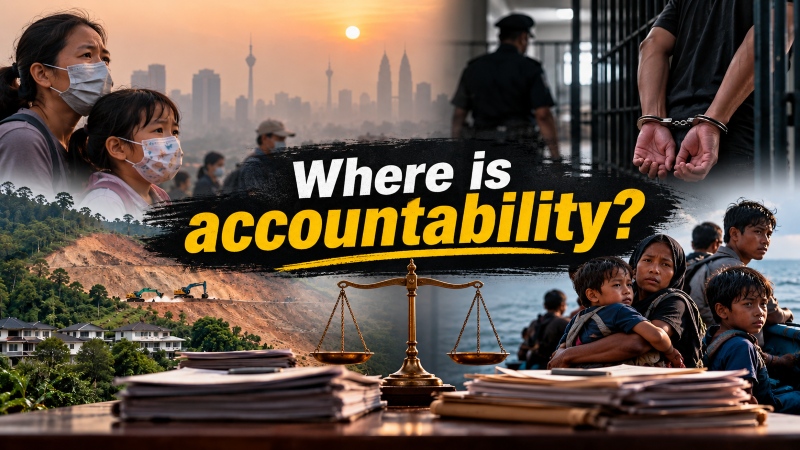
A lack of accountability runs through many of the issues we see in the country today. Many of these issues are not new. We see them emerge time and again.
Often, there is outrage, then promises of reform or monitoring. Then, attention fades until the issue crops up again.
This newsletter looks at accountability in four areas: the recent transboundary haze, a death in police custody, dangerous hill development and the dehumanising of refugees.
Transboundary haze
For the past two to three months, millions of people in Malaysia, Singapore and Indonesia suffered the toxic effects of forest and peatland fires in Indonesia. They include children, older people, people with respiratory conditions, and those who work outdoors.
Schools and businesses were not spared.
The fires recur on a seasonal basis.
A series of articles, ‘We are not angry enough!’, elaborates on the harm to health, the causes of the smoke haze and asks who will stop these peatland and forest fires.
- Sign up for Aliran's free daily email updates or weekly newsletters or both
- Make a one-off donation to Persatuan Aliran Kesedaran Negara (ALIRAN), Maybank a/c 507246118995 or CIMB a/c 8004240948
- Make a regular pledge or periodic auto-donation to Aliran
- Become an Aliran member
While we rushed to buy air filters (if we can afford them) and instinctively blamed Indonesia, we should look closer to home. As people keep saying: ‘Follow the money’.
Reports apparently list plantation and corporate entities connected to wildfire hotspots and land concessions in Indonesia. They allegedly include companies from Malaysia and Singapore. [However, Malaysia’s environment minister has said there is no solid evidence that Malaysian companies caused the fires in Indonesia.]
Civil society groups and Suhakam have called for legislation to empower Malaysian authorities to investigate and hold companies accountable for environmental harm abroad.
Singapore, using its Transboundary Haze Pollution Act 2014, recently served legal notices on 10 Singapore-registered companies. These firms are in the oil palm or forestry sectors and own land concessions in Indonesia or are linked to firms that do.
Among other things, they were asked to account for their corporate links, land concessions and fire prevention and suppression measures.
Can the Malaysian government follow suit and hold any Malaysian companies accountable, where credible evidence establishes their links to fires or land concessions?
Can it use the Asean Declaration on the Right to a Safe, Clean, Healthy and Sustainable Environment (2025) as a platform to get multi-country commitment and cooperation?
How about using the UN’s sustainable development goals, specifically goal 3 (good health and wellbeing), goal 11 (sustainable cities and communities) and goal 13 (climate action), as advocacy points for legislation and action?
All the commitments are already there. But is there a clear strategy and enough political will?
How many more times must it be said? Access to clean air is a basic right. People’s health must come before commodity profits and investments.
Death in police custody
At the start of October, 42-year-old Noorizwan Zulkefly became a ‘death in police custody’ case. Noorizwan was arrested on 19 or 20 September to assist in investigations under Section 39A(1) of the Dangerous Drugs Act 1952, as well as Sections 457 and 379 (burglary and theft) of the Penal Code.
Less than two weeks later, he was pronounced dead at Hospital Canselor Tuanku Muhriz (HCTM) on 1 October
His family’s lawyers disclosed that a post-mortem examination documented 21 injuries on his body. These included bleeding in the brain and intestines and extensive injuries spanning his body from head to feet.
Instead of an explanation of how he ended up with such injuries, his criminal record and alleged wrongdoings were highlighted. What is the relevance of this to his injuries?
Thanks to the relentless efforts of Noorizwan’s family, their lawyers (who were reportedly harassed) and civil society groups, the case is being investigated, including by the Independent Police Conduct Commission (IPCC).
There are many unanswered questions. There are now calls for his death to be probed under section 302 of the Penal Code (murder).
We find ourselves yet again asking why deaths in police custody are happening.
What has happened to the draft cabinet memorandum? It outlined recommendations from the Enforcement Agency Integrity Commission’s committee on custodial deaths, along with 13 proposed preventive measures. These were designed for all enforcement bodies involved in detainee management, particularly the Immigration Department and the police. The memorandum was submitted to the Prime Minister’s Department in December 2024. What was the follow-through?
Earlier this year, the home minister, in a written reply to a question on deaths in custody, was reported as saying that “the ministry has tightened standard operating procedures for lock-ups and prisons, improved health screening and monitoring of detainees and inmates, boosted integrity and detainee-handling training for enforcement personnel, and expanded the use of CCTV with regular compliance audits”.
And how has that worked out? Why is it such an uphill battle to hold to account those responsible and ‘the system’ that allows this to happen?
Dangerous hill development
The tragic death of Dr Wong Kar Lin, a 73-year-old retired doctor, in a landslide has put the spotlight yet again on dangerous hill development. The landslide hit the back of his house in Taman Seri Rambai, Paya Terubong, Penang recently.
Residents of Paya Terubong raised safety and environmental concerns over high-density hill development projects 10 years ago. They cited hill cutting, exposed slopes, rock blasting, teh tarik-like muddy runoffs and so on.
But who was listening, and who was monitoring, especially with the increasingly heavy recent downpours?
Investigations are ongoing, but we have been here before, with lives lost in landslides in Bukit Kukus and the Granito tragedy in Tanjong Bungah.
There are many guidelines for hill-slope development, but how closely are these followed? It is unclear how risky hill-slope projects get approvals.
There is apparently now a proposal to replace the existing precautions on hill cutting.
The current Penang State Structure Plan 2030 bars development on land 76 metres (250 feet) or more above sea level, or on slopes of 25 degrees or steeper – apart from some exceptions for infrastructure and utilities.
But a new draft structure plan covering the period until 2040 would instead allow case-by-case approvals for selected hill land, with each project’s own technical studies – including geotechnical and climate-risk assessments – helping to decide whether a hill slope can take the development.
Have we lost the plot completely? There is only so much development Penang and its hills can safely take. Without clear safeguards, what would stop decisions being made on profit margins? Will environmental consultants be able to give independent impact assessments if it is the developers themselves who employ them?
How many more lives must be lost before the Penang state government, local authorities and developers understand this and are made to bear the full brunt of the consequences?
There can be no compromise on stringent safeguards where hill-slope cutting or development is concerned. Rapacious, unchecked development does not bode well for Penang or its people.
The alarm bells have been ringing for quite a while. Who is listening and who will be held accountable for the loss of lives and ecological destruction?
Calls for accountability are often directed at government (at its various levels), agencies and corporate entities.
But what about the accountability of individuals who incite hatred towards vulnerable groups in our society, including refugees in the country?
Dehumanising refugees
The dehumanising of refugees in the country continues unabated.
Yet no one is being held accountable for the hate and misinformation spreading, especially online. This dangerously incites abuse and violence towards refugees.
When people are not held to account for ‘bad behaviour’ online, it emboldens them to push the boundaries even further. It can spill into not only how people are perceived but also how they are treated.
Already, we have witnessed online hate translating into offline problems. These include evictions from homes and the closing of learning centres for refugees.
Recently, a Molotov cocktail attack hit a refugee settlement in Kulai, Johor. Police said the attack may have been retaliation linked to racially provocative videos circulating on social media.
Demeaning and persecuting vulnerable groups, especially those unable to defend themselves, amounts to bullying. This is happening all over the world. We can see so clearly the impact of this type of persecution, both in history and in present events.
Enough collective wisdom exists in the country’s leadership to know that hatred is not the answer. They should know that the way to manage the refugee situation and address local people’s grievances does not lie in instilling hatred towards refugees or inciting their ill treatment.
Yet, the situation is allowed to continue. What are we to think? Are refugees being used as opportunistic political fodder?
The issues raised above are not the only ones where accountability is deeply lacking in this country. They point to a deficit in integrity. This serves as a catalyst for the erosion of public trust in government and eventual societal disillusionment and breakdown.
We have a choice over the government we want and the society we want to build.
In the current climate, where accountability is so hard to come by, we must demand it repeatedly, especially when harm is caused.
We must also ask it of ourselves, especially in our actions towards others.
Let’s hope the choices we make lead us to build and sustain an accountable government and a compassionate society.
Deepavali, the Festival of Lights, is around the corner, and many of us will join in the celebrations.
Let us all hope that the light within us will shine forth and inspire efforts to seek greater accountability, compassion and harmony with creation.
Prema Devaraj
Co-editor, Aliran newsletter
4 November 2026
The views expressed in Aliran's media statements and the NGO statements we have endorsed reflect Aliran's official stand. Views and opinions expressed in other pieces published here do not necessarily reflect Aliran's official position.
- Tegakkan maruah serta kualiti kehidupan rakyat
- Galakkan pembangunan saksama, lestari serta tangani krisis alam sekitar
- Raikan kerencaman dan keterangkuman
- Selamatkan demokrasi dan angkatkan keluhuran undang-undang
- Lawan rasuah dan kronisme
