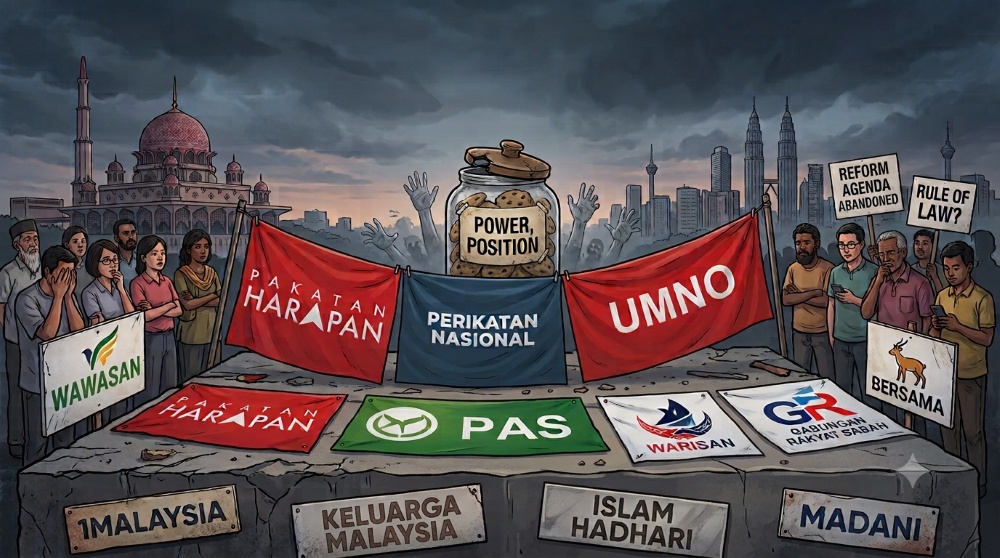
Will politics in Malaysia continue to be driven by race, religion and the insatiable greed for power, position and a hand in the cookie jar?
Is that all Malaysian politics is about?
Coalitions in disarray
Pakatan Harapan is broken. The Gabungan Rakyat Sabah coalition is unstable, and Amanah is weak. PKR seems to be in self-destructive mode.
Umno, at the height of its hubris and imperiousness, is going for broke ahead of the next election.
Perikatan Nasional is in disarray. Bersatu, the MIC, the MCA and Gerakan are all shattered.
- Sign up for Aliran's free daily email updates or weekly newsletters or both
- Make a one-off donation to Persatuan Aliran Kesedaran Negara (ALIRAN), Maybank a/c 507246118995 or CIMB a/c 8004240948
- Make a pledge or schedule an auto donation to Aliran every month or every quarter
- Become an Aliran member
Warisan is recovering.
For now, both the coalition in government and the opposition are fractured. Only the DAP and the Gabungan Parti Sarawak coalition are still holding firm in their strongholds.
There is no telling which party will join which after the election to form a new coalition.
Many argue the likely path is that one Malay-centric party will join another on the grounds of race or religion to secure power, while ethnic-minority-based parties, as always, remain the ‘broken rice at the edge of the bushel’ (the leftover grains pushed aside, never quite counted).
Some smaller mosquito parties have been ‘re-founded’ or revived from deep slumber.
The latest is Bersama, riding the mousedeer and hoping to play the clever, quick-witted trickster in a new kind of politics.
A Bersatu breakaway faction led by Hamzah Zainudin, with the blessing of Pas president Hadi Awang, launched a new party, Wawasan, on 13 June in Kelantan.
As expected, Pas then broke away from Bersatu in the PN coalition. This paved the way for the new party to replace Bersatu as Pas’ key ally. No other party has shifted its alliances as often as Pas – which says a lot about its ideological inconsistency.
Disillusionment
Observers following such volatile political expedient developments are growing disillusioned and jaded by the never-ending turmoil.
Frequent changes of federal government, broken promises of institutional reform, endemic corruption, increasingly divisive ethnic-based and religion-based politics and the pressing cost-of-living crisis are making life difficult for everyone.
This chronic political instability, corruption and deepening polarisation are largely caused by ethnic Malay leaders fighting among themselves within every party they lead. Ethnic minority leaders and parties involved in the politics of the peninsula are simply collateral damage that nobody seems to care about.
Fence-sitters, mostly ethnic minority voters, are so disillusioned with broken politics they may not even vote in the next election. They will continue to be the pelanduk mati di tengah – the mousedeer that dies in the middle – while watching from the sidelines.
Many pressing issues have led to long-term disappointment and fatigue, particularly among the middle-aged. Political and economic instability, uncertain prospects, broken promises, stagnant wages, rising living costs, abuse of power, unfair placements in higher education, and conservative policies are among the issues that have worn them out.
Recent disputes over temples, churches and interfaith or conversion issues, compounded by perceived selective police action on sedition, have made things worse. The mutual respect that people once boasted of has long evaporated.
Reform agenda abandoned
Successive governments have failed to fix the political system. It remains deeply rooted in structural and social problems: ethnic-based and religion-based disparities, endless infighting, shifting alliances, endemic corruption, political betrayals and shattered public trust.
People waited painfully for one party to dislodge the old order. They prayed it would deliver promised reforms, social justice and the rule of law.
In the end, that party did win power – only to crumble before the very party that had long been accused of race-based politics, which people had finally voted out after over six decades of decadent rule.
The public perception of Prime Minister Anwar Ibrahim, after over three years in power, is that he did not try hard enough to deliver his promised sweeping reforms.
Critics argue he sacrificed his reform agenda. They blame intense pressure from his deputy, Zahid Hamidi, and Umno’s political warlords.
Many of these warlords faced massive financial scandals and corruption charges, but were given a discharge not amounting to acquittal or a full discharge and acquittal.
Zahid himself was embroiled for years in 47 corruption and money-laundering charges. The court found this amounted to a prima facie case. Yet the case was closed for good in January 2026, with no further action taken against him.
The inclusion of such tainted leaders in the federal government, one even appointed to high public office, continues to erode public trust.
People are also disillusioned with the “Madani” (trustworthy) government’s record on the rule of law. People still disappear, die in custody and become victims of the incessant use of archaic, draconian laws such as the Sedition Act 1948.
Civil liberties on freedom of speech and expression continue to be infringed. Provisions such as Section 233(1)(a) of the Communications and Multimedia Act, popularly known as ‘Akta sakit hati’ (hurt feelings act), are often used, alongside crackdowns on advocacy groups, whistleblowers and journalists.
It is believed an estimated 3,000 archaic, obsolete colonial-era laws remain on the statute books. The overly broad definition of “seditious tendency” was the very legal provision that Madani supporters suffered under when they were in opposition.
Yet, after coming to power, the same Madani leaders lost the political will to abolish oppressive laws and clean up the books, despite it being the lowest-hanging fruit.
Hollow slogans
Since independence, every prime minister has come up with fancy slogans and taglines to mark their political vision, policy framework and guiding principles.
Every day, national radio and TV have sung songs of harmony, tolerance, unity in diversity, and peaceful coexistence. They sang of compassion, trust, mutual respect, multiculturalism, ethics, moral values, goodwill and courtesy.
But after over six decades since the formation of Malaysia, these slogans ring hollow. They are political slogans that mean nothing. Society remains broken. If anything, confidence, tolerance, trust and race relations have worsened.
Anwar gave us ‘Madani’. Ismail Sabri Yaakob gave us ‘keluarga Malaysia’ (Malaysian family). Mahiaddin Yasin gave us ‘Kerajaan prihatin’ (Caring government). Najib Razak gave us ‘1Malaysia’. Abdullah Badawi gave us ‘Islam hadhari’ (civilisational Islam) and laid the groundwork for ‘wasatiyyah’ (Islamic moderation or middle path).
What have these slogans really contributed to people’s wellbeing, social justice and prosperity? A massive gap still exists between different sections of society. Let’s hope the next government to take power stops these crude jokes.
When will we begin to treat each other with respect, as one large family, regardless of racial, religious and political differences? When will we manage to build on the values of inclusion, togetherness and gratitude? When will we replace these vague platitudes with real, credible goals?
Come to think of it, are we any better today compared to when we won independence and broke free from colonial rule?
Can we break free again from the new ‘colonial’ masters who are more interested in gaining political power and position so that they can go on keeping their hands in every cookie jar?
Sarajun Hoda Abdul Hassan
Co-editor, Aliran newsletter
30 June 2026
AGENDA RAKYAT - Lima perkara utama
- Tegakkan maruah serta kualiti kehidupan rakyat
- Galakkan pembangunan saksama, lestari serta tangani krisis alam sekitar
- Raikan kerencaman dan keterangkuman
- Selamatkan demokrasi dan angkatkan keluhuran undang-undang
- Lawan rasuah dan kronisme