

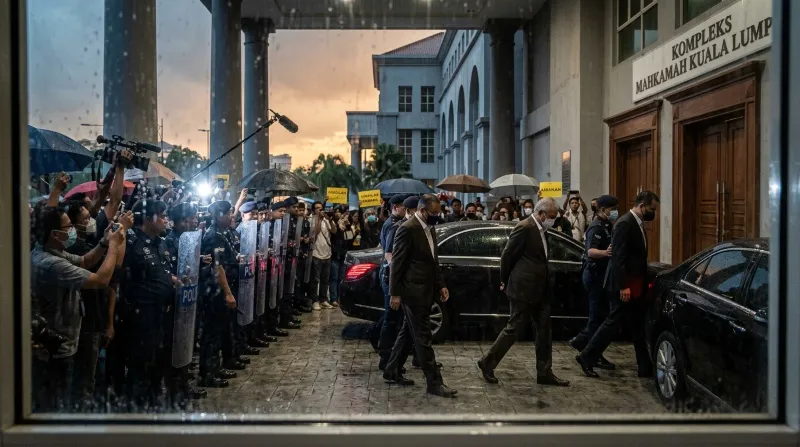
What a tragedy. Three former Malaysian prime ministers – Najib Razak, Mahiaddin Yasin and Ismail Sabri Yaakob – were in court on the same day, 27 August.
They faced very different charges: Najib in a civil suit over the 1MDB affair, Mahiaddin over abuse of power and money laundering, and Ismail Sabri over failing to declare his assets. All former Barisan Nasional leaders.
I have been asking myself why no MCA or MIC leader has been exposed. That was answered by the recent arrest of a senior MIC leader. We wait patiently for the ‘muhibah’ (unity) spirit so that the MCA can perhaps also be included!
Some would say the MIC and the MCA share some of the responsibility too. If they knew what was going on and did nothing to stop it, that is a failure of its own kind.
Perhaps the reason why others are not exposed is that their revelations may implicate many others.
Fear behind the imbalance
Greed has no colour nor race, but it thrives where values are set aside.
Some believe that involving people of another ethnic background is risky, in case they speak out. This, some argue, is why one ethnic community has long been favoured in the civil service, at the expense of minorities.
- Sign up for Aliran's free daily email updates or weekly newsletters or both
- Make a one-off donation to Persatuan Aliran Kesedaran Negara (ALIRAN), Maybank a/c 507246118995 or CIMB a/c 8004240948
- Make a regular pledge or periodic auto-donation to Aliran
- Become an Aliran member
This shows up as a Malay-ethnic emphasis in the civil service, the armed forces, local councils and other areas. You can meet many capable people in Malaysia’s private sector, whether in healthcare, legal services or education.
Somehow the myth that all ethnic Malays need special assistance seems to justify an aversion to meritocracy. It becomes an excuse not to pick the best person for the job. This thinking is also used to justify ethnic-based affirmative action and quotas.
When short-term measures are continually extended, injustice creeps in. Greed takes over, and the exploitation that follows ultimately discredits the exploiter.
We now see who they are. Yet, sadly, everyone in Malaysia pays the price.
Diversity is our strength. But when fear of ‘the other’ is subtly encouraged, it blurs reality. To protect secrets or non-disclosure, some choose to exclude others.
After all, if it is someone from the same ethnic group who is exploiting others through corruption, just turn a blind eye. It does not matter which ethnic group is in the majority. Crass, negative human nature appears to be at work.
So why should I resent their ‘good fortune’?
Critics say this thinking was subtly encouraged by Dr Mahathir Mohamad, who helped build a culture where asking questions was seen as arrogance. The ‘direction from above’ syndrome seemed to be a safer bet: just do what needs to be done.
Today, this culture is having its impact. It is difficult for someone from an ethnic minority group who holds the title ‘Encik’ or ‘Cik’ (Mr or Ms) to secure an appointment with a minister, let alone a senior civil servant.
The unconscious class system bred by titles and honorifics gives priority to those with such appendages.
But the effects of all our actions eventually catch up with us. We are not immune to the consequences.
This law of cause and effect does not exempt anyone – irrespective of religion, ethnicity or how much power the person holds.
Payback time
The time has come for the three former prime ministers to answer for their alleged misdeeds. They held the highest office in the land. It would be ‘payback time’ if their cases go against them.
What is sad is that the amounts lost to corruption run into the billions, even trillions. Recently, the Mara chairman lamented that outstanding debts from loan defaulters stand at close to RM900m.
It is amazing how much has leaked away. Spend a moment thinking about what that money could have done for the nation and its people. The scale of it would amaze anyone.
This is the cost of promoting ethnic-based politics. Minimise the presence of other ethnic groups in the civil service, the armed forces and government-linked companies, in case they become whistleblowers – so the thinking goes. The exploiter feels this is their right.
When will more leaders in Malaysia speak out and stand up for what is right for everyone in Malaysia? So few do so.
Yet the cost is paid by everyone. The ones who ultimately pay the biggest relative price are the poor of all ethnic backgrounds.
The loss shows up in education, healthcare, social welfare and quality of life. Meanwhile, the rich elite carry on in their luxury cars and upscale lifestyles, parading their titles and wealth.
The other question is about the nature of the charges. Why is Ismail Sabri being charged for not declaring wealth?
If convicted, he would face a jail term of up to five years and a fine of up to RM100,000. Not bad for a man found to be holding over tens of millions of ringgit in cash and foreign currencies, plus gold. He has pleaded not guilty.
Who else knew? Perhaps they may yet become prosecution witnesses for the Malaysian Anti-Corruption Commission.
Billions gone
There is so much written about Umno stalwarts and their use of Petronas money. As an off-budget agency, Petronas answers to the prime minister. For 22 years, that meant Mahathir. What has happened to all the Petronas money?
Had Malaysia followed Norway’s example in managing oil revenues, this nation today would have savings and revenues running into the billions, if not trillions.
We trusted the rhetoric of our leaders. Much was spent on glamour projects like Putrajaya, all of which show evidence of development.
Yet these came with an opportunity cost. Money that could have gone towards the people’s living costs and living conditions went to building glamour projects instead.
All this was possible because Petronas lacks transparency, and its audits, if any, are not made public.
Muar MP Syed Saddiq Syed Abdul Rahman has also highlighted how much some long-serving MPs earn in pensions. This has to be addressed, or the wrong people, through contacts and family ties, will keep securing advantages.
To lead a progressive nation in today’s high-tech world, we need people who are skilled, qualified and of sound character.
Sri Lanka’s economic crisis holds a lesson worth heeding. Its parliament voted, 154 to two, to scrap MPs’ pensions in February 2026. It is an irony that politicians, while shouting about justice and fairness, are blind to their own benefits.
Sri Lanka had to face a major crisis before this became a reality. Its leaders had to feel like ordinary people before they understood the hardship facing so many.
We, the people, watch all this, unable to change it. Only when politicians are arrested do we grasp the scale of their wrongdoing.
This culture has taken root, and it lets so many of them take personal advantage of their positions.
They champion the three Rs (race, religion, royalty) while shouting good intentions over bad motives. In the end, much of the money seems to end up in their own pockets or that of their relatives and cronies.
Character is missing, while a lot of piety remains on display. Special prayers are announced whenever they are caught. When convicted, they neither apologise nor show remorse.
Why is this government afraid of whistleblowers? They are the fastest way to rein in corruption in any country. Yet the laws that govern whistleblowing remain unfair to the whistleblower.
Whistleblowing, combined with an effective ombudsman, could help transform a government delivery service that at best is poor.
Putrajaya has not helped. In their ivory towers, officials are no longer really ‘civil’ servants. Reaching them is a small miracle, and an appointment can take two visits to arrange.
Letters go unanswered, phones sit unused, and even digital submissions bring more questions and more delay rather than a response.
Despite several auditor general’s reports, little action follows. Civil servants protect their own turf, and one wonders what departments like Mampu, the Malaysian Administrative Modernisation and Management Planning Unit – actually do.
It is all top-down with little discussion with stakeholders. ‘This is the new policy, and you must simply adhere to it’ – with no question of whether it is fair to the public.
When feedback is treated as a threat, and accountability follows from it, the civil service closes ranks. It represents 1.5 million or more people. Politicians appease them because their votes matter.
Change becomes difficult when Putrajaya offers so much comfort, and there seems little appetite to make a difference.
K Haridas
Co-editor, Aliran newsletter
7 September 2026
The views expressed in Aliran's media statements and the NGO statements we have endorsed reflect Aliran's official stand. Views and opinions expressed in other pieces published here do not necessarily reflect Aliran's official position.
- Tegakkan maruah serta kualiti kehidupan rakyat
- Galakkan pembangunan saksama, lestari serta tangani krisis alam sekitar
- Raikan kerencaman dan keterangkuman
- Selamatkan demokrasi dan angkatkan keluhuran undang-undang
- Lawan rasuah dan kronisme
