

Three years ago, I wrote an article on the six state elections that were held that year.
I noted we should have celebrated small victories while remaining cautious about the Pakatan Harapan government. I warned that it risked losing more seats if it kept taking an overly conservative approach to win voters.
Three years and two state elections later, with another in Malacca in a few weeks, the coalition appears reluctant to change course. This is despite projections for the next general election, which must be held by early 2028, showing the coalition gaining fewer than 45 seats.
That result would be worse than the 82 seats won by the then-opposition coalition in the 2008 general election. Back then, we had our first glimmer of hope that change was possible.
But the reverse of change is also another kind of change.
In that same article, I wrote about an interview with Ibrahim Suffian of the Merdeka Center on Consider This with Melisa Idris. He explained how economic anxiety could be the root cause of our divisiveness and identity politics.
Like any anxiety, there is comfort in seeking solidarity with someone who shares your fears or with someone who claims to have the answers. This ultimately leads to the various forms of identity politics we see today.
- Sign up for Aliran's free daily email updates or weekly newsletters or both
- Make a one-off donation to Persatuan Aliran Kesedaran Negara (ALIRAN), Maybank a/c 507246118995 or CIMB a/c 8004240948
- Make a regular pledge or periodic auto-donation to Aliran
- Become an Aliran member
After the Negeri Sembilan state election, where the Barisan Nasional-Perikatan Nasional alliance – including Pas emerged as victors – analyst Tricia Yeoh raised the same issue. It feels as if the current coalition government has not done enough to ease this anxiety over the past three years.
A worldwide phenomenon
However, this is a worldwide phenomenon. Young people experiencing economic anxiety are protesting on the streets in many parts of Europe and Asia.
Our economic anxieties are simply translated differently. Rather than protesting, we assert our identities or become divisive over issues of race, ethnicity, language and religion. This has created a trust problem among people in Malaysia, especially in the digital space.
Economist Sum Dek Joe highlighted the same trust deficit between the people and the government in a post-budget commentary on Consider This. We struggle to trust that the government will provide better services, public transport or education if we forgo our massive monthly petrol subsidies amid the current surge in global oil prices.
The government’s partial restriction on Waze – barring civil servants from using it for official duties – and the resulting backlash are clear signs of public mistrust in the government, even though it says the restriction was motivated by data security concerns.
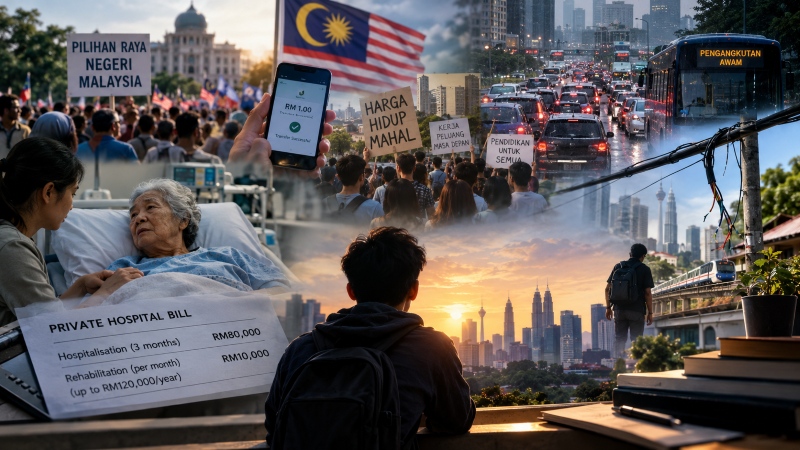
Many of us have to navigate the confusing roads of Kuala Lumpur because of poor public transport connectivity. When it rains, traffic comes to a complete standstill. I experienced this first-hand when working there.
This is because decades of policy have made us rely on personal vehicles and petrol subsidies. I would call for a total revamp of our public transport system, with control decentralised to state and local levels, in line with the Aliran People’s Election Agenda.
Still, it is hard to believe that even with a budget surplus or a strong economy, we would all share the same vision of becoming a developed nation. It seems many would prefer to stay where they are, enjoying the subsidies and patronage provided by political parties.
To me, this suggests a zero-sum game. One day, resources will become scarce and the government will run out of things to offer. People will then compete for whatever remains.
This is already happening, which is why we are seeing so much economic anxiety.
The cost of care
I have felt it personally. My annual salary alone cannot cover, let alone match, any future medical expenses.
My grandmother, who is nearly 80 and has no income for the rest of her life, recently faced a bill of RM80,000 for just three months in a private hospital. Rehabilitation adds another RM10,000 a month – up to RM120,000 a year.
In our experience, most insurers are unwilling to cover such costs for older people her age. Malaysia’s median monthly salary and wages were RM2,940 in 2025, or about RM35,280 a year – nowhere near enough to cover such costs.
You might think we should have gone to a public hospital. But, as we often discuss regarding public health, the public healthcare system is stretched to its limits.
When my grandmother was first admitted to the general hospital, she was already at risk of stroke and might have been experiencing multi-organ failure. The doctors warned us to prepare ourselves emotionally.
It became a zero-sum game in which we needed to pay a huge amount just to secure better healthcare. To me, the numbers are insane, and I cannot understand how these fees are set.
Of course, if the government had been willing to fix public healthcare, things might have been different for my grandparents. That would mean an independent commission, doubling public healthcare funding to 4% of gross domestic product, more staff and hospitals, and subsidised fees at hospitals run by government-linked companies, in line with the People’s Election Agenda, put forward by Aliran.
A burden for the young
Now I understand why my parents and grandparents wanted me to become a doctor. It was not out of a genuine desire to save or appreciate lives, but to save their own money. It is rather ironic.
My grandmother would often tell me in Mandarin that we should eat more today, or we would not be able to eat tomorrow. Today, I understand that phrase is another reflection of economic anxiety that has remained unresolved for decades.
It is a burden young people today must now bear. I doubt whether the government and the people can even renew the social contract to restore opportunity and social mobility.
Ultimately, rather than trusting the government to reduce this anxiety, it is better for young people and me to figure things out on our own. That is in line with the need for young people to be self-sufficient, as mentioned in my very first newsletter.
Hopefully, we will not pass this anxiety down to the next generation.
John Fong
Co-editor, Aliran newsletter
28 October 2026
The views expressed in Aliran's media statements and the NGO statements we have endorsed reflect Aliran's official stand. Views and opinions expressed in other pieces published here do not necessarily reflect Aliran's official position.
- Tegakkan maruah serta kualiti kehidupan rakyat
- Galakkan pembangunan saksama, lestari serta tangani krisis alam sekitar
- Raikan kerencaman dan keterangkuman
- Selamatkan demokrasi dan angkatkan keluhuran undang-undang
- Lawan rasuah dan kronisme
