

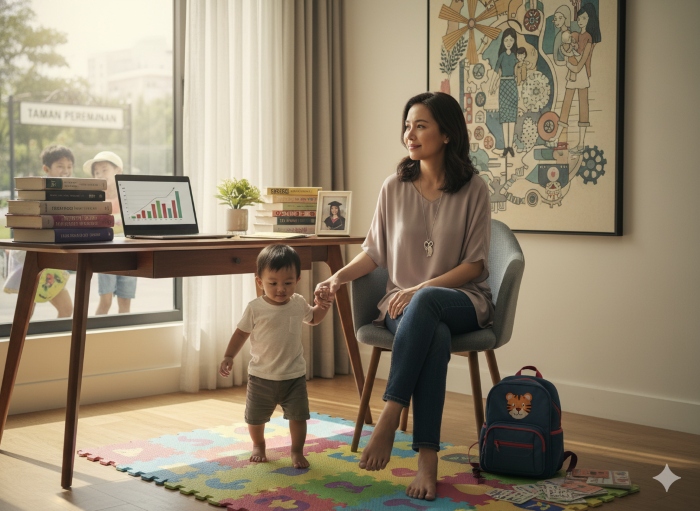
As a stay-at-home mother, I think about motherhood often. I also wonder if I am still a feminist.
I put my career on hold to hold my toddler’s hand as she took her first steps, used her first potty, and formed her first sentence.
This has made me ponder if I am reinforcing traditional patriarchy by inadvertently affirming the essentialist views of gender and women as I step back from the workplace.
If you’re wondering what the term stay-at-home mum is, it doesn’t necessarily refer to a woman wearing an apron all day and running around the house with a vacuum cleaner.
Like many other stay-at-home mums, I am not so house-bound. Many of us are out getting sunburnt at parks, singing repetitive songs at playgroups, and attending Mandarin and music classes with our little ones.
When I was a young undergraduate, I explored various feminist theories, examining gender inequality and potential solutions from multiple angles.
In general, it is argued that inequalities stem from societal roles and expectations rather than innate differences between men and women. Poststructuralist theories espouse that gender is performative and hardly a matter of biological traits.
- Sign up for Aliran's free daily email updates or weekly newsletters or both
- Make a one-off donation to Persatuan Aliran Kesedaran Negara (ALIRAN), Maybank a/c 507246118995 or CIMB a/c 8004240948
- Make a regular pledge or periodic auto-donation to Aliran
- Become an Aliran member
Becoming a mother
The category of mother, however, is arguably distinct from the category of woman.
Becoming a mother is a transformative experience. It is well established that pregnancy rewires the brain, its architecture remodelled to attune to the needs of a newborn. Mothers undergo matrescence as identities, hormones and priorities shift, attuning them for caregiving and nurturing.
Today, women have the right to get an education and join the workforce.
Patriarchy relegated women to being mothers alone, while early waves of feminism sought to liberate women to exercise agency.
But it seems as if motherhood is now a burden that holds women back. Recent statistics in Malaysia show that young women are re-evaluating motherhood due to rising living costs and the reality of all-consuming careers.
Mothers (and some fathers, too) often sneak out from their offices midday to fetch their children from school, as if it were a crime to do so.
Sometimes, mothers endure comments about how men, compared to women, luckily, don’t need maternity leave.
Motherhood is undervalued in a culture that celebrates productivity and KPIs (key performance indicators).
But motherhood isn’t just about maternity leave. Nor is it about engaging in a detailed discourse about the benefits of breastfeeding or babywearing, or looking for that elusive baby-changing room at the end of a long corridor in a shopping mall.
The politics of mothering
Motherhood can, in fact, be political, because laws and policymakers shape our lives for better or for worse.
In Malaysia, non-Muslim mothers occasionally have to fight for the right to decide the religion of their children, with the unilateral conversion of minor children to Islam after one parent has converted being a perennial problem.
Also, a constitutional amendment passed in 2024 will, once enforced – expected in mid-2026 – grant automatic citizenship to children born overseas to Malaysian mothers.
With children exposed to social media and pornography in an age of smartphones and screens, pushing for laws that regulate social media companies becomes imperative. From 1 January 2026, the Online Safety Act 2025 mandates that platforms mitigate harmful content for child users.
Meanwhile, giving birth in life-threatening conditions in the war in West Asia demands a call for access to basic health care and a push for peace. Mothering, alongside nurturing and relationality, run counter to the militant masculinity propagated by US Defence Secretary Pete Hegseth.
Hegseth represents the certainty of the ideals of an obscure Calvinist wing of evangelical Christianity that is firmly rooted in predestination – where everything that happens is believed to be God’s will – dangerously combined with militant masculinity and a passion for the Crusades.
Feminine images of the Divine
But there is much feminine imagery of the Divine reflected in verses comparing God to a mother in labour (Isaiah 42:14), a mother who nurtures (Isaiah 66:10–13) and a mother hen (Matthew 23:37).
In referring to the “maternal semiotic” that represents what Julia Kristeva describes as the tenderness and femininity of the mother-child union at an age where the child is physically dependent on the mother, Wonhee Ann Joh’s postcolonial theology recuperates the tender and feminine Divine in contrast with a patriarchal Christian conception of God as Father and Son only.
In Korean liberation or Minjung theology, while masculine military language focuses on the elimination of one’s enemies, Joh contrasts this with “jeong” perceived as weaker, feminised and “untidy”, yet embracing life’s ambiguities and complexities.
While “dan” signifies rupture or cutting off from the systems of injustice and oppression, Joh argues that Jesus embraces jeong in transforming both victims and oppressors. Jeong in vulnerability and suffering is extended even to oppressors or those undeserving of mercy. (Some of this material is discussed in my upcoming monograph, titled Questioning and Queering Evangelical Christianity in Malaysia: Liminality, Faith, and Doubt. The book explores how doubt facilitates creative agency as LGBT and heterosexual Evangelicals reimagine their faith in multireligious, conservative Malaysia.)
Nurturing and caregiving are not weaknesses, but a solution to the coldness of a world breaking from war and inequality.
Mother’s Day may have come and gone, but mothering, be it through raising children or sustaining and protecting lives, continues often without making headlines.
Let’s make it a goal to support policies that engender compassion and challenge systems that create inequality.
Cheah Wui Jia
Co-editor, Aliran newsletter
20 May 2026
The views expressed in Aliran's media statements and the NGO statements we have endorsed reflect Aliran's official stand. Views and opinions expressed in other pieces published here do not necessarily reflect Aliran's official position.
- Tegakkan maruah serta kualiti kehidupan rakyat
- Galakkan pembangunan saksama, lestari serta tangani krisis alam sekitar
- Raikan kerencaman dan keterangkuman
- Selamatkan demokrasi dan angkatkan keluhuran undang-undang
- Lawan rasuah dan kronisme
