
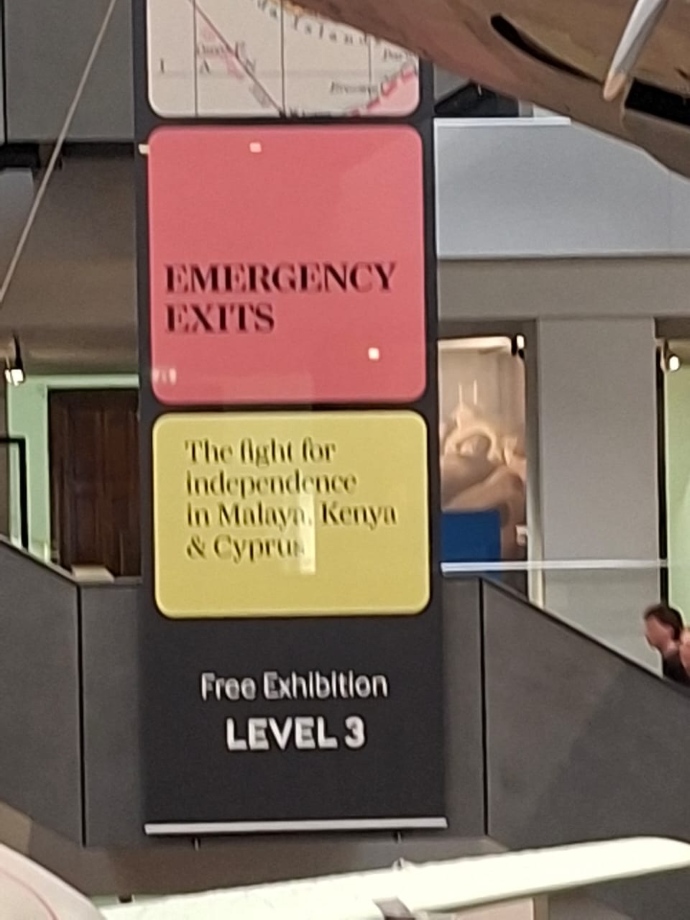
Have you heard of the Imperial War Museum?
It is one of London’s public museums – one that celebrates and commemorates the imperialism and glory days of Great Britain, whose empire once stretched across the seven seas.
Given its pretensions, the museum’s frontage is fittingly intimidating. Its entrance on Lambeth Road is guarded by two massive cannons.
Inside, the museum displays the war machines of empire: planes, tanks, missiles, even a submarine with a torpedo, and a wide variety of bombs, guns and other weaponry.

On its floors and in its corridors are busts, photographs and memorabilia of political leaders, generals and commanders who planned war campaigns and sent foot soldiers out to fight and destroy in the name of empire.
- Sign up for Aliran's free daily email updates or weekly newsletters or both
- Make a one-off donation to Persatuan Aliran Kesedaran Negara (ALIRAN), Maybank a/c 507246118995 or CIMB a/c 8004240948
- Make a pledge or schedule an auto donation to Aliran every month or every quarter
- Become an Aliran member
Less well known is that the museum is also a repository of documents, photographs, war diaries, flags, insignias, pamphlets and films – an archive of war materials less often put on display.
It was, therefore, a significant moment when the exhibition Emergency Exits: The Fight for Independence in Malaya, Kenya and Cyprus opened on the museum’s third floor. The exhibition has been running since 17 October 2025.
Decolonisation’s dirty secret: forced resettlement
The exhibition invites a rethink of the decolonisation process – In particular, how forced resettlement was part of the coercive measures adopted by the British to combat the struggles for independence in Malaya, Cyprus and Kenya in the 1950s and 1960s.
All three “exits” were declared “emergencies” by the British colonial authorities. As the exhibition explains, “calling them wars would have invalidated many of the insurance policies of the European settlers. It also allowed new powers to be adopted.”
The exhibition reveals that “there was no ordered, peaceful change from British colonial rule to independence.” The exit from empire – accelerated by the events and experiences of the World War Two – was “painful for those who lived through it: there was as much violence at the end of empire as in its formation”.
One exhibition poster asked: “What was the British Empire?” Its answer:
Like all empires, Britain’s was built mainly to provide resources for the homeland. This involved taking control of territories, most often without the consent of the people who lived there.
Some colonies were prized because they possessed resources that would enrich Britain. Others were valued because they were in strategic locations needed to maintain or protect the empire itself.
In Canada, Australia and New Zealand, thousands of Europeans settled and indigenous communities were disrupted, sometimes destroyed, and soon outnumbered by the newcomers. In most British colonies, smaller groups of British officials ruled over large indigenous populations, often working with local allies and troops.
The curators informed visitors that “you’ll meet people from all sides and hear directly their thoughts on the wars that shaped their lives”, and invited them to “reflect on the costs of freedom – and whether we are still paying the price”.
The British also misled young people at home into participating in these wars by designating their recruitment as “National Service”.
One of them, John Scurr, served his “National Service” in Malaya in 1950. He was candid about it: “They said they had National Service to train people in case there was a world war, but that wasn’t the real reason. They needed the men at that time because we still had the empire to police.”
The real reason for continued control of Malaya was spelt out in this note from the commissioner general’s office, dated May 1957.
The future of the Federation of Malaya is of importance to the United Kingdom for four reasons:
- as a source of raw materials and a very substantial dollar earner
- as a country in which many millions sterling of British capital were invested
- as a base for defence purposes
- as a symbol of British influence in the area
So, the British determined that Malaya must continue to be a source of great economic benefit to Britain. In doing so, it would also prevent the expansion of communism in the growing global Cold War.
A poster in the exhibition recounted what a British politician noted in 1950: Malayan products “very largely supported the standard of living of the people of this country and the sterling area ever since the war ended; what we should do without Malaya, and its earnings in tin and rubber, I do not know”.
Not surprisingly, the Malayan Communist Party (MCP) and its Malayan Races Liberation Army (MRLA) resorted to economic sabotage, among other tactics, in their struggle against the British. In the early years of the “Emergency”, the resistance from the MCP and its MRLA proved considerable, for the communists were well supported.
Many of the British military and police personnel who came to Malaya had been reposted from the newly created Jewish state of Israel in 1948, transformed from the British Mandate of Palestine. Britain must bear responsibility not only for the formation of Israel, but for the Nakba – the Catastrophe – that followed. Malaya, in a sense, inherited the remnants of a British army shaped by that earlier exit.
The exit of the British from Israel/Palestine also affected their subsequent exit from Malaya, no doubt.
[The British military and police forces came to Malaya after the formation of the Jewish state and Naqba – the catastrophe.
If you are not familiar with the Naqba, check out Ilan Pappe, The Ethnic Cleansing of Palestine (Oxford: Oneworld, 2006). Pappe, a Jewish historian who taught in Hebrew University, describes the Naqba, as the “ethnic cleansing” or the de-Arabisation of parts of Jerusalem, Jericho and other urban areas; the transformation of the Arab towns like Haifa and Jaffar into Jewish centres in a matter of weeks; the destruction of Arab villages and the creation of kibbutz after kibbutz over them. Even the landscape was made-over and planted with more European-looking pine trees to erase traces of the original Palestinian settlements.
The creation of the Jewish state of Israel brought to an end 2,000 years of exile for the Zionists. However, it also caused the Naqba, which is the original cause of the extensive Palestinian refugee problem. Following the Naqba, refugee camps were created in neighbouring countries like Lebanon, Jordan and Syria, and in Gaza and the West Bank.
Contrary to the belief spread by Israeli and some Western scholars, the refugee problem did not result from the war between the Arabs and Israel which began in 1948. Pappe’s study shows that the expulsion of the Palestinians predates the war and the invasion of Israel by the neighbouring Arab countries. It began the day after the UN General Assembly passed Resolution 1981 – the Partition Plan – announced on 29 November 1947.
Pappe also likens the mass immigration of Jews to Palestine to other examples of settler colonisation by the British in particular, which, also resulted in the expulsion or extermination of the natives (as in the US, Canada, Australia, New Zealand) or in their segregation (as in South Africa).]
To combat the Malayan National Liberation Army, who had fled into the jungles, “British soldiers recruited the services of Dyak people as fighters and trackers. The colonial authorities encouraged the practice of decapitating killed MNLA fighters. Both British and Dyak soldiers collected the heads of the enemy. This was justified at that time as a method of identifying those killed.”
Behind barbed wire
Beyond recruiting Dayak fighters, the British sought to cut the MNLA off from its local support. To do so, the colonial authorities implemented the Briggs Plan, which forcibly resettled people into barbed-wire, guarded “New Villages”. The aim was to “starve the insurgents of food and medical supplies, and prevent them attracting new members and followers”.
In all, the British colonial government compelled about 1.2 million rural dwellers – about one-seventh of the Malayan population at the time – into around 600 new settlements. Some 650,000 people were “regrouped” in rubber estates and tin mines and around existing towns. Another 573,000 were resettled into 480 New Villages, often miles from their original homes.
A poster in the exhibition described what these villages were like:
Although no two villages were identical, they shared many features: barbed-wire fencing, guarded gates, watchtowers, a prominently placed police station beside the main point of entry, and a grid-like layout.
Some New Villages were built from scratch; others adapted existing villages or settlements.
Rows of houses – often built by the villagers themselves on allocated plots – were placed alongside markets, schools, temples, farms and community buildings. People were monitored by British and locally recruited officers, who recorded movements, mediated disputes and enforced control.
Subjected to curfews, body searches and other restrictions – including enforced communal cooking and eating occasionally – the villagers often called the villages “concentration camps” or jizhongying. The term New Village or sincun, given by the British authorities, sounded too innocent and neutral.
Many Malays, Indians and Chinese also played key roles in defending the New Villages as members of Home Guard units. The exhibition noted that people joined for different reasons – some to protect their new homes and families from communist attack, others as a means of economic survival. Either way, local forces were a vital part of the colonial counter-insurgency effort.
Kenyans and Cypriots were subjected to similar coercive and repressive measures.
The 80,000 Kenyans involved in the Mau Mau uprising were detained without trial in resettlement camps and subjected to collective punishment and torture.
The National Organisation of Cypriot Fighters (EOKA), which had launched an armed campaign to end British colonial rule in Cyprus, faced curfews, fines, shop closures, detention without trial and collective punishment.
The exits also witnessed a worsening of ethnic tensions. The exhibition shows that the British authorities were not averse to souring relations between communities – “divide and rule” had long been central to post-conquest colonial domination.
In Malaya, the British “focused on winning support from Indian and Malay communities, dividing the population further”.
In Kenya, the Mau Mau – primarily composed of the Kikuyu, Embu and Meru communities – were separated from other groups loyal to the British. “Loyalty was rewarded by the colonial authorities, for example with allocations of land or jobs. When Kenya began moving towards self-government, loyalists controlled most of the key positions in business and politics.”
In Cyprus, the British courted the Turkish Cypriots, who were not involved in the EOKA’s armed uprising to end British rule and achieve Enosis – the unification of Cyprus with Greece.
Seven decades on, the rebels and insurgents of Malaya, Kenya and Cyprus are now treated with less prejudice – if not acknowledged outright as freedom fighters. This is part of the broader decolonisation rethink.
A three-minute 1960 film made by the Malayan Film Unit was played on a loop during the exhibition, when visitors pressed a little button. This was part of British propaganda that presented the communist insurgents as bandits and terrorists threatening peace and the Malayan economy.
A newer 22-minute film, released by the museum on 22 November 2025, takes a far fairer view, describing the Emergency as “a brutal counter-insurgency conflict”. Watch it here:
At the end of the exhibition, the museum thanked, among others, Professor Jeremy Taylor, Dr Goh Ai Tee, Dr Tan Teng Phee and Megan Hamilton, along with other experts on Cyprus and Kenya, for co-curating the event.
Recovering lost voices
Accompanying the exhibition was an international conference – Recovering Late-Colonial Malay(si)a: Histories and Legacies of Resettlement – held at the museum on 17–18 March.
The principal convenor was Prof Taylor, a professor of history at the University of Nottingham. Thanks to his efforts, the conference was funded by a UK Arts and Humanities Research Council grant. His stated aim was “fostering an international and multidisciplinary dialogue about resettlement and the New Villages – one which focuses on the unheard voices, subjugated knowledge, alternative epistemology and ground-up perspectives on resettlement and its legacies”. His co-convenors were Dr Jenifer Chao of De Montfort University and Dr Ling Teck Soon of the University of Malaya.
There were four main panels and several special sessions.
The panel on New Village Governance – Past and Present, chaired by Dr Goh, was an all-women panel with presentations by Dr Tan Miau Ing, Dr Helen Ting and Dr Sing Pei Tan.
Resettlement and the Imaginary, chaired by Dr Rio Creech-Nowagiel, featured Professor Karl Hack – who has written an important book on the Emergency – alongside younger presenters Dr Zhou Hau Liew and Dr Oh Soon Hwa.
Malay(si)a and Beyond – Comparative Cases, chaired by Dr Ling, covered the exit from Kashmir (Dr Mallika Leuzinger and Dr Majed Akhter), Free Villages in Saigon (Dr Adrian Kwong) and the Malayan Emergency in propaganda photography (Triparna Kalita),
Chinese Identity and Resettlement, chaired by Prof Taylor, included presentations by Dr Ho Kee Chye on the plight of those repatriated to China between 1948 and 1964, Zhen Hao Liew on the overseas Chinese farms in China where repatriates lived and worked, and Randy Ho on colonial infrastructure and the Emergency.

A session on an ongoing research project, Resettling the Colonial Lens, featured Prof Taylor, Dr Chao, Dr Ling, Dr Creech-Nowagiel and Dr Ma Ying.
This was followed by an interactive session, Photo-Exhibition Co-Creation – Into and Beyond the Frame, by Dr Chao, exploring several photographs from the Emergency. What new captions would we add to these iconic pictures from that colonial past and the repressive exit?

A closing roundtable featured Prof Francis Loh, Prof Karl Hack, Dr Tan Teng Phee, Dr Ting and Jacky Chew, who shared their reflections on the state of the field.
From concentration camps to cultural pride
The conference keynote was delivered by Francis Loh, who has studied the New Villages since the late 1970s. He divided their history into five phases.
In phase one, the New Villages were essentially viewed as a security problem. The Briggs Plan made forced resettlement a major component of the fight against the communists, and this contributed to the British regaining the initiative.
From the start, the villages were categorised as “permanent”, “intermediate”, “supposedly temporary” and “expected to disappear” once the Emergency ended.
Although significant funds were allocated for the New Villages in the early 1950s, this stopped due to competing demands for poverty eradication in rural Malay villages. The coming of Malayan independence in 1957, the formation of Malaysia in 1963, “confrontation” with Indonesia, and the separation of Singapore in 1965 were also given more attention once the Emergency was over.
Meanwhile, conditions in the New Villages, especially those categorised as temporary, deteriorated rapidly.
Phase two began in the 1970s, when the New Villages were rediscovered after a new emergency was declared in response to a renewed communist security threat. The villages came into focus again, and it emerged that they had grown old and dilapidated.
Perak MCA took up their plight and succeeded in getting the New Villages incorporated into the federal government’s five-year development plans. An MCA leader was appointed as the first federal minister in charge of the New Villages, and development funds followed.
That said, the New Economic Policy (1971–90) prioritised the bumiputra community, and the New Villages received only meagre allocations. Poverty persisted.
Phase three, spanning the 1980s into the early 1990s, saw the New Villages remain in economic limbo. Malaysia’s development strategy prioritised export-oriented industrialisation and urbanisation.
Benefits accrued to those living and working in the cities and free trade zones. To achieve NEP goals, bumiputra youth and would-be entrepreneurs were directed towards the modern sectors of the economy.
Those new villages near urban centres – such as those around Kuala Lumpur (in Subang and Serdang) and Ipoh (in Simee, Bercham and Menglembu) – benefited. But the majority, in rural and semi-urban areas, did not.
The quality of national-type Chinese vernacular primary schools in the New Villages was poor. Strong exam results in Chinese schools was largely an urban, not a New Village, phenomenon.
A migration of young people from the New Villages in search of education and employment followed. Yes, the villages were “encapsulated” – brought under state control. But they were not integrated in the sense of building positive identification with the authorities.
Residential leases issued in the early 1950s also expired during this period. Yet, neither state governments nor the villagers appeared to push for resolution. It appeared that things were simply kept in limbo, not moving forward at all.
The economy went into recession in 1986–87, and the region experienced the financial crisis of 1996–97.
Phase four, from the late 1990s, brought rapid economic growth along with the adoption of neoliberal globalisation policies. New capital flowed into the New Villages, partly because young people, working overseas, often illegally, sent money home. New housing, small businesses and even light industries developed. So, the New Villages received a lifeline.
The government also provided more allocations during this period of Malaysia Boleh (Malaysia can do it). By 2000, most New Villages had received a full complement of amenities and services. Secondary schools were being built in rural areas, including the new villages. More young people, including New Village youth, enrolled for higher education, as tertiary education expanded with the privatisation of higher education and ensuing investments in the sector.
Phase five covers the recent period of political ferment, Reformasi and regime change.
A split in the ruling coalition gave rise to the Reformasi movement, exciting young people about politics – perhaps for the first time since the 1970s.
This awakening coincided with globalisation and the rise of information technology and social media. Even as they were being drawn into a global monoculture, the Malaysian youth also searched for their own ethno-religious roots and identity.
In 2008, the opposition came to power in five west-coast states, where most New Villages are concentrated.
In 2018, the Umno-Barisan Nasional ruling coalition was defeated for the first time since independence, igniting excitement throughout the country, including in the New Villages. Although the new Pakatan Harapan government fell in less than three years, the sense of change in these villages continued.
This ferment has gone hand in hand with the rise of an educated middle class within the New Villages. Their children have graduated, entered the professions and built successful businesses. One of them – Pua Khein-Seng from Sekinchan – pioneered the world’s first single-chip USB flash drive controller, a breakthrough that made today’s portable data storage possible.
Young people who once left the New Villages in search of opportunities have also begun returning and launching new ventures. For the first time, well-educated, middle-class New Villagers are writing the narratives about their own communities.
There has been unprecedented interest in the history, identity and sense of belonging among these young New Villagers.
The narrative is no longer only about security, poverty, securing a full range of amenities and services or even development. It is about confronting the past, understanding the trials endured and the resilience shown by parents and elders – resilience that has kept these communities going for 70 years.
With a firmer grasp of where they came from and the circumstances that led to the present situation, they are confident about steering their New Villages into the future.
An explosion of YouTube videos and online content about the New Villages, mostly produced by the villagers themselves, have highlighted local food, tourist attractions and historical sites. Invariably, some of them have talked about their origins during the Emergency.
Search for videos on New Villages such as:
- Jenjarom, alongside the largest Fo Guang Shan Zen Buddhist temple and monastery
- Sekinchan,a seaside and agro-tourism resort just over an hour west of Kuala Lumpur
- Papan, famous for wartime heroine Sybil Kathigasu
- Kukup, with the world’s second-largest mangrove island
- Kuala Sepetang (previously called Port Weld), where charcoal is still produced from mangrove wood
Or visit weekend outdoor destinations like Broga, Tanah Hitam and Gunung Hijau – once communist hotbeds, now recreational retreats.
New Villages are also outstanding producers of fresh fruit and vegetables for the cities, from the farms in Kanthan Baru and Kuala Kuang around Chemor and south Perak to the durian growers of Raub, Bentong and other parts of Pahang.
Many of these farmers complain they still work on temporary occupation licences without security of tenure.
Rice farming in Sekinchan, Chui Chak and Langkap, however, has been licensed since before the Emergency. Sekinchan even has a museum devoted to rice production.
Beyond these videos, Icomos Malaysia – the Malaysian chapter of the International Council on Monuments and Sites – is pursuing Unesco inscription for the New Villages as a site of historical and heritage significance, on account of the forced resettlement of about a million people, one-seventh of the total population of Malaya in the early 1950s.
This is an ongoing effort by the New Village working committee of Icomos Malaysia, led by professionals who grew up in the New Villages. This initiative itself is part of the new narrative they are writing.
A story still being written
It is heartening that an exhibition on the exits of Malaya, Cyprus and Kenya from the British Empire has been held at the Imperial War Museum in London. So too the convening of an international conference on the New Villages and the resettlement process.
The call to amplify previously unheard voices, unearth subjugated knowledge and consider ground-up perspectives and alternative epistemologies makes both events especially welcome. Seventy years on, it is time to recover and rethink the Emergency and the New Villages.
Two things are worth noting.
First, a small group of historians has called on us to get interested and excited about Malaysian history.
For too long, the study of Malaysian history has been marginalised. Few people major in history at university unless they are struggling academically or intend to teach – a career path that is now widely frowned upon.
This negative impression is in no small part a product of more than 60 years of Umno-BN control over the history curriculum before their ouster in 2018.
Hopefully, the history curriculum will undergo its own reformasi and inspire a new generation of history enthusiasts.
Second, it is uplifting that so many of the individuals digging into the history, heritage, identity and soul of the New Villages are people who grew up in them.
They succeeded despite the poor standard of education in the discriminated-against Chinese vernacular primary schools in the New Villages. Many had to transfer to public and private schools to continue their secondary education. A smaller number have gone on to graduate from universities and colleges, at home and abroad.
Today, they are as well educated as those who wrote the earlier narratives about the New Villages. And they possess an asset that outsiders find difficult to acquire quickly: local knowledge gained from growing up and studying “at home”.
It has been a privilege to journey with these young New Village narrators – several of whom helped to curate the museum exhibition and were present at the international conference in London. Prof Taylor deserves thanks for facilitating both events and for reaching out to the young narrators of an alternative New Village history.
There is energy and hope to continue this journey forward.
Dr Francis Loh
Co-editor, Aliran newsletter
2 April 2026
Dr Francis Loh Kok Wah, a former professor of politics at Universiti Sains Malaysia, first conducted research in several New Villages in northern Kinta in the late 1970s.
His PhD thesis was published as Beyond the Tin Mines: Coolies, Squatters and New Villagers in the Kinta Valley, Malaysia, c 1880–1980 (Singapore: Oxford University Press, 1988). A subsequent study of the New Villages in the 1980s resulted in Chinese New Villages: Ethnic Identity and Politics in the book The Chinese in Malaysia, edited by Tan Chee Beng and Lee Kam Heng (Singapore: Oxford UP, 1999). Both may be downloaded for free.
Also watch his video: New Villages in Malaysia: Origins and Evolution, produced by Icomos Malaysia in 2021.
AGENDA RAKYAT - Lima perkara utama
- Tegakkan maruah serta kualiti kehidupan rakyat
- Galakkan pembangunan saksama, lestari serta tangani krisis alam sekitar
- Raikan kerencaman dan keterangkuman
- Selamatkan demokrasi dan angkatkan keluhuran undang-undang
- Lawan rasuah dan kronisme
