

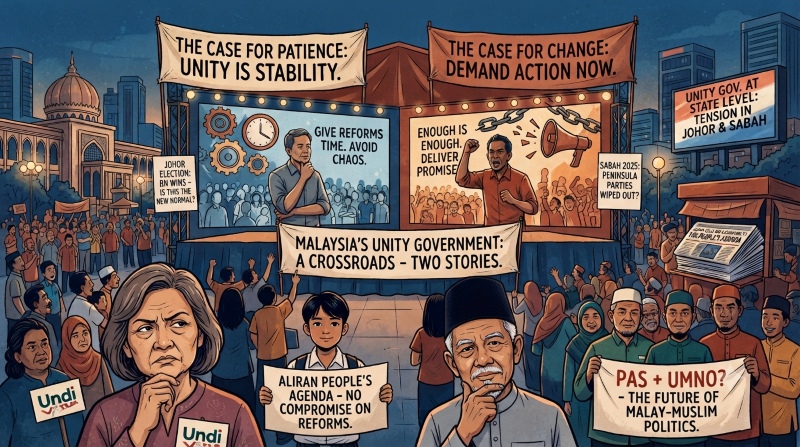
The Johor state election on 11 July set off fresh debate over two competing stories about Malaysia’s ‘unity government’.
Barisan Nasional won 48 or over 85% of the 56 seats up for grabs in Johor. Anwar Ibrahim’s PKR contested 20 state seats and won only one, Puteri Wangsa.
It is worth noting that the pattern was similar in Sabah. In the Sabah state election held in November 2025, peninsula-based parties were almost wiped out. The DAP contested eight seats and won none. PKR contested 12 and won just one.
Alarm bells have understandably gone off within Pakatan Harapan, the coalition comprising the DAP, PKR and Amanah.
Two elections, one warning
Many are asking whether what happened in Sabah, and now Johor, is a sign of things to come. The general election is due by 2027, and possibly could be held by the end of 2026. Political observers are watching closely for the outcome of the Negeri Sembilan state election on 1 August.
Two narratives have emerged from this debate.
The case for patience
The first narrative argues that the Pakatan Harapan-led unity government, formed after the 2022 general election, should be given space to govern with minimal interference. Its supporters say the government needs time to carry out meaningful reforms.
- Sign up for Aliran's free daily email updates or weekly newsletters or both
- Make a one-off donation to Persatuan Aliran Kesedaran Negara (ALIRAN), Maybank a/c 507246118995 or CIMB a/c 8004240948
- Make a regular pledge or periodic auto-donation to Aliran
- Become an Aliran member
Those who back this view describe themselves as pragmatic. They accept that political expediency and compromise are necessary to keep the unity government from collapsing. They echo Anwar’s own argument that genuine reforms take time and need consensus among all stakeholders.
In 2022, PKR and Umno fought each other in many seats. So did the DAP against the MCA and the MIC, and Amanah against Umno.
Yet in forming the unity government, BN and PH came together – unlikely partners by any measure. The DAP and Umno had for decades been sworn rivals. Now their members sit in the same cabinet, under Anwar’s leadership.
Anwar’s call was for these parties to set aside old grudges and work together. To its credit, the federal government has kept basic stability going for three and a half years, and relations between ministries have generally held up.
The guiding principle is meant to be the wellbeing of the ordinary people. After over three years in office, can the unity government claim it has worked consistently towards that goal?
To many people in the country, the honest answer is no. Ethnic and religious politics still dominate, and the arguments around them keep dividing the nation rather than uniting it.
On 23 July, a campaign speech by Kedah Menteri Besar Sanusi Nor of Pas stirred further controversy. He argued that the Chinese have China and Indians have India, but Malays only have Malaysia.
Cracks at state level
Federal-level cooperation is one thing. At state level, relations between unity government partners are often tense, and sometimes openly hostile.
Onn Hafiz Ghazi, BN’s Johor chairman and the re-elected menteri besar, campaigned hard against the DAP in the recent state election. He caused a stir when he said he would rather not be menteri besar than sit at the same table as the DAP in a state government.
DAP hit back, accusing him of arrogance and exclusivity. Fence-sitters unsure about voting the DAP may well have been pushed towards the party by his remarks.
Yet the results tell a different story. The DAP retained only six seats, down from 10 in 2022. The MCA staged a comeback, winning eight.
The DAP and Umno are not the only pairing with friction. PKR and Umno, and the DAP and the MCA, all have their own history of distrust.
Even so, supporters of the unity government argue the alternative would be worse. They urge critics to look at the bigger picture.
Political commentator Tajuddin Rasdi, a strong supporter of the unity government, believes progressive parties such as the socialist party PSM, Muda and Bersama risk splitting the PH vote. That, he argues, would hand an advantage to Pas, Umno and possibly Bersatu.
In a recent social media post, he warned that if ethnic Malay and Islam-based parties strike pacts for the coming general election, the country could end up with a more conservative government. His predicted formula: BN leads federally with the prime minister from BN, while Perikatan Nasional, through Pas, dominates the north and east coast of the peninsula.
Commentator Charles Chia takes a similar view. He argues Pas and Umno do not even need a formal pact – just an understanding not to contest each other’s seats. Under this arrangement, Pas keeps its 40-plus seats, while Umno focuses on seats currently held by PKR, Bersatu and Amanah.
Chia poses the same challenge to reform-minded parties: can PKR, Bersama, Muda, the DAP and PSM find a way to stop competing for the same voters?
The case for change
The second narrative is blunter: enough is enough. Nearly four years into government, critics say the unity government has little to show for the social, economic and political reforms it promised.
Much of the criticism falls on PH parties – the DAP, PKR and Amanah – who campaigned hard against corruption, cronyism and poor governance while in opposition. In power, their record looks less impressive.
Many people were initially willing to give the government time to settle in. A year on, they expected the Madani government to begin delivering the reforms it had promised. Those reforms have been slow to arrive, and some decisions have even looked like steps backwards.
Anwar’s efforts to court the Malay-Muslim electorate have sometimes come at the cost of non-Muslim and ethnic minority confidence. In the last federal budget, Jakim, the department responsible for Islamic development, received RM2.6bn, compared with RM50m for non-Muslim houses of worship.
The size of the gap need not be the issue. The real question is whether Jakim’s programmes bring people of different faiths together or widen the gaps between them.
One early sign of political compromise came with the appointment of Umno president Zahid Hamidi as Deputy PM, when the unity government was formed. At the time, Zahid was due to enter his defence on 47 charges of criminal breach of trust, bribery and money laundering in the Yayasan Akalbudi trial, after the prosecution had established a prima facie case.
By September 2023, less than 10 months after the unity government took office, Zahid was granted a discharge not amounting to an acquittal on technical grounds, lifting the immediate threat of prosecution.
Justice Collin Sequerah, who presided over the case, noted at the time that discontinuing proceedings at that stage represented “a considerable waste of judicial time and taxpayer money”.
In January 2026, the Attorney General’s Chambers announced it would take no further action on the case, effectively closing it. The chambers did offer reasons, pointing to further Malaysian Anti-Corruption Commission (MACC) investigations.
But critics said the explanation failed to address why the High Court’s earlier finding of a prima facie case no longer applied. A separate application by Zahid for a full legal acquittal remains before the courts.
The public can be forgiven for asking whether things would have played out differently if Zahid were not Deputy PM.
The unity government’s promise to fight corruption “without fear or favour” has also lost credibility as enforcement appeared to tilt towards selective prosecution.
The MACC, under Azam Baki, was initially praised for taking on figures such as Daim Zainuddin, Mahiaddin Yasin and Dr Mahathir Mohamad.
Then came reports about the “corporate mafia” and allegations that the MACC may have colluded with certain parties to pressure certain listed companies to sell off shares. This raised questions about whether the commission was overstepping its powers and whether Azam was aware.
The questions remain unanswered, and many felt Azam was shielded from scrutiny.
News that his brother, Nasir Baki, secured a RM178m contract with the Ministry of Transport through a company called Integriti Padu Sdn Bhd raised further eyebrows. The company may well have won the tender fairly. But the optics are poor, given that Azam had only recently stepped down as MACC chief.
Anwar himself announced that the Federal Land Development Authority (Felda) had lost nearly RM10bn to mismanagement and political interference. Felda was set up in 1956 to resettle rural communities and reduce poverty through oil palm and rubber cultivation. It has since grown into a sprawling institution.
On 29 July, the cabinet decided to declassify the royal commission of inquiry report into Tabung Haji. The inquiry was meant to explain an RM11bn gap between the fund’s assets and liabilities – a fund set up to help Muslims save for their pilgrimage.
What went wrong, and why did Anwar wait three years to release a report that was already finished?
These are just a few examples fuelling doubts about whether the Madani government will deliver on transparency and accountability. Some believe the coming general election should send PH a clear message: improve, or face the consequences.
What Aliran wants
When the general election arrives, how will the people vote?
Some will back the Madani government and Anwar for a second term.
Others, convinced the trust deficit has grown too wide, may turn to the opposition, or simply stay home.
At Aliran, we believe voters should take time to weigh up every state and parliamentary candidate on their track record and on what they offer through their manifestos.
To help with that, we are updating and developing further the People’s Agenda that we put forward in the 2022 general election. The agenda focuses on the overall wellbeing of the people.
We hope readers will take the time to look through it.
It calls for affordable healthcare for all, particularly the poor and marginalised.
It calls for an education system built on critical thinking.
The People’s Agenda also calls for basic social services – affordable housing, welfare and support for those in need.
And it calls for a country that recognises and celebrates its diversity, rather than one divided by racism and bigotry.
In Malaysia, as everywhere else, there is enough for everyone’s need. There is never enough for everyone’s greed.
Henry Loh
Co-ordinator, Aliran newsletter
30 July 2026
The views expressed in Aliran's media statements and the NGO statements we have endorsed reflect Aliran's official stand. Views and opinions expressed in other pieces published here do not necessarily reflect Aliran's official position.
- Tegakkan maruah serta kualiti kehidupan rakyat
- Galakkan pembangunan saksama, lestari serta tangani krisis alam sekitar
- Raikan kerencaman dan keterangkuman
- Selamatkan demokrasi dan angkatkan keluhuran undang-undang
- Lawan rasuah dan kronisme
