By Nur Balqis Zahirah Ali and Siti Idayu Hasan
Behind the smiles of our older people lie countless stories of sacrifice, love and the long journey of building the nation. Yet the question we must ask ourselves is this: are they truly enjoying their golden years in peace, with appreciation, and with meaning?
One in three older people in Malaysia believes their quality of life is poor – a sobering reality for a nation that is racing towards aged-nation status by 2030.
According to the Department of Statistics, the proportion of the population aged 65 years and above rose from 7.0% to 7.3% between 2021 and 2022. Based on the United Nations’ definition, Malaysia has now officially become an ageing nation.
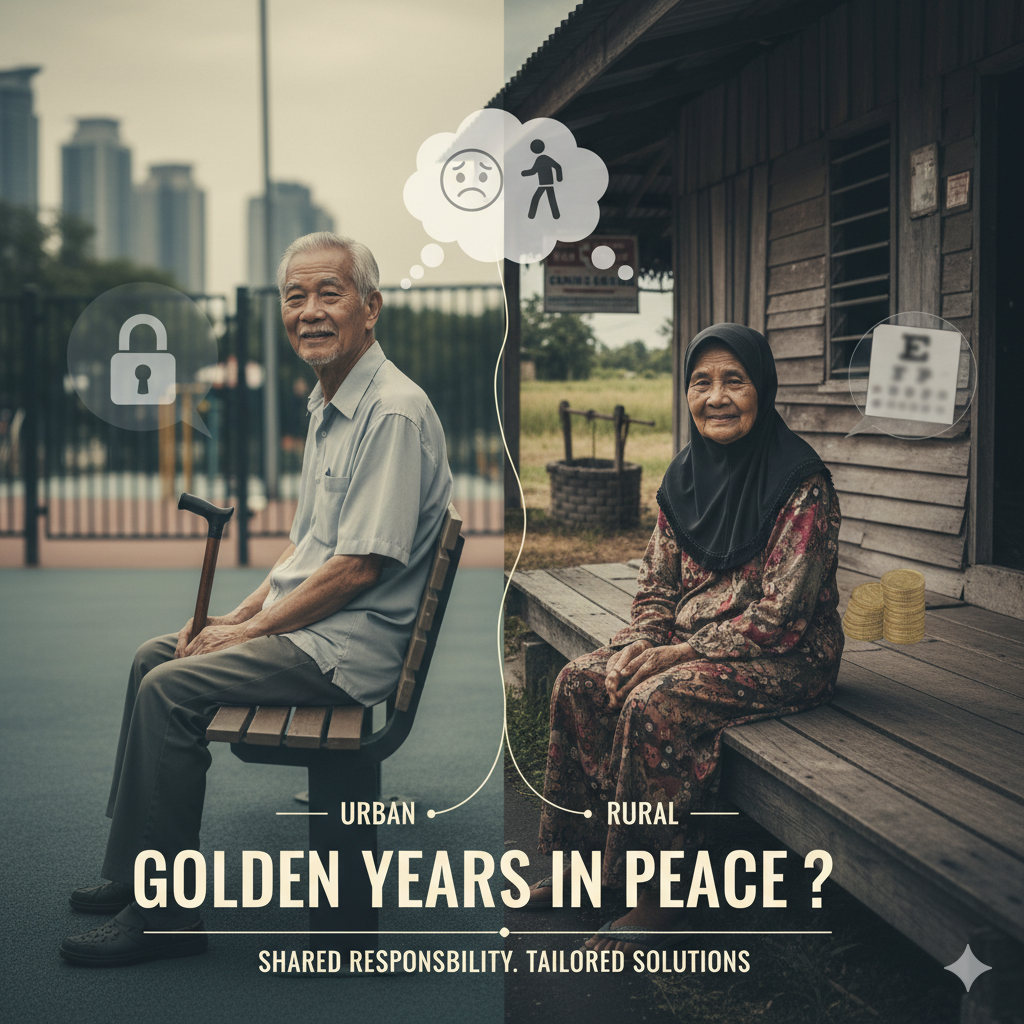
New research from the University of Malaya, Factors Associated with Quality of Life Among Older Malaysians in an Urban and Rural Setting, reveals that the gap runs even deeper: older adults in rural villages fare worse than those in cities, highlighting a divide that shapes how people in Malaysia age.
- Sign up for Aliran's free daily email updates or weekly newsletters or both
- Make a one-off donation to Persatuan Aliran Kesedaran Negara (ALIRAN), Maybank a/c 507246118995 or CIMB a/c 8004240948
- Make a pledge or schedule an auto donation to Aliran every month or every quarter
- Become an Aliran member
The study, based on a nationwide health survey, found that “older people in rural areas reported lower overall quality of life scores than their urban peers”.
But more than numbers, it is the reasons behind those scores that reveal the true story. City dwellers primarily struggle with lack of safe spaces and exercise facilities. For their counterparts in villages, the challenges are more basic: “income, ethnicity, visual disability and urinary incontinence were found to play a greater role”.
Yet some burdens cut across both city and village life. “Depression and functional limitations remain the most consistent threats to quality of life,” the researchers noted, underscoring how mental health and age-related decline weigh heavily regardless of postcode.
Why does this matter? Because quality of life is not just about comfort, it is about dignity. It reflects whether older adults feel happy, satisfied and respected after decades of contributing to their families and society.
Preserving that dignity, the researchers argue, is a shared responsibility. “It is not just the task of policymakers, but of families, caregivers, neighbourhoods, and older persons themselves.”
The findings convey a clear message: a one-size-fits-all approach will not be effective.
Urban older adults require support in accessing and using facilities that promote active living.
Rural older adults need more targeted interventions – from financial aid to culturally sensitive community programmes.
As the study puts it, “what shapes quality of life, and what is valued, differs depending on where older persons live.”
That means policies must be tailored.
In the city, removing barriers to gyms, parks and recreational activities could make a difference.
In the countryside, solutions might look like mobile healthcare units, subsidies for the poor, or programmes that bridge ethnic divides.
Without these tailored moves, the gap in wellbeing between city and village older adults will only widen.
Still, waiting for sweeping policy change may not be enough. The researchers point to the power of grassroots action: “Communities themselves can play a role in transforming how older Malaysians experience their later years.”
The call is simple – look out for the older adults around you: a neighbour who struggles with shopping, a relative who feels isolated, or a parent who needs encouragement to stay active.
Small acts of community support, multiplied across neighbourhoods, can begin to close the divide long before government policies take effect.
The study ends on a hopeful note: while the challenges are serious, they are not insurmountable. Older people are not a burden, but a living legacy who paved the way for today’s generation.
Their future wellbeing depends on how willing we are to share the responsibility, from national policies to community support. If we do not care for our older people today, then who will?
Dr Nur Balqis Zahirah Ali is a medical officer and master’s of public health candidate at the University of Malaya.
Dr Siti Idayu Hasan is a senior lecturer at the Department of Social and Preventive Medicine, Faculty of Medicine, University of Malaya.
AGENDA RAKYAT - Lima perkara utama
- Tegakkan maruah serta kualiti kehidupan rakyat
- Galakkan pembangunan saksama, lestari serta tangani krisis alam sekitar
- Raikan kerencaman dan keterangkuman
- Selamatkan demokrasi dan angkatkan keluhuran undang-undang
- Lawan rasuah dan kronisme